
Key Takeaways
-
Internet downtime costs businesses an average of $5,600 per minute in lost productivity; switching to business fiber with 99.9%+ uptime SLA protection can dramatically reduce these catastrophic losses.
-
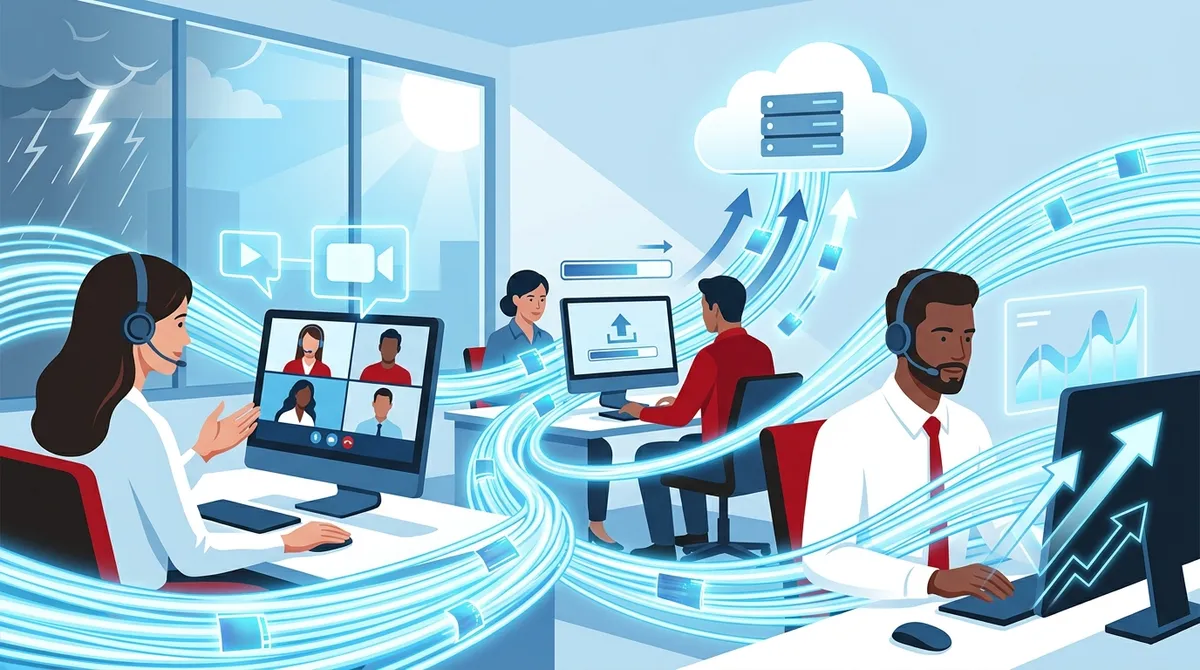
Fiber’s symmetrical upload and download speeds (equal in both directions) are essential for businesses using VoIP, video conferencing, and cloud applications—traditional cable’s slow uploads directly degrade call quality.
-
Fiber-optic cables are immune to electromagnetic interference and weather disruptions, making them ideal for businesses in storm-prone areas like Tampa that need reliable year-round connectivity.
-
Business fiber supports easy scalability from 1 Gbps to 10 Gbps without replacing physical cabling, making it a future-proof investment that grows with your company without major infrastructure overhauls.
-
Companies switching to fiber report a measurable 20–30% increase in team performance by eliminating friction points like buffering, slow uploads, and dropped calls—ROI is achieved within months through productivity gains alone.
-
Fiber’s physical security advantage (harder to tap than copper cables) combined with 99.9% uptime guarantees make it non-negotiable for businesses handling sensitive data in healthcare, finance, and legal sectors.
If your business still relies on old copper-based internet, you may be leaving serious money on the table. Fiber internet for business has become the backbone of modern operations — and for very good reason. From lightning-fast speeds to rock-solid reliability, fiber is changing the way companies communicate, collaborate, and compete.
Think about the last time your internet went down. How much did it cost you? According to recent data, internet downtime costs businesses an average of $5,600 per minute in lost productivity and missed opportunities. That number stings, doesn’t it? The good news is that switching to business fiber internet can dramatically reduce those painful outages.
Whether you’re a small business owner in Tampa, an IT manager juggling multiple sites, or a franchise operator expanding nationwide, understanding fiber internet’s real benefits will help you make smarter decisions. Let’s break down exactly why fiber internet is the smartest upgrade your business can make right now.

What Makes Fiber Internet Different for Business?
Before diving into the benefits, it helps to understand what sets business fiber apart. Fiber-optic cables transmit data as pulses of light through thin glass strands. This is fundamentally different from traditional copper cables, which carry electrical signals. As a result, fiber delivers faster speeds, lower latency, and far greater reliability.
Business-grade fiber also comes with something consumer internet simply doesn’t offer — a Service Level Agreement (SLA). This is a formal guarantee of uptime, repair times, and performance standards. You can learn more about what separates business-class connectivity from standard options by checking out Fiber vs. Cable Business Internet in Tampa: Which Wins?.
| Feature | Business Fiber Internet | Traditional Cable/DSL |
|---|---|---|
| Max Speed | Up to 10 Gbps | 100–500 Mbps |
| Upload/Download | Symmetrical (equal up & down) | Asymmetrical (slow upload) |
| Uptime SLA | 99.9% or higher | No guaranteed uptime |
| Latency | Very low (under 10ms) | Higher (20–100ms) |
| Interference | None (immune to EMI) | Susceptible to electrical noise |
| Scalability | Easy upgrades to 10 Gbps | Limited by physical infrastructure |

7 Fiber Internet Business Benefits You Need to Know
1. Symmetrical Speeds Power Your Cloud-Based Tools
One of the biggest advantages of fiber internet for business is symmetrical upload and download speeds. Traditional internet connections give you fast downloads but painfully slow uploads. That’s a real problem when your team is using VoIP phones, hosting video conferences, or uploading large files to the cloud every day.
With fiber, you get equal speeds in both directions — think 1 Gbps up and 1 Gbps down. This matters enormously for businesses running cloud-based phone systems or video collaboration tools. If you’re curious how internet speed affects your VoIP quality, check out What Internet Speed Do I Need for VoIP in Tampa? for a detailed breakdown.
2. Guaranteed Uptime With SLA Protection
Every minute your internet is down, your business loses money. Top business fiber providers guarantee 99.9% or higher network uptime backed by formal SLAs. These agreements also include committed repair response times, so if something does go wrong, help arrives fast.
This level of protection simply doesn’t exist with residential or basic business cable internet. For mission-critical operations — like healthcare, finance, or customer service centers — that guaranteed uptime is non-negotiable. The Internet Service Provider landscape has evolved significantly, and business-grade SLAs are now the standard expectation for serious organizations.
3. Superior Reliability in Any Weather
Fiber-optic cables are completely immune to electromagnetic interference (EMI) and weather-related disruptions. Copper lines can degrade during storms or near high-voltage equipment. Fiber doesn’t have that problem — it transmits light, not electricity.
For Tampa businesses especially, where summer storms are a way of life, this reliability difference is huge. You can also explore why Tampa businesses need dedicated fiber internet to stay competitive year-round, especially during hurricane season.
4. Enhanced Security for Your Business Data
Here’s something most people don’t think about: fiber-optic cables are much harder to tap than copper lines. Copper cables radiate electromagnetic signals that can be intercepted. Fiber doesn’t radiate signals the same way, making unauthorized data interception significantly more difficult.
For businesses handling sensitive customer data, financial records, or healthcare information, this physical security layer matters. Combined with cloud-based security solutions and proper network infrastructure, fiber creates a much more secure communications environment overall.
| Security Factor | Fiber Internet | Copper/Cable Internet |
|---|---|---|
| Signal Radiation | Minimal — transmits light | High — electrical signal leaks |
| Data Interception Risk | Very low | Higher risk |
| Physical Tap Detection | Easier to detect intrusions | Harder to detect |
| Ideal For | Healthcare, finance, legal, gov | Low-sensitivity applications |
5. Easy Scalability as Your Business Grows
One of the most exciting things about fiber infrastructure is how easily it scales. Your business can start with a 1 Gbps connection today and upgrade all the way to 10 Gbps — without replacing the physical cabling. The glass fiber strands themselves can handle far more bandwidth than most businesses will ever need right now.
This makes fiber a smart long-term investment. You’re not just buying internet service — you’re building a communications foundation that grows with you. For multi-location franchise operators or growing mid-sized companies, this scalability is a game-changer. See how this plays into broader network planning at Best Network Setup for a Growing Business in Tampa, FL.
6. Measurable Boost in Team Performance
Slow internet doesn’t just frustrate your team — it actively hurts your bottom line. Businesses that switch to fiber report a 20–30% increase in team performance and higher customer satisfaction scores. When your connection is fast and reliable, employees spend less time waiting and more time doing actual work.
Think about all the small friction points your team deals with daily:
- Buffering during video calls
- Slow file uploads to shared drives
- Dropped VoIP calls during peak hours
- Lag when accessing cloud-based applications
- Delayed responses from remote team members
Fiber eliminates most of these pain points almost instantly. That’s not just a productivity win — it’s a morale win too. And if you want more tips on squeezing maximum value from your connection, this list of 13 high-speed internet for business tips that save money is a great starting point.
7. The Perfect Foundation for Hybrid Work Models
Hybrid work is here to stay in 2026. Your employees expect to access company tools, video conferencing platforms, and cloud applications from anywhere — and they expect it to work perfectly. Business fiber internet is the ideal backbone for supporting this new reality.
With fiber, remote employees connecting to your headquarters experience minimal latency and high reliability. Combined with cloud-based phone systems, your team can work seamlessly whether they’re in the office or across the country. Explore your options by reading Which Cloud-Based Phone System Is Best for Tampa Businesses? to pair your fiber connection with the right communications platform.
How to Choose the Right Fiber Plan for Your Business
Not all fiber plans are created equal. Here’s a simple step-by-step process to find the right fit for your organization:
- Assess your bandwidth needs — Count the number of users, devices, and cloud applications running simultaneously at peak hours.
- Check provider availability — Fiber availability varies by location. Work with a telecom partner who has relationships with multiple providers to compare options.
- Review the SLA carefully — Look for guaranteed uptime percentages, mean time to repair (MTTR) commitments, and escalation procedures.
- Evaluate scalability options — Make sure your plan allows bandwidth upgrades without major infrastructure changes.
- Consider bundling services — Combining fiber internet with VoIP, networking, and security solutions often yields better pricing and simpler management.
If you’re unsure where to start, How to Choose the Right Fiber Internet for Your Business walks you through each step in plain language. You can also reach out to our team at Ideal Solutions Provider for a free consultation — we work with 35+ vetted suppliers to find the best fit for your specific needs.
What to Expect From Business Fiber Speed Tiers
Speed tiers for business fiber internet vary widely. Here’s a general overview of what each tier supports:
| Speed Tier | Ideal For | Concurrent Users |
|---|---|---|
| 100–500 Mbps | Small offices, light cloud use | 5–25 users |
| 1 Gbps | Mid-sized teams, VoIP, video calls | 25–100 users |
| 2–5 Gbps | Large offices, media production | 100–300 users |
| 7–10 Gbps | Enterprise, data-heavy operations | 300+ users |
Note that some providers, like Frontier Business, now offer symmetrical speeds reaching up to 7 Gbps — ideal for digital media firms and software development companies with massive bandwidth demands. Meanwhile, fiber networks in general can support speeds all the way up to 10 Gbps, far exceeding what traditional DSL or cable connections can offer.
To see which providers serve the Tampa area and what speeds are available, check out 7 Best Business High Speed Internet Services in Tampa FL for a current comparison.
Common Mistakes Businesses Make With Fiber Internet
Even the best fiber connection won’t help if you make these common mistakes:
- Choosing speed based on current usage only — Always plan for 12–18 months of growth, not just today’s needs.
- Ignoring internal cabling — Fast fiber internet is useless if your office’s internal network wiring can’t handle the speed. CAT6 cabling is a must-have companion to fiber.
- Skipping the SLA review — Not all SLAs are equal. Read the fine print on repair times and credits.
- Not having a backup connection — Even 99.9% uptime means about 8.7 hours of potential downtime per year. A secondary connection adds peace of mind.
- Managing multiple vendors separately — Juggling different providers for internet, phones, and cabling creates unnecessary headaches.
Working with a single, experienced telecom partner eliminates most of these pitfalls. Learn why having one telecom partner in Tampa FL simplifies everything from installation to ongoing support. You can also give us a call at 813-388-4935 to discuss your current setup with a real telecom expert.
Is Fiber Internet Worth the Investment?
The short answer? Absolutely yes. While initial installation costs for fiber may be higher than traditional connections, the long-term ROI is undeniable. Reduced IT support tickets, higher employee productivity, fewer outage-related losses, and improved customer satisfaction all add up quickly.
Remember that $5,600-per-minute downtime figure? Even a few prevented outages each year can more than cover the cost difference between fiber and cable. And when you factor in the 20–30% boost in team performance that fiber enables, the business case becomes very compelling.
For businesses watching their budget, How to Find Affordable Business Broadband Service in Tampa FL can help you find the right balance between cost and performance. You can also follow Ideal Solutions Provider on Facebook for the latest telecom tips and updates, or watch expert walkthroughs on the Ideal Solutions Provider YouTube channel.
Ideal Solutions Provider has been helping businesses across Tampa and nationwide navigate these decisions for over 24 years. As an independent telecom partner — not tied to any single carrier — we find the fiber solution that actually fits your needs and budget, not one that fits a sales quota.
Quick Checklist: Are You Ready for Business Fiber?
Use this checklist to see if your business is ready to make the move:
- Do you use cloud-based applications, VoIP phones, or video conferencing daily?
- Does your team experience slow speeds or dropped connections during peak hours?
- Are you planning to add more employees or locations in the next 12–24 months?
- Do you handle sensitive customer or financial data that requires secure transmission?
- Are you currently paying for multiple internet connections to compensate for unreliable service?
If you answered yes to even two or three of these questions, fiber internet for business is likely the right move. And you don’t have to figure it out alone — that’s exactly what telecom partners are here for.
Stay connected and inspired by following us on Instagram @idealsolutionsprovider for real-world business telecom tips. Ready to explore your options? Get in touch with our team today for a free, no-obligation consultation and let’s find the fiber solution your business deserves.
FAQs
Q: What is the difference between consumer fiber and business fiber internet?
A: Great question! Business fiber comes with a formal Service Level Agreement (SLA) that guarantees uptime — usually 99.9% or higher — plus committed repair response times. Consumer fiber offers no such guarantees, which can be fine at home but is a real risk for a business that depends on reliable connectivity every single day.
Q: How does symmetrical upload speed benefit businesses using cloud tools?
A: Symmetrical speeds mean your upload is just as fast as your download — think 1 Gbps each way. This is a huge deal when your team is constantly uploading files to the cloud, hosting video calls, or using VoIP phones. Slow uploads are one of the top causes of poor video and voice call quality, and fiber solves that completely.
Q: Is fiber internet for business more expensive than cable, and is it worth it?
A: Fiber can cost more upfront than cable, but the long-term ROI is genuinely impressive. When you factor in reduced downtime (remember, outages cost an average of $5,600 per minute!), fewer IT support needs, and a 20–30% boost in team productivity, the investment pays for itself surprisingly quickly.
Q: Can business fiber support a hybrid work model with remote employees?
A: Absolutely — fiber is actually the ideal backbone for hybrid work! It delivers low latency and high reliability, so remote employees can access cloud applications, join video calls, and use VoIP phones with the same seamless experience as being in the office. Pair it with a cloud-based phone system and your team is set up for success anywhere.
Q: How scalable is fiber internet if my business grows quickly?
A: Fiber is wonderfully scalable! The physical fiber-optic cabling itself can handle speeds up to 10 Gbps, so as your team and bandwidth needs grow, you can upgrade your service tier without replacing your infrastructure. That makes fiber a smart, future-proof investment for any business planning for growth.