

Key Takeaways
-
VoIP resellers buy wholesale cloud phone services from major providers and resell them with added value like local support, custom setup, and management—typically offering better personalized service than going directly to large carriers.
-
The VoIP reseller market is projected to reach $326 billion by 2032 with 10.8% annual growth, driven by legacy system migrations, remote work demands, and businesses seeking simplified one-stop-shop telecom solutions.
-
VoIP resellers typically earn 20-40% recurring revenue margins through monthly per-seat fees, usage-based charges, add-on services, and bundled telecom packages, creating sustainable long-term business relationships.
-
Seek vendor-neutral resellers with access to multiple platforms (not just one provider), Tier-1 infrastructure guarantees, transparent pricing, and local expertise—avoiding partners who push high-commission solutions over what’s best for your needs.
-
VoIP reseller services cost $20-35/seat monthly for small businesses and $25-45/seat for mid-size companies, almost always less expensive than traditional PBX systems when factoring in hardware, maintenance, and long-distance charges.
-
Before engaging a VoIP reseller, audit your current telecom costs and usage, define must-have features, request free consultations comparing multiple platforms, and ensure contracts offer month-to-month flexibility and number porting guarantees.
If you’ve been shopping for business phone services lately, you may have come across the term “VoIP reseller” and wondered what it actually means. You’re not alone! Many business owners, IT managers, and office administrators hear this term and aren’t quite sure how it fits into the telecom landscape. The good news? Understanding VoIP resellers can actually help you make smarter decisions about your business communications — and potentially save you money in the process.
In simple terms, a VoIP reseller is a company or partner that buys cloud-based phone services from a larger provider at wholesale rates, then sells those services to businesses like yours. They often bundle in extra value — like local support, custom setup, and ongoing management — that you’d never get going straight to a big carrier. Think of them like a knowledgeable local expert who shops the market on your behalf. Pretty handy, right?
In this article, we’ll break down everything you need to know about VoIP resellers — how they work, why they matter, and how partnering with the right one can transform your business communications.

What Is a VoIP Reseller? The Simple Explanation
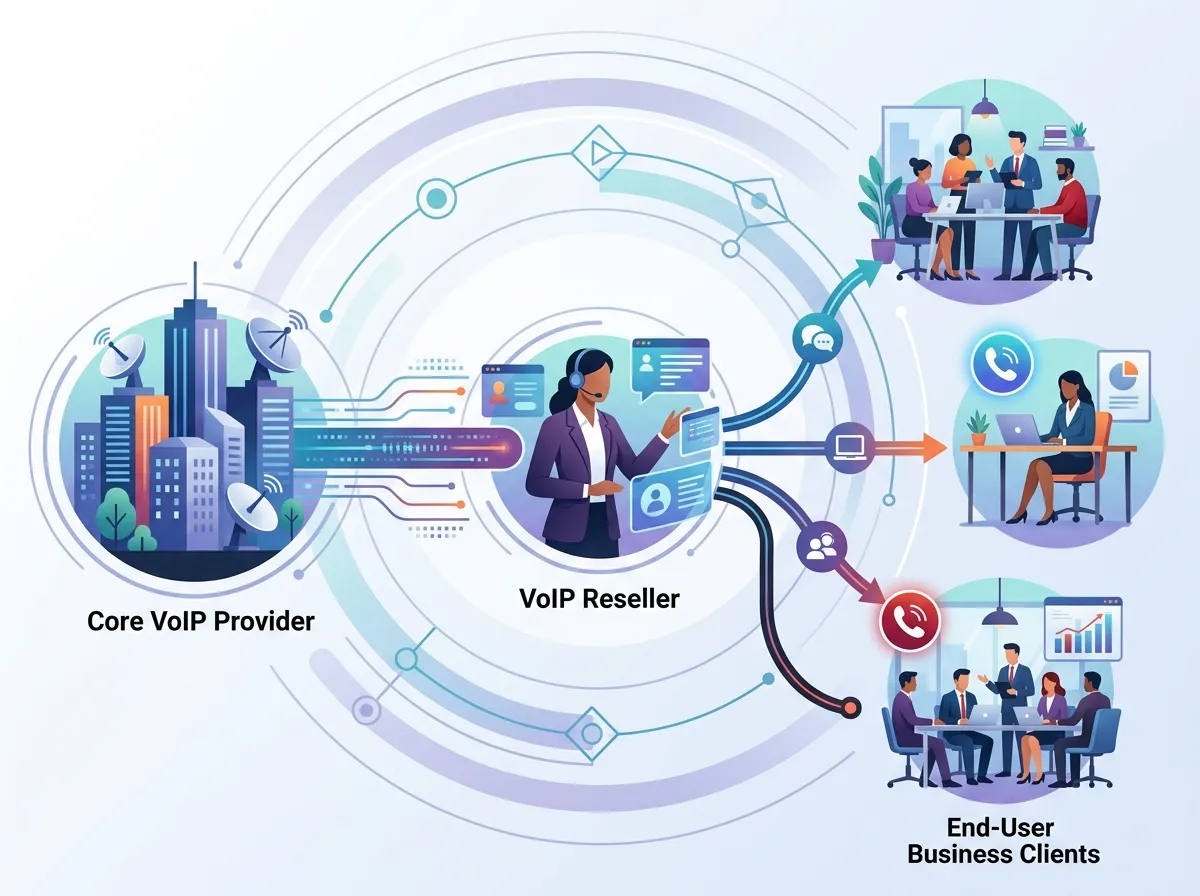
A VoIP reseller acts as a middleman between a major VoIP service provider and the end business customer. The reseller purchases voice and cloud phone system services at discounted wholesale rates, then repackages and resells them — often under their own brand name — to businesses that need reliable phone services.
This model is incredibly common in the business telecom solutions space. Rather than building their own phone network infrastructure (which costs millions of dollars), resellers partner with established Tier-1 networks and cloud platforms. They focus their energy on what they do best: customer relationships, local support, custom configurations, and bundled service packages.
Most modern VoIP reseller programs are white-label, meaning the reseller can brand the service portal, billing system, and support desk under their own company name. From the customer’s perspective, it feels like a fully branded, end-to-end experience — even though the underlying network is powered by a major carrier behind the scenes.
How Does a VoIP Reseller Program Work?
The mechanics behind a VoIP reseller program are pretty straightforward. Here’s a step-by-step breakdown of how the process typically works:
- The reseller partners with a VoIP provider. They sign up for a wholesale or white-label reseller agreement with an established VoIP or UCaaS (Unified Communications as a Service) platform.
- The reseller sets their own pricing. They mark up the wholesale rates to create their retail pricing, building in their margin while still offering competitive rates to businesses.
- The reseller sells to businesses. They approach small and mid-sized businesses, enterprises, or specific vertical markets and pitch their bundled communications packages.
- The reseller handles onboarding and setup. This includes provisioning phone systems, configuring call routing, porting existing numbers, and training staff on the new system.
- Ongoing support and billing. The reseller manages monthly billing, provides customer support, and handles any service changes or upgrades the business needs over time.
This model works well for businesses because they get a local, knowledgeable partner who understands their specific needs — rather than being just another ticket number in a massive carrier’s support queue. For more insight on selecting the right communications partner, check out how to choose a telecom provider that fits your business.
VoIP Reseller vs. Direct Provider: Key Differences
It’s helpful to understand what sets a VoIP reseller apart from going directly to a large national VoIP provider. Here’s a quick comparison:
| Feature | VoIP Reseller | Direct VoIP Provider |
|---|---|---|
| Personalized Support | ✅ Local, dedicated support | ❌ Generic call center support |
| Custom Bundling | ✅ Bundle VoIP, internet, cabling, etc. | ❌ Usually voice services only |
| Vendor Flexibility | ✅ Can compare multiple platforms | ❌ Locked to one provider’s products |
| Onsite Installation | ✅ Often included | ❌ Typically self-install |
| Audit & Optimization | ✅ Reviews your existing setup | ❌ No competitive review process |
| Pricing | ✅ Competitive wholesale-based rates | ⚠️ Varies — may be higher retail |
As you can see, the reseller model adds a meaningful layer of value for businesses. You can also explore the differences between a telecom broker and a direct provider to see how these models compare in even more depth.
Why the VoIP Reseller Model Is Growing in 2026
The VoIP reseller market is booming — and for good reason. The global VoIP services market is projected to reach approximately $326 billion by 2032, growing at a compound annual growth rate (CAGR) of around 10.8%. That’s enormous growth, and VoIP resellers are capturing a significant slice of it.
Several factors are driving this growth in 2026:
- Legacy PBX migrations: Thousands of businesses are still using outdated on-premise phone systems and are ready to move to the cloud.
- Remote and hybrid work: Distributed teams need flexible, cloud-based communications that work anywhere — a perfect fit for hosted VoIP.
- SMB demand for simplicity: Small and mid-sized businesses want one trusted partner to handle all their telecom needs, not five different vendors.
- UCaaS expansion: Businesses want more than just a phone line — they want video, messaging, analytics, and collaboration tools bundled together.
- Cost pressure: Companies are actively looking to reduce telecom costs, and a good VoIP reseller can often deliver better value than legacy carriers.
If you’re still on a traditional phone system, you’ll want to read about why businesses are switching to VoIP in 2026. The reasons are pretty compelling!
What Services Do VoIP Resellers Typically Offer?
A quality VoIP reseller does much more than just provide dial tone. Here’s what a comprehensive VoIP reseller package typically looks like:
| Service Category | What’s Included |
|---|---|
| Hosted PBX / Cloud Phone System | Virtual phone extensions, auto-attendant, voicemail to email |
| SIP Trunking | Direct connection of business phone system to VoIP network |
| UCaaS Features | Video conferencing, team messaging, file sharing, presence |
| Advanced Call Routing | Hunt groups, ring strategies, time-based routing, IVR menus |
| Analytics & Reporting | Call volume reports, agent performance, missed call tracking |
| Number Porting | Keep your existing business phone numbers when switching |
| Mobile & Desktop Apps | Softphone apps so staff can work from anywhere |
Many resellers also bundle complementary services like structured cabling that supports VoIP phones, high-speed internet, and even cloud security cameras — giving businesses a true one-stop-shop experience. To learn about all the features modern VoIP systems include, check out 12 VoIP phone system features every business needs in 2026.
How VoIP Resellers Make Money
Understanding the VoIP reseller revenue model helps you see why it’s a sustainable, long-term business relationship — not just a one-time transaction.
VoIP resellers typically earn revenue through:
- Monthly recurring revenue (MRR): Per-seat or per-line monthly fees that create predictable, consistent income.
- Usage-based charges: Overages on minutes, international calls, or toll-free usage.
- Add-on services: Premium features like call recording, advanced analytics, CRM integrations, and AI call routing.
- Installation and setup fees: One-time charges for onboarding, hardware provisioning, and system configuration.
- Bundled telecom services: Additional margin from bundling internet, cabling, or security solutions alongside VoIP.
Industry data shows that VoIP reseller partners can achieve recurring revenue margins of 20–40% on wholesale pricing, depending on how they package their services. That’s a healthy business model — which is why so many telecom partners are embracing it. You can also learn more about how much a VoIP phone system costs for a business to understand what you’ll be paying as a customer.
What to Look for in a VoIP Reseller Partner
Not all VoIP resellers are created equal. Whether you’re a business looking to buy services or you’re evaluating how to source your communications solutions, here are the key factors to consider:
- Network reliability: The underlying VoIP platform should run on Tier-1 infrastructure with strong uptime guarantees (99.999% is the gold standard).
- Range of services: A great reseller bundles VoIP with internet, cabling, and IT services so you don’t need multiple vendors.
- Local expertise: A reseller with knowledge of your market, local regulations, and industry-specific needs is far more valuable than a generic national provider.
- Transparent pricing: No hidden fees, clear contracts, and honest billing make for a trustworthy long-term relationship.
- Support quality: Fast, knowledgeable support — not just an automated chatbot — is non-negotiable for business-critical communications.
- Vendor-neutral approach: The best resellers compare options across multiple platforms and recommend what’s genuinely best for your needs.
A vendor-neutral approach is especially important. You want a partner who recommends the best solution for your business, not the one that pays them the highest commission. For tips on avoiding common pitfalls, read about VoIP provider mistakes businesses must avoid.
How Ideal Solutions Provider Fits the VoIP Reseller Model
This is exactly where a company like Ideal Solutions Provider shines. As a Tampa-based telecom and IT partner with over 24 years of experience, they operate as an independent, vendor-neutral reseller with access to 35+ vetted suppliers — including leading VoIP platforms like RingCentral, Nextiva, Net2Phone, and Cloudli.
Rather than pushing one specific product, Ideal Solutions Provider audits your current setup, compares options side-by-side, and recommends the solution that genuinely fits your needs and budget. They back it up with professional installation, structured cabling, ongoing support, and a single point of contact for all your telecom needs. In fact, their data shows that 9 out of 10 businesses they audit are either overpaying or underperforming on their current telecom setup. That’s a sobering statistic — but also a huge opportunity to save money and communicate better.
If you’d like to learn more about what to look for when choosing a VoIP solutions provider, this guide on how to choose a business VoIP solutions provider is a great starting point. You can also follow their updates on Facebook to stay current on the latest telecom tips and offers.
Best Business Types for VoIP Reseller Services
VoIP reseller services are a great fit for a wide range of businesses. Here are some of the top candidates:
- Small businesses: Affordable, scalable phone systems without expensive hardware or long-term contracts.
- Healthcare practices: HIPAA-compliant calling, call recording, and patient communication tools.
- Legal and professional services: Call routing, voicemail transcription, and mobility features for attorneys and consultants on the go.
- Multi-location franchises: Consistent phone systems across all locations with centralized management and reporting.
- Growing mid-sized companies: Scalable seat-based pricing that grows as the team does, with no major capital investment.
- Remote-first organizations: Cloud-based VoIP works on any device, anywhere — perfect for distributed teams.
For franchise operators and multi-location businesses, a trusted VoIP reseller with nationwide reach is especially valuable. Check out how to leverage a single point of contact for all your telecom services to keep operations smooth across every location.
VoIP Reseller Pricing: What to Expect
One of the most common questions businesses ask is about cost. Here’s a general pricing overview for VoIP reseller services:
| Business Size | Estimated Monthly Cost Per Seat | What’s Typically Included |
|---|---|---|
| Small Business (1–10 users) | $20 – $35/seat | Basic VoIP, voicemail, auto-attendant |
| Mid-Size Business (11–50 users) | $25 – $45/seat | UCaaS features, analytics, CRM integration |
| Enterprise (50+ users) | Custom pricing | Full UCaaS, dedicated support, SLAs |
Pricing can vary based on the features you need, the number of users, and whether you’re bundling additional services. The good news is that VoIP almost always costs less than a traditional phone system when you factor in hardware, maintenance, and long-distance charges. For a detailed breakdown, read about affordable VoIP phone services for businesses and what you can realistically expect to pay.
You can also follow Ideal Solutions Provider on Instagram for real-world examples of how businesses are saving money by making the switch to VoIP through a trusted reseller partner.
Getting Started With a VoIP Reseller
If you’re ready to explore VoIP reseller services for your business, here’s a simple action plan to get started:
- Audit your current telecom setup. Know what you’re paying now and what features you’re actually using. Many businesses are surprised to find they’re paying for services they don’t need.
- Define your must-have features. Make a list of what your business truly needs — call routing, mobile apps, video conferencing, integrations, etc.
- Request a consultation. A good VoIP reseller will offer a free consultation and side-by-side comparison of options. No pressure, just clarity.
- Review the contract carefully. Look for month-to-month flexibility, clear pricing, support commitments, and number porting guarantees.
- Plan your migration. Work with your reseller to schedule a smooth cutover with minimal downtime. A professional VoIP reseller will handle the heavy lifting for you.
For a more detailed walkthrough, check out this guide on 5 steps to switch your business phone to the cloud. And if you want to explore what cloud-based options are available in your area, browse the best cloud-based phone systems for businesses to compare your choices. You can also watch educational videos and system demos on Ideal Solutions Provider’s YouTube channel for visual walkthroughs of what’s possible.
Conclusion: Is Working With a VoIP Reseller Right for You?
If you want expert guidance, competitive pricing, and a single partner who handles your phone systems, internet, and IT infrastructure — then yes, working with a VoIP reseller is absolutely the right move. The VoIP reseller model exists precisely to give businesses like yours access to enterprise-grade communications without the enterprise-level headaches.
The key is finding a reseller who is vendor-neutral, experienced, and genuinely invested in your success. That means someone who will audit your current setup honestly, compare real options, and stand behind their recommendations with solid ongoing support.
Whether you’re a small business owner in Tampa, an IT manager at a growing enterprise, or a franchise operator with locations nationwide, the right VoIP reseller partner can make a huge difference in how well your business communicates — and how much you spend doing it.
Ready to see what the right VoIP reseller partner can do for your business? Reach out to our team at Ideal Solutions Provider for a free, no-obligation telecom consultation. We’d love to help you communicate better and spend less doing it!
FAQs
Q: What is a VoIP reseller and how does it work?
A: A VoIP reseller is a company that purchases cloud-based phone services at wholesale rates from a major VoIP provider and then resells them to businesses — often under their own brand name. They handle everything from setup and installation to billing and ongoing support, so businesses get a personalized, local experience backed by enterprise-grade infrastructure. It’s a win-win: you get better service and support, and the reseller builds a sustainable recurring revenue business!
Q: Why should I use a VoIP reseller instead of going directly to a big carrier?
A: Going directly to a large national carrier often means generic support, rigid contracts, and no flexibility to compare options. A VoIP reseller, on the other hand, acts as your advocate — comparing multiple platforms, customizing your package, and providing dedicated local support that actually knows your business. Many resellers can also bundle in internet, cabling, and IT services, saving you the headache of managing multiple vendors.
Q: How much does VoIP service from a reseller typically cost?
A: VoIP reseller pricing is usually seat-based, meaning you pay a monthly fee per user. For small businesses, expect to pay roughly $20–$35 per seat per month for basic features, with mid-sized business packages typically ranging from $25–$45 per seat when UCaaS features are included. The exact cost depends on your feature needs, the number of users, and whether you bundle additional services like internet or structured cabling.
Q: Can a VoIP reseller help me keep my existing business phone numbers?
A: Absolutely! Number porting is a standard part of any professional VoIP reseller’s onboarding process. Your reseller will handle the technical details of transferring your existing business phone numbers to the new system, so your customers, partners, and vendors won’t experience any disruption. Just make sure to confirm the porting timeline with your reseller before your go-live date!
Q: What types of businesses benefit most from working with a VoIP reseller?
A: Virtually any business that relies on reliable phone communications can benefit from a VoIP reseller — but it’s especially valuable for small businesses looking to reduce costs, multi-location franchises needing consistent systems, and growing companies that want to scale their phone system without a major hardware investment. Healthcare, legal, and professional services firms also find great value in the specialized features and dedicated support that resellers provide.