

Key Takeaways
-
Business internet includes guaranteed SLAs with 99.9%+ uptime, symmetrical speeds, static IPs, and dedicated support—features residential internet rarely offers, making it essential for VoIP, cloud apps, and video conferencing.
-
Assess your bandwidth needs (FCC recommends 100+ Mbps for small businesses), check local provider availability, and compare SLA terms before signing; the cheapest option often means slowest speeds and weakest support.
-
Fiber-optic internet provides the fastest, most reliable connection with symmetrical speeds and low latency, making it a worthwhile investment for small businesses dependent on cloud applications and VoIP systems.
-
Regional ISPs often deliver faster speeds, fewer outages, and personalized service through locally-owned fiber networks, while national providers offer better multi-location coverage and scalability.
-
Pair your internet connection with VoIP carefully by prioritizing symmetrical speeds, low latency, QoS settings, and static IPs; a slow connection directly causes choppy calls and dropped connections.
-
Have a secondary backup internet connection for redundancy so outages don’t shut down operations; request quotes from at least three providers and negotiate pricing, as many ISPs offer better deals when asked.
Choosing the right internet service provider for your business can feel overwhelming. There are so many options, so many promises, and so many plans. How do you know which one will actually keep your team connected and productive every single day? Whether you run a small Tampa office or manage multiple locations across the country, picking the right Internet Service Provider is one of the most important decisions you’ll make for your business.
This guide breaks everything down in simple terms. We’ll walk you through what makes business internet different, which types of providers stand out in 2026, and how to make a smart choice without overpaying. Let’s dive in!

What Makes Business Internet Different From Residential Internet?
Business internet and home internet are not the same thing. Not even close. Understanding the difference helps you make a much smarter decision for your company.
Home internet plans are built for casual browsing, streaming, and social media. Business internet is built for reliability, speed, and uptime. Here’s a quick look at the key differences:
| Feature | Residential Internet | Business Internet |
|---|---|---|
| Service-Level Agreements (SLAs) | Rarely included | Usually guaranteed |
| Symmetrical Speeds | Uncommon | Often included |
| Priority Support | Standard queue | Dedicated business support |
| Static IP Options | Rarely offered | Commonly available |
| Uptime Guarantee | Not typical | 99.9%+ guaranteed |
Business internet plans also include stronger security features, higher bandwidth capacity, and the ability to scale as your team grows. If you’re running VoIP phones, cloud applications, or video conferencing, having business-grade internet is essential. You can learn more about this in our article on what makes high-speed internet essential for your business.
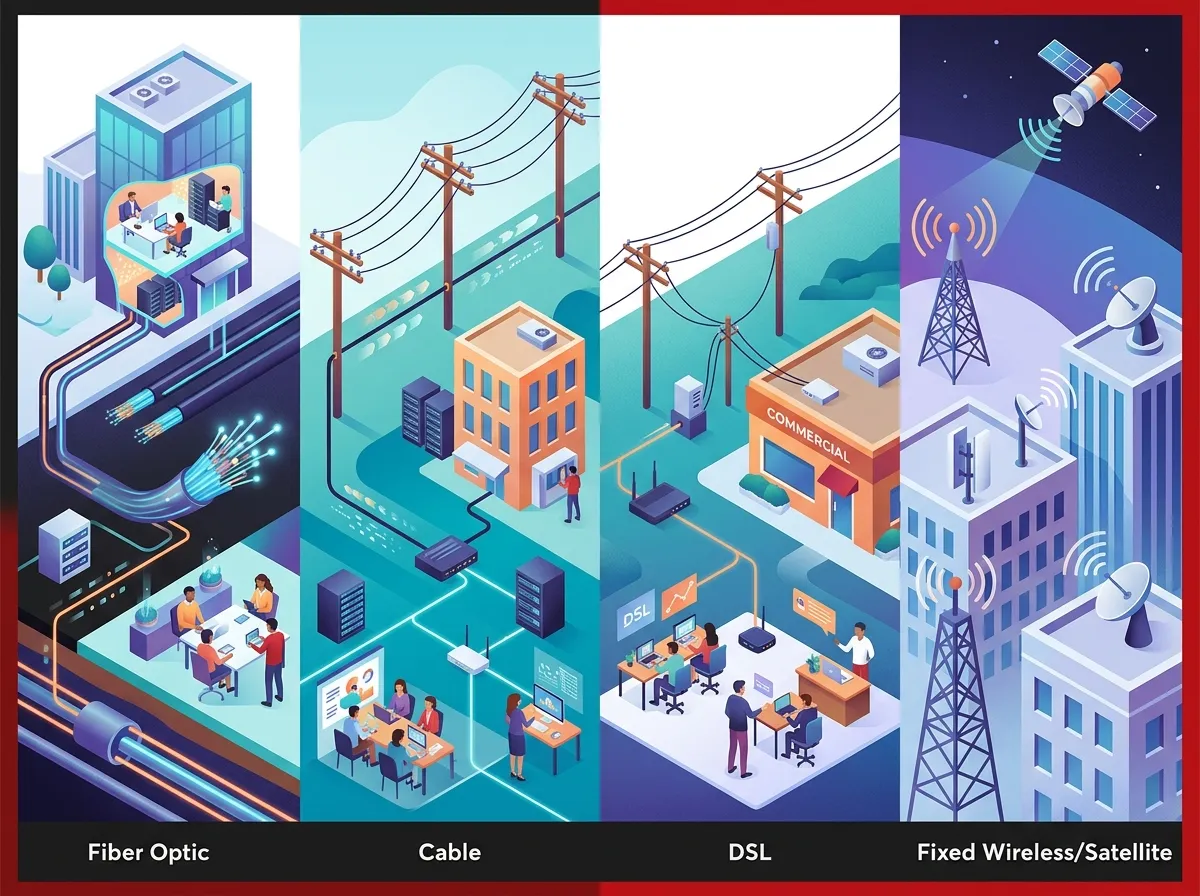
Types of Business Internet Connections Explained
Not all internet connections work the same way. The type of connection you choose affects your speed, reliability, and cost. Here are the most common options for businesses in 2026:
- Fiber-Optic Internet: The fastest and most reliable option. Runs on light signals through fiber cables. Ideal for data-heavy businesses.
- Cable Internet: Uses coaxial cables. Widely available and affordable, but speeds can vary during peak hours.
- Dedicated Internet Access (DIA): A private connection just for your business. No sharing, consistent speeds, and strong SLAs.
- Fixed Wireless: Uses radio towers to deliver internet. Great for areas where cables can’t reach.
- Satellite Internet: Providers like Starlink Business are changing the game for remote locations, offering speeds up to 220 Mbps.
- 5G Business Internet: Mobile-based broadband that’s growing fast. Works well as a backup or primary connection in 5G-covered areas.
Want to dig deeper into fiber options? Check out our guide on fiber vs. cable business internet in Tampa for a detailed comparison.
Top Business Internet Service Providers in 2026
The business ISP market is packed with strong options. Here’s a breakdown of some of the most notable providers and what they bring to the table:
| Provider | Max Download Speed | Coverage | Key Strength |
|---|---|---|---|
| AT&T Business | Up to 1,000 Mbps | Nationwide | 24/7 support, fiber network |
| Verizon Business (Fios) | Up to 940 Mbps | Nationwide | Fiber + flexible 5G options |
| Google Fiber Business | Up to 1,000 Mbps | Select cities | No-contract plans |
| Comcast Business | Up to 1,250 Mbps | Nationwide | VoIP and cloud integration |
| Starlink Business | Up to 220 Mbps | Global | Remote location coverage |
Each provider has strengths and weaknesses. Choosing the right one depends on your location, your team size, and how you use the internet daily. For businesses in Florida, our breakdown of business internet service providers in Tampa, Florida is a great starting point.
How to Choose the Right Internet Service Provider for Your Business
Great question — and one we help businesses answer every single day. Here’s a simple step-by-step process to guide your decision:
- Assess your bandwidth needs. The FCC recommends at least 100 Mbps for small businesses relying on video conferencing. Add more if you have cloud apps, VoIP phones, or many connected devices.
- Check what’s available in your area. Not every provider services every location. Start with what’s actually accessible where you operate.
- Compare SLA terms carefully. Look for uptime guarantees, response times, and what happens when service goes down.
- Look at static IP and security options. These matter a lot for businesses running servers, VPNs, or cloud-based security cameras.
- Ask about scalability. As your team grows, your internet needs will too. Choose a plan and provider that can grow with you.
You can also find practical tips in our article on how to choose the right internet speed for your Tampa business.
The Importance of Service-Level Agreements for Businesses
An SLA is essentially your safety net. It’s a written promise from your internet service provider about the quality and reliability of their service. Without one, you’re just crossing your fingers and hoping for the best.
Here’s what a solid business SLA should include:
- Guaranteed uptime percentage (look for 99.9% or higher)
- Maximum response time for outages or issues
- Clear process for reporting and resolving problems
- Compensation or credits if the provider misses their targets
- Defined bandwidth guarantees (especially important for dedicated connections)
If your current provider doesn’t offer a strong SLA, it may be time to reconsider. A slow or unreliable connection costs your business money every hour it’s down. Read more about this in our post on why Tampa businesses need dedicated fiber internet.
Regional vs. National Internet Service Providers: Which Is Better?
This is a debate worth having. National providers offer wide coverage and brand recognition. But regional providers often deliver surprising advantages for businesses in their service areas.
For example, regional fiber providers like LOGIX in Texas own and operate large private fiber networks. They connect over 10,000 businesses and 3,000 enterprise clients across their region. That level of local infrastructure can translate into faster speeds, fewer outages, and more personalized service.
Here’s a quick comparison to help you think it through:
| Factor | National ISPs | Regional ISPs |
|---|---|---|
| Coverage Area | Nationwide | Specific regions or cities |
| Network Infrastructure | Varies by location | Often 100% owned fiber |
| Customer Service | Larger call centers | More personalized support |
| Pricing Flexibility | Fixed national plans | Often negotiable |
| Scalability | Strong for multi-location | Best within their region |
The best answer really depends on where your business operates. For multi-location businesses, national providers often make more sense. For single-location companies in a well-served city, regional providers can be a fantastic deal. Explore our guide on how to compare business internet providers in Tampa, Florida for more insight.
Business Internet and VoIP: A Powerful Combination
Here’s something a lot of business owners don’t realize: your internet connection directly affects the quality of your VoIP phone calls. If your internet is slow or unreliable, your calls will be choppy, drop frequently, or fail to connect entirely.
That’s why smart businesses choose internet service providers that can also support cloud-based phone systems. Many major providers bundle internet with VoIP services, cloud integrations, and even security solutions — all under one plan.
Key things to look for when pairing internet with VoIP:
- Symmetrical upload and download speeds (critical for clear calls)
- Low latency and jitter for smooth voice transmission
- Quality of Service (QoS) settings to prioritize voice traffic
- Static IP addresses for reliable VoIP performance
You can find out exactly how much speed you need in our post on what internet speed you need for VoIP in Tampa. And if you’re thinking about upgrading your phone system too, check out our resource on affordable VoIP phone services for Tampa businesses in 2026.
How a Telecom Partner Can Simplify Your ISP Search
Shopping for internet service providers on your own is time-consuming. You have to gather quotes, read fine print, compare SLAs, and figure out which providers even serve your area. It’s a lot of work — especially when you’re already busy running a business.
That’s where a trusted telecom partner comes in. Ideal Solutions Provider has been helping businesses across Tampa and nationwide find the right internet solutions for over 24 years. With access to 35+ vetted suppliers — including Spectrum, Verizon, Comcast, AT&T, and more — they do the comparison work for you.
Instead of calling five different companies and sitting through five sales pitches, you get one clear recommendation based on your actual needs. No pressure, no guesswork. Learn more about working with a partner like this by reading our article on 11 reasons to use one telecom partner in Tampa FL.
You can also follow along with real business tips and updates on Facebook, Instagram, and YouTube.
Common Mistakes Businesses Make When Choosing an ISP
Avoid these pitfalls to save money and frustration down the road:
- Choosing based on price alone. The cheapest plan often comes with the slowest speeds, weakest SLAs, and poorest support. You usually get what you pay for.
- Not testing for local availability. Just because a provider advertises nationally doesn’t mean they serve your specific building or area.
- Ignoring contract terms. Some plans lock you in for years with heavy exit fees. Always read the fine print before signing.
- Overlooking upload speeds. If your business uses cloud storage, video calls, or file sharing, upload speed matters just as much as download speed.
- Skipping the backup connection. Smart businesses have a secondary internet connection for redundancy. An outage shouldn’t shut your whole operation down.
For more ways to avoid costly errors, check out our article on 12 business internet cost mistakes Tampa owners make in 2026.
Quick Tips for Getting the Best Business Internet Deal
Before you sign anything, run through this quick checklist:
- Request quotes from at least three providers in your area
- Ask specifically about SLA terms and guaranteed uptime
- Negotiate — many providers will offer better pricing if you ask
- Bundle services when it makes sense (internet + VoIP + security can save money)
- Schedule a free telecom audit to see if you’re currently overpaying
Our blog post on 13 high-speed internet for business tips that save money is packed with actionable advice to help you cut costs without cutting quality. And if you want to understand more about what broadband really means for your business, our guide on what is business broadband and why your company needs it is a must-read.
Conclusion: Finding the Right ISP Doesn’t Have to Be Hard
Choosing the right internet service provider for your business is a big decision — but it doesn’t have to be stressful. Focus on what matters: reliable uptime, strong SLAs, speeds that match your actual needs, and a provider that offers great support when things go wrong.
The good news is that you don’t have to figure it all out alone. Whether you’re a small business owner in Tampa or a franchise operator with locations across the country, the right help is available. From comparing providers to installing structured cabling and VoIP systems, a knowledgeable telecom partner can handle it all.
Ready to find the best internet solution for your business? Reach out to our team today for a free consultation and let us do the heavy lifting for you. You focus on running your business — we’ll make sure you’re always connected.
FAQs
Q: What is the minimum internet speed my business needs in 2026?
A: The FCC recommends at least 100 Mbps download speed for small businesses that rely on video conferencing. That said, if your team uses cloud apps, VoIP phones, or handles large file transfers, you’ll want to aim higher — 250 Mbps or more is a safe target for most growing businesses.
Q: How do business internet service providers differ from residential ISPs?
A: Business internet plans come with stronger service-level agreements (SLAs), symmetrical speeds, static IP options, and dedicated customer support. Residential plans are built for casual home use and simply don’t offer the reliability or guarantees that businesses depend on day to day.
Q: Is fiber internet really worth it for small businesses?
A: Absolutely! Fiber internet delivers symmetrical upload and download speeds, extremely low latency, and rock-solid reliability. For small businesses running VoIP phones or cloud applications, fiber is one of the best investments you can make in your daily operations.
Q: Can I bundle my business internet with other telecom services?
A: Yes, and it’s often a smart move! Many internet service providers offer bundled plans that include VoIP phone service, cloud security, and networking solutions. Bundling can simplify billing, reduce costs, and give you one point of contact for all your tech support needs.
Q: How do I know if I’m overpaying for my current business internet plan?
A: A great first step is to schedule a free telecom audit with a trusted partner. Many businesses discover they’re locked into outdated plans with speeds or features they no longer need. A quick review can reveal better options and potentially save you hundreds of dollars each month!