

Key Takeaways
-
SD-WAN enables centralized management of network traffic from one dashboard instead of manual device-by-device configuration, making it ideal for multi-location Tampa businesses looking to reduce MPLS costs and improve cloud app performance.
-
Businesses with multiple locations, remote/hybrid workers, or heavy cloud application usage (Microsoft 365, Zoom, VoIP) see the most value from SD-WAN through faster performance, lower costs, and simplified IT management.
-
SD-WAN can coexist with existing MPLS circuits during transition, allowing gradual migration to cheaper broadband connections without complete network overhaul.
-
SD-WAN improves security through centralized traffic visibility, policy-based access control, and integration with third-party security tools, while prioritizing critical applications like VoIP for crystal-clear calls.
-
Single-location small businesses with basic internet needs may not require SD-WAN immediately, but multi-location franchises, healthcare providers, and growing companies benefit significantly from its scalability and dynamic routing.
-
Start with a free network audit to assess current pain points, compare SD-WAN solutions from multiple providers without vendor bias, and plan a gradual rollout rather than switching everything at once.
If you’ve been shopping for better internet or networking solutions for your Tampa business, you’ve probably heard the term SD-WAN thrown around. But what does it actually mean? And more importantly, does your business really need it? These are great questions, and you’re not alone in asking them. Many Tampa business owners feel confused by the technical jargon — and that’s totally okay.
In this article, we’re going to break down SD-WAN in plain, simple language. We’ll compare it to traditional WAN so you can understand the real difference. By the end, you’ll have a clear picture of whether SD-WAN makes sense for your business size, budget, and goals. Let’s dive in!

What Is SD-WAN, Exactly?
SD-WAN stands for Software-Defined Wide Area Network. That’s a mouthful, we know. But the concept is actually pretty simple. A WAN (Wide Area Network) is just the network that connects your business locations, cloud apps, and remote users over long distances — essentially, anything beyond your office walls.
Traditional WAN relies on physical hardware and manual configuration to manage that connectivity. SD-WAN adds a smart software layer on top of your existing connections. This software layer lets your IT team (or a managed provider) monitor and control all your network traffic from one central dashboard. Think of it like having a smart traffic controller for all your internet connections instead of a bunch of manual stop signs.
According to Cisco, SD-WAN has become one of the most popular software-defined networking (SDN) use cases for enterprise WAN management. It’s not a passing trend — it’s the new standard for businesses that need reliable, flexible connectivity. You can learn more about how business network solutions like SD-WAN work in practice.
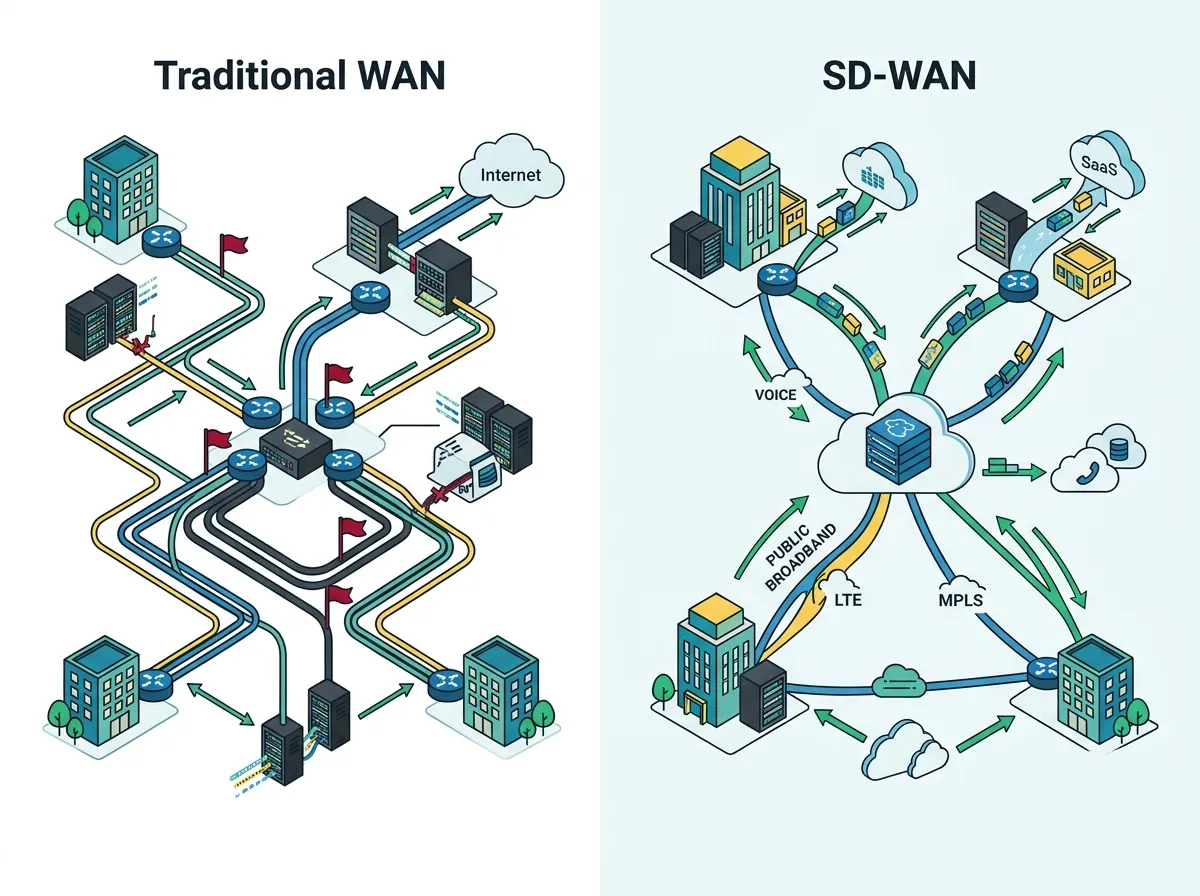
SD-WAN vs. Traditional WAN: The Key Differences
To really understand SD-WAN, it helps to see how it stacks up against traditional WAN side by side. Here’s a straightforward comparison:
| Feature | Traditional WAN | SD-WAN |
|---|---|---|
| Management | Manual, device-by-device | Centralized software dashboard |
| Connection Types | Typically MPLS or private circuits | Broadband, fiber, LTE/5G, MPLS, VPN |
| Traffic Routing | Static, pre-configured paths | Dynamic, policy-based routing |
| Cost | Higher (MPLS-dependent) | Lower operational costs for multi-site |
| Cloud Support | Limited, not optimized | Built for cloud apps and hybrid work |
| Security | Basic perimeter security | Policy enforcement and traffic monitoring |
| Scalability | Complex to scale | Easy to add locations or users |
As you can see, the differences are significant. SD-WAN gives your business much more flexibility and control. If you’re curious about how this compares to MPLS specifically, check out this guide on which MPLS network provider is right for Tampa businesses.
How Does SD-WAN Actually Work?
Here’s the simple version: SD-WAN creates a smart software layer that sits on top of one or more physical internet connections. Those connections could be broadband, fiber, LTE, 5G, or even legacy MPLS circuits. The software manages all of them at once.
According to Gartner’s definition, SD-WAN must support four key characteristics:
- Multiple connection types — It can use broadband, MPLS, LTE, fiber, and more at the same time.
- Dynamic path selection — It automatically picks the best route for each type of traffic.
- Simple, centralized management — Everything is controlled from one interface.
- Support for VPNs and third-party security services — It integrates with your security tools.
When your team is on a video call, SD-WAN knows to prioritize that traffic. When someone is downloading a large file, that gets routed separately so it doesn’t interfere. It’s intelligent networking that works quietly in the background. This is especially valuable if you use cloud apps like Microsoft 365, VoIP phone systems, or other SaaS tools. Speaking of VoIP, you might want to explore how cloud-based phone systems pair perfectly with SD-WAN for crystal-clear calls.
SD-WAN vs. MPLS: Which Is Better for Tampa Businesses?
Many Tampa businesses still run on MPLS (Multiprotocol Label Switching) circuits. MPLS was the gold standard for years — it’s reliable and predictable. But it’s also expensive and inflexible. Here’s how the two compare for common business needs:
| Business Need | MPLS | SD-WAN |
|---|---|---|
| Multi-location connectivity | Works well but costly | Excellent and cost-efficient |
| Cloud app performance | Not optimized for cloud | Built specifically for cloud |
| Remote/hybrid workers | Difficult to support | Easy to support |
| Bandwidth flexibility | Fixed and expensive to change | Flexible and scalable |
| Setup complexity | High, requires specialist | Simpler with right provider |
The good news is that SD-WAN doesn’t always mean ripping out your MPLS. Many businesses use both together during a transition period. SD-WAN can actually sit on top of your existing MPLS circuit while you gradually shift to more affordable broadband connections. For a deeper dive, check out our guide on how to choose SD-WAN solutions for Tampa Bay businesses.
Does Your Tampa Business Actually Need SD-WAN?
This is the big question! Honestly, not every business needs SD-WAN right now. It depends on your specific situation. Here are the most common signs that SD-WAN could be a game-changer for you:
- You have multiple office locations — Whether across Tampa Bay or nationwide, SD-WAN connects them all seamlessly.
- Your team works remotely or in a hybrid setup — SD-WAN makes remote access fast, secure, and reliable.
- You rely heavily on cloud applications — Tools like Microsoft 365, Zoom, Salesforce, or VoIP phones perform better with SD-WAN.
- You’re paying too much for MPLS — SD-WAN can dramatically reduce WAN costs for multi-site businesses.
- You experience frequent network slowdowns — Dynamic traffic routing eliminates bottlenecks.
- Your IT team is overwhelmed managing routers — Centralized control cuts down manual configuration work significantly.
On the flip side, if you’re a single-location small business with basic internet needs and a simple network, traditional broadband or fiber might be all you need right now. If you’re unsure about your current internet situation, this resource on why your business internet is slow in Tampa might help you diagnose the problem first.
SD-WAN Benefits at a Glance
Let’s summarize the main benefits of SD-WAN so you have a quick reference:
| Benefit | What It Means for Your Business |
|---|---|
| Better performance | Priority routing keeps critical apps fast and smooth |
| Lower costs | Use cheaper broadband instead of expensive MPLS |
| Improved reliability | Automatic failover if one connection goes down |
| Enhanced security | Traffic monitoring and policy enforcement built in |
| Easy scalability | Add new locations or users without major reconfiguration |
| Simplified management | One dashboard to control your entire WAN |
Who Benefits Most from SD-WAN in Tampa?
Certain types of Tampa businesses tend to get the most value from SD-WAN. Here’s a quick breakdown by business type:
- Franchise operators — Multi-location franchises across Tampa Bay and beyond can unify their networks and reduce per-location costs. Our guide on reliable network solutions for multi-location Tampa businesses is a great read for franchise owners.
- Healthcare and professional services — Industries with strict compliance needs benefit from SD-WAN’s enhanced security and traffic visibility.
- Growing mid-sized companies — Businesses that are scaling quickly need a network that can grow with them without massive IT overhead.
- Remote-first or hybrid teams — If your workforce is spread across locations, SD-WAN ensures everyone gets a consistent, reliable connection.
- Businesses using VoIP phone systems — SD-WAN prioritizes voice traffic, which means crystal-clear calls and fewer dropped connections. Learn more about affordable VoIP phone services for Tampa businesses.
What About Security with SD-WAN?
One of the biggest concerns Tampa business owners have is network security. SD-WAN actually improves your security posture compared to traditional WAN. Here’s how:
- It gives you centralized visibility into all traffic across your network.
- It enables policy-based access control, so only the right users reach the right resources.
- It integrates with third-party security tools like firewalls and intrusion detection systems.
- It supports encrypted VPN tunnels between all your locations and remote users.
If you’re also thinking about physical security for your Tampa business locations, pairing SD-WAN with cloud video security and cloud-based access control gives you a truly comprehensive security setup — both digital and physical.
How to Get Started with SD-WAN in Tampa
Getting started with SD-WAN doesn’t have to be overwhelming. Here’s a simple process to follow:
- Audit your current network — Understand what connections you have, what you’re paying, and where the pain points are.
- Define your goals — Are you trying to reduce costs, improve performance, support remote workers, or all three?
- Work with a trusted local partner — A qualified telecom expert can compare SD-WAN solutions from multiple providers and recommend the right fit.
- Plan your rollout — SD-WAN can be deployed gradually, so you don’t have to switch everything at once.
- Monitor and optimize — Use the centralized dashboard to fine-tune performance after deployment.
This is exactly where Ideal Solutions Provider shines. As a Tampa-based telecom and IT partner with over 24 years of experience and relationships with 35+ vetted suppliers, they can audit your current setup and recommend the right SD-WAN solution without any vendor bias. They’ve found that 9 out of 10 businesses they audit are either overpaying or underperforming — or both! You can also explore their business high-speed internet services to see how internet and SD-WAN work hand in hand.
For more tips on getting your business network running at its best, follow Ideal Solutions Provider on Facebook and Instagram for helpful updates, and subscribe to their YouTube channel for video walkthroughs of business telecom topics.
Wrapping It Up: Is SD-WAN Right for Your Tampa Business?
Here’s the simple truth: if your Tampa business has multiple locations, relies on cloud apps, supports remote workers, or is tired of paying too much for slow and unreliable connectivity — SD-WAN is absolutely worth exploring. It gives you smarter, more flexible, and more affordable networking than traditional WAN or MPLS alone.
If you’re a single-location business with basic needs, you might not need SD-WAN just yet. But as your business grows, it’s a powerful upgrade to keep in mind. Either way, the best first step is a free network audit to see what you have and what you’re missing.
Ready to find out if SD-WAN is the right move for your Tampa business? Reach out to our team today for a free consultation — we’ll review your current setup, compare solutions from top providers, and give you a clear recommendation with no pressure and no jargon. You deserve a network that works as hard as you do!
FAQs
Q: What is SD-WAN in simple terms?
A: SD-WAN is a smart software layer that manages and optimizes all your internet connections from one central dashboard. Think of it like a traffic controller for your business network — it makes sure the right data gets to the right place, fast and reliably.
Q: Is SD-WAN better than MPLS for Tampa small businesses?
A: For many small and mid-sized Tampa businesses, SD-WAN offers more flexibility and lower costs than traditional MPLS. That said, the right choice depends on your number of locations, cloud app usage, and budget — a quick network audit can help you figure out which makes more sense for you!
Q: Can SD-WAN help improve my VoIP phone call quality?
A: Absolutely! SD-WAN prioritizes voice traffic so your VoIP calls stay clear and consistent, even when other parts of your network are busy. It’s one of the best upgrades you can make if your team relies on cloud-based phone systems daily.
Q: How much does SD-WAN cost for a Tampa business?
A: SD-WAN costs vary based on the number of locations, connection types, and the provider you choose. While there’s an upfront investment, most multi-location businesses actually save money over time by reducing dependence on expensive MPLS circuits — a free telecom audit is the best way to get a real number for your situation.
Q: Do I need SD-WAN if I only have one office location in Tampa?
A: If you’re a single-location business with straightforward internet needs, you may not need SD-WAN right away. However, if you heavily rely on cloud apps, support remote workers, or plan to grow, SD-WAN could still deliver meaningful performance and reliability benefits worth exploring.