

Key Takeaways
-
MPLS uses short labels attached to packets so carrier routers forward traffic by label instead of making full routing lookups at every hop, enabling more predictable paths across the network.
-
MPLS does not automatically guarantee bandwidth, latency, or uptime; always request service level agreements (SLAs) in writing before signing a contract.
-
Private MPLS routing is not encryption; if you handle sensitive data like patient or payment information, add encryption and security controls separately.
-
MPLS and SD-WAN are not the same: MPLS is a carrier-managed transport network, while SD-WAN is a software overlay that can manage MPLS, broadband, and cellular links together.
-
Many businesses use a hybrid approach, keeping MPLS for critical traffic like voice and core applications while routing other traffic over SD-WAN and internet links to balance cost and flexibility.
-
MPLS costs vary by number of sites, bandwidth, access type, and contract length, and it often takes longer to provision than internet options, so compare multiple quotes and plan lead times.
If you have ever looked at a telecom proposal and wondered what MPLS means, you are not alone. It is one of those acronyms that gets tossed around in meetings as if everyone already knows it. The good news is that the idea behind it is simple, and once you get it, comparing network options becomes much easier.
So, what is MPLS? MPLS stands for Multiprotocol Label Switching. It is a way for carrier networks to move your data between locations using short labels instead of long, complicated address lookups. Businesses use it to link offices, warehouses, and branches over a private, provider-managed network.
Whether you run one office in Tampa or manage a dozen franchise sites across the country, this guide walks you through how MPLS works, where it shines, where it falls short, and how it fits alongside newer options like SD-WAN. Grab a coffee, and let’s make this easy.

What Is MPLS in Plain English?
Think of MPLS like a well-run delivery service. Instead of every driver stopping at every intersection to read a full street address, each package gets a tag that tells drivers exactly which route to follow. Packages move faster and more predictably because the route decisions are made up front.
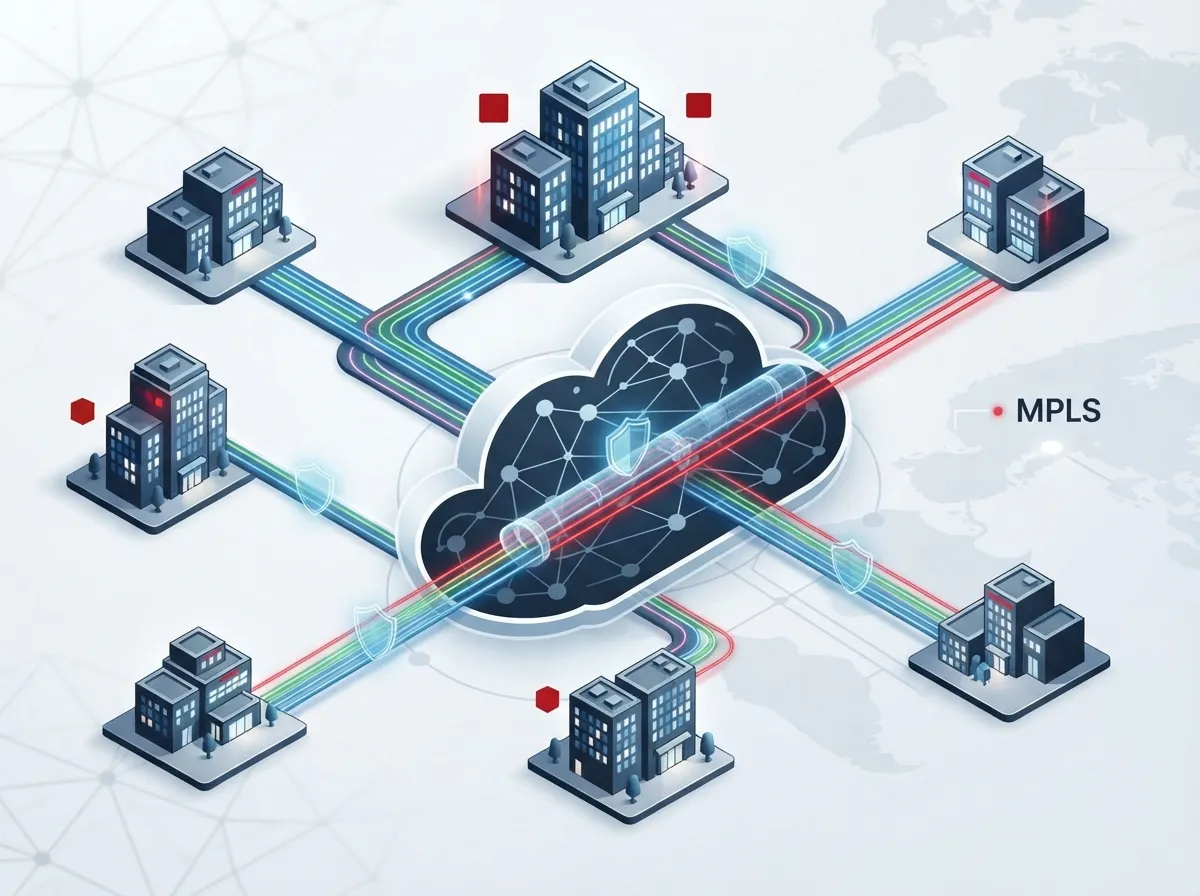
In technical terms, MPLS is a packet-forwarding technique used in carrier networks and business wide-area networks (WANs). The architecture is defined in the IETF standard known as RFC 3031. At the edge of the provider network, a router sorts your traffic into groups called forwarding equivalence classes (FECs) and attaches a short label to each packet. Routers inside the network then forward packets based on that label instead of making a full IP-routing decision at every hop.
For a business owner, the takeaway is this: MPLS is a managed, private-style network service your telecom provider builds and runs for you.
How Does MPLS Work in a Business Network?
Here is a simple step-by-step look at what happens when data travels over an MPLS network.
- Traffic enters at the edge. A router at your office sends data into the provider’s network.
- The edge router classifies the traffic. It decides which group (FEC) the data belongs to, such as voice, video, or regular file transfers.
- A label is attached. A short label is added to each packet to mark its path and priority.
- Core routers forward by label. Routers inside the provider network read the label and pass the packet along quickly.
- The label is removed at the exit. The last router strips the label and delivers the data to its destination site.
Because the provider manages the paths, it can steer traffic with intent. That is what makes MPLS popular for companies that want predictable behavior across many locations.
What Is an MPLS VPN?
Most businesses do not buy raw MPLS. They buy an MPLS VPN service. Providers commonly deliver private Layer 3 VPNs that connect company sites together, and Layer 2 VPN options are also available. Your traffic is logically separated from other customers on the same carrier network, and the provider manages routing across it.
Here is a quick comparison of the two common flavors.
| Service Type | How It Behaves | Best For |
|---|---|---|
| Layer 3 MPLS VPN | Provider participates in routing between your sites | Businesses wanting a fully managed, any-to-any WAN |
| Layer 2 MPLS VPN | Acts more like a private Ethernet connection between sites | Teams that want to run their own routing |
Not sure which one fits? A telecom partner can look at your sites, applications, and budget and point you in the right direction.
Why Do Businesses Use MPLS?
MPLS has stuck around for a reason. Many organizations value it for these strengths:
- Predictable performance. Provider-managed paths can deliver steadier results than the open internet.
- Traffic prioritization. Class-of-service policies let providers prioritize traffic like voice and video over less urgent data.
- Multi-site connectivity. It is well suited to connecting many locations on one private network.
- Provider-managed service. Your carrier handles the underlying paths and routing, which reduces day-to-day work for your team.
For IT managers juggling many sites, that last point can be a real time saver. For franchise operators, a consistent network across every location makes rolling out new sites far less stressful.
What MPLS Does Not Do Automatically
Here is where honesty matters. MPLS gets described in glowing terms sometimes, but it is not magic. Keep these points in mind.
- It does not guarantee bandwidth, latency, or uptime by itself. Actual performance depends on how the service is designed and what commitments your provider puts in the contract. Always ask for service level agreements in writing.
- It is private, but not automatically encrypted. MPLS VPNs separate your traffic logically from other customers, yet private routing is not the same as encryption. If you handle sensitive data, such as patient or payment information, review encryption and other security controls separately.
- It can cost more. Compared with internet-based options, MPLS circuits often carry a higher price per megabit.
- It can take longer to set up. Provisioning lead times for carrier circuits can stretch out, so plan ahead for new locations.
MPLS vs. SD-WAN: Are They the Same Thing?
This is one of the most common questions we hear. The short answer: no. SD-WAN is not a direct synonym for MPLS.
MPLS is a transport service delivered over a carrier network. SD-WAN is an overlay and policy-management approach that can sit on top of many types of connections, including MPLS, broadband internet, and cellular links. It can steer traffic across several links at once based on rules you set.
| Feature | MPLS | SD-WAN |
|---|---|---|
| What it is | Carrier-managed transport network | Software overlay that manages multiple links |
| Typical connections | Provider’s private network | MPLS, broadband, cellular, or a mix |
| Flexibility | Lower; carrier circuits take time to provision | Higher; can add internet links more quickly |
| Cost profile | Often higher | Often lower when using internet links |
| Management | Largely provider-managed | Can be self-managed or fully managed |
Many businesses do not pick one or the other. Some keep MPLS for selected critical traffic, like voice or core applications, while using SD-WAN and internet links for everything else. If you want to dig deeper, our guide on SD-WAN vs. MPLS: What Tampa Businesses Need to Know breaks the decision down further, and 6 SD-WAN Benefits Every Business Owner Should Know covers the other side of the story.
Is MPLS Still Relevant in 2026?
Yes, though its role has changed. Cloud apps, remote work, and cheaper broadband have pushed many companies to rethink their WANs. Even so, the market remains large. One market-research estimate put the global managed MPLS market at about US$18.56 billion in 2025, with a forecast of US$25.37 billion by 2031, according to Mordor Intelligence. Keep in mind these are vendor-research estimates, not audited industry totals.
What does that tell us? Plenty of organizations still rely on MPLS where steady, managed connectivity matters most, often alongside newer tools. Hybrid setups are common, and they are a very reasonable way to modernize without ripping everything out at once.
How Much Does Business MPLS Cost?
There is no single price tag, and anyone who quotes one without asking questions is guessing. Several factors shape what you will pay:
- Number of locations. More sites usually means more circuits and more cost.
- Bandwidth at each site. Bigger pipes cost more.
- Access type. Fiber, copper, and other last-mile connections are priced differently.
- Distance and availability. Sites in hard-to-reach areas can cost more to connect.
- Service levels. Stronger performance and support commitments typically add to the price.
- Class-of-service options. Extra traffic prioritization features can change the bill.
- Contract length. Longer terms may lower the monthly rate.
Because pricing varies so much from carrier to carrier, comparing several quotes side by side is the best way to avoid overpaying. For help budgeting, take a look at How to Budget for Managed Network Services in Tampa.
Who Should Consider MPLS?
MPLS is not for everyone, and that is perfectly okay. Here is a quick way to think about it by audience.
Small Business Owners
If you have one or two locations, you may not need MPLS at all. Solid business internet paired with a cloud phone system often does the job. Start with our tips on high-speed internet for business before committing to anything bigger.
Mid-Sized Enterprises and Franchise Operators
Connecting many sites with consistent performance is where MPLS often earns its keep. Franchise groups with locations across Tampa Bay and beyond may like having one managed network with predictable behavior. Our article on reliable network solutions for multi-location businesses is a helpful next read.
IT Managers and Office Managers
If your team is stretched thin, a provider-managed WAN can reduce the number of moving parts you have to babysit. Just make sure you understand the contract terms, the support process, and what happens when a circuit goes down.
How to Decide If MPLS Fits Your Business
Use this simple checklist as a starting point:
- Map your locations. List every site, how many people work there, and what they need to connect to.
- List your critical applications. Voice, video, and core business systems often matter most.
- Check your security needs. Decide whether you need encryption on top of private routing.
- Compare options. Look at MPLS, SD-WAN, dedicated fiber, and broadband side by side.
- Ask for written commitments. Get performance and support terms in writing before you sign.
- Plan for lead times. Allow extra time for carrier provisioning at new sites.
If you are already comparing carriers, Which MPLS Network Provider Is Right for Tampa Businesses? offers a practical look at what to ask providers.
Getting Help Choosing the Right Network
Picking a WAN can feel like decoding a foreign language, especially when every carrier has its own sales pitch. That is where an independent partner helps. Ideal Solutions Provider has more than 24 years of experience and works with 35+ vetted suppliers, so we can compare MPLS, SD-WAN, dedicated fiber, and broadband options side by side based on what your business actually needs rather than what one carrier wants to sell. We can also review your current setup to spot where you may be overpaying.
You can learn more about our business network solutions or see how we handle MPLS connectivity for growing companies. And if you want to understand the cabling side that makes any network run smoothly, our overview of structured cabling is a great background read, and we cover it in depth through our structured cabling services.
Wrapping Up: MPLS in a Nutshell
So, what is MPLS? It is a label-based forwarding technology that carriers use to deliver managed, private-style WAN connections between business locations. It can offer predictable performance and traffic prioritization, but it does not automatically guarantee speed or uptime, it is not the same as encryption, and it can cost more and take longer to deploy than internet-based options.
For many companies, the smartest move is not MPLS or SD-WAN, but the right mix of both. If you are ready to figure out what that looks like for your business, we would love to help. Contact us for a free review of your current setup, or call us to chat with a real person who can walk you through your options.
FAQs
Q: What does MPLS stand for?
A: MPLS stands for Multiprotocol Label Switching. It is a packet-forwarding technique carriers use to move business data between locations using short labels instead of full routing lookups at every hop.
Q: Is MPLS more secure than the public internet?
A: MPLS VPNs keep your traffic logically separate from other customers, which is a nice plus. But private routing is not the same as encryption, so if you handle sensitive data, you will want to review encryption and other security controls separately.
Q: Does MPLS guarantee bandwidth, latency, or uptime?
A: Not by itself. MPLS supports traffic prioritization, but actual performance depends on how the service is designed and what commitments your provider puts in your contract, so always ask for service levels in writing.
Q: What is the difference between MPLS and SD-WAN?
A: MPLS is a carrier-managed transport network, while SD-WAN is a software overlay that can manage MPLS, broadband, cellular, or a mix of connections. Many businesses use them together, keeping MPLS for critical traffic and SD-WAN for everything else.
Q: Is MPLS still relevant for businesses?
A: Yes, especially for companies that want predictable, provider-managed connectivity across many sites. Many organizations now blend MPLS with SD-WAN and internet links to balance reliability and cost.





