

Key Takeaways
-
Single-vendor or coordinated partner approaches are often best for Tampa businesses because they provide one point of contact, simpler billing, and avoid finger-pointing when issues arise, saving time for small to mid-sized teams.
-
Service availability in Tampa is address-specific and varies significantly—fiber, cable, and fixed wireless options differ block by block, so verify written confirmation of speeds and technology at your exact location before signing.
-
Structured cabling quality directly impacts performance of phones, cameras, and internet; planning wiring alongside internet and voice services prevents costly rework and ensures your business can scale efficiently.
-
Plan backup connectivity (second wired line, cellular failover, or cloud call forwarding) before outages happen to protect revenue-critical operations and maintain business continuity during network failures.
If you run a business in Tampa, you have probably felt the headache. One company handles your internet. Another runs your phones. A third installs your cameras. When something breaks, everyone points a finger at someone else. Sound familiar?
Choosing the right telecom solutions Tampa businesses can rely on starts with one big question. Should you buy everything from one vendor, or split services across several? There is no one-size-fits-all answer. But there is a smart way to decide.
In this friendly guide, we will compare both approaches side by side. We will look at cost, support, speed, and risk. You will also learn what to check before you sign any contract. Whether you own a small shop, manage an office, or run several franchise sites, you will leave with a clear plan. Let’s dive in!

What Do Telecom Solutions in Tampa Actually Include?
Business telecom is more than a phone line and a Wi-Fi password. In Tampa, a full setup can mix several services that work together.
- Business internet: fiber, cable, fixed wireless, or dedicated circuits
- Voice and VoIP: cloud phone systems with apps, voicemail, and call routing
- Networking: SD-WAN, MPLS, and managed network services
- Structured cabling: the wiring behind every wall that keeps it all running
- Security: cloud video cameras and access control
Several national carriers and fiber specialists advertise service in the Tampa area. But availability is address-specific. A building on one block may get fiber while the next block gets only cable. That is why checking your exact address matters so much. You can learn more about how an Internet Service Provider delivers service to your door.
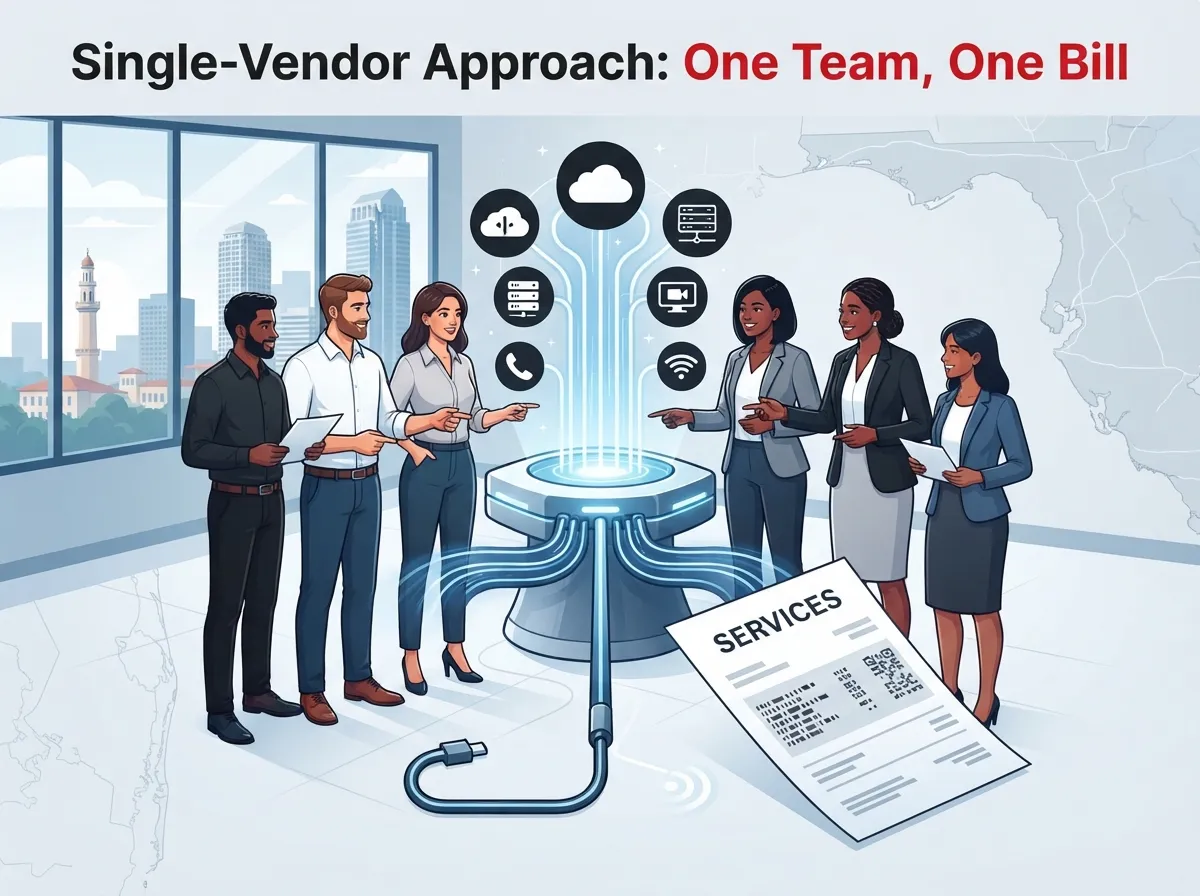
The Single-Vendor Approach: One Team, One Bill
With a single-vendor approach, one company manages most or all of your telecom needs. In practice, that often means a trusted partner who coordinates carriers for you.
Where It Shines
- One point of contact: You call one number when something goes wrong.
- Simpler billing: Fewer invoices means fewer surprises.
- Better planning: Phones, internet, and cabling are designed to fit together.
- Less finger-pointing: One team owns the whole problem.
Where It Can Struggle
- You may depend on one company’s strengths and weaknesses.
- Some single carriers cannot serve every address or every need.
- Bundles can lock you into long contracts if you are not careful.
This approach works especially well for office managers and small business owners who do not have time to manage many vendors. If you want to see how this works in real life, read about why one telecom partner can simplify things in Tampa.
The Multi-Vendor Approach: Pick the Best Piece for Each Job
With a multi-vendor approach, you choose a different company for each service. One provider might handle internet. Another handles phones. A third installs security gear.
Where It Shines
- Best-in-class picks: You can choose a specialist for each service.
- More negotiation power: Each contract stands alone.
- Flexibility: You can swap one piece without touching the rest.
Where It Can Struggle
- More work: Someone must manage every vendor, renewal, and invoice.
- Slower fixes: When voice quality drops, is it the phone vendor or the internet vendor?
- Hidden gaps: Cabling and network design can fall through the cracks.
This path can suit a strong in-house IT team. If you have one, compare the trade-offs in in-house IT vs. a network solutions provider.
Side-by-Side Comparison
Here is a quick look at how the two approaches stack up for most Tampa businesses.
| Factor | Single Vendor / One Partner | Multi-Vendor |
|---|---|---|
| Support | One call covers everything | Multiple support lines |
| Billing | Often consolidated | Many separate invoices |
| Flexibility | Depends on partner’s network of suppliers | High, but requires management |
| Time Required | Low | High |
| Risk of Blame Games | Low | Higher |
| Best For | Small and mid-sized teams, franchises | Companies with strong in-house IT |
Notice something? The best single-vendor option is often a partner who works with many carriers behind the scenes. You get choice and simplicity together.
What Carriers Offer in Tampa (And Why Your Address Matters)
Tampa has a mix of national carriers and fiber specialists. Based on provider pages and market listings, options include AT&T Business, Spectrum Business, Frontier, Verizon Business, and metro fiber providers like FiberLight.
Here are a few provider-advertised details to keep in mind:
- AT&T advertises Business Fiber with speeds up to 5 Gbps where available, and business internet pricing starting at $40 per month. Offers can change, so confirm directly.
- Spectrum advertises plans with 500 Mbps internet and promotional pricing starting at $50 per month for one year, plus business phone with more than 35 calling features.
- Frontier advertises business fiber in select Tampa locations. Speeds depend on address and network conditions.
- FiberLight describes metro fiber for enterprise needs like cloud access and data transport. Custom quotes and site surveys are common.
Remember, these are advertised maximums, not guarantees. Spectrum also notes that its network is fiber-fed but may use coaxial cable for the final connection. So ask what technology reaches your building. For a deeper look, see fiber vs. cable business internet in Tampa.
Five Questions That Help You Choose
Not sure which path fits? Walk through these steps in order.
- Count your locations. Multi-site and franchise operators often benefit from one coordinator who can standardize setups.
- Check your in-house IT capacity. If nobody has time to chase vendors, lean toward one partner.
- List must-have services. Phones, internet, cabling, cameras, and door access all need to work together.
- Verify address-level availability. Ask for written confirmation of what can be delivered at each site.
- Review contract terms. Look at length, installation fees, and what happens if service falls short.
What to Compare Before You Sign Anything
No matter which route you pick, compare these items carefully:
- Upload and download speeds: Video calls and cloud tools lean heavily on upload.
- Service-level commitments: Ask about uptime promises and repair response times.
- Static IP needs: Some phone and security setups need them.
- Backup connectivity: A wired, cellular, or satellite failover can save a bad day.
- Number porting support: You should be able to keep your phone numbers.
- Total cost: Include installation, equipment, and taxes, not just the monthly price.
Money matters, of course. If you want to avoid common slip-ups, peek at 12 business internet cost mistakes Tampa owners make in 2026.
Do Not Forget the Wiring Behind the Walls
Here is a secret many owners learn the hard way. Even the best internet plan will disappoint if your cabling is old or messy. Phones, cameras, and computers all depend on clean, well-planned wiring. Good structured cabling gives you a neat, organized base that grows with your business.
It also helps your phones and cameras perform better. See how structured cabling supports VoIP and cameras, or read about professional structured cabling services for Tampa businesses. A single vendor who plans cabling, internet, and phones together can avoid a lot of rework.
How Different Businesses Should Think About It
Small Business Owners and Office Managers
Your time is precious. A single partner who handles phones, internet, and wiring will usually save you hours and stress. Start with how to choose the right phone system for a small business.
Mid-Sized Enterprises and IT Managers
You may want deeper control over network design, security, and access. A coordinated partner can still help by comparing carriers and managing installs, while your team keeps the strategy. Check out telecom broker vs. direct provider for Tampa businesses for another angle.
Franchise Operators
Consistency is gold. Using the same phone platform, network design, and security setup across sites makes training and support much easier. Scalable cloud tools are a big plus.
Why a Coordinating Partner Often Wins
For many Tampa businesses, the sweet spot is a partner that sits between you and the carriers. Ideal Solutions Provider works this way. With over 24 years of experience and relationships with 35+ vetted suppliers, the team compares options, audits current setups, and handles consultation, installation, and ongoing support. These are company-reported figures, so always ask questions and request references before you commit.
The big benefit is balance. You get the choice of a multi-vendor world with the simplicity of one contact. If you are curious how cost savings can happen, read is your Tampa business overpaying for telecom services? You can also see the company’s range of business high speed internet services and cloud based phone systems.
Plan for Downtime Before It Happens
Every business hits an outage eventually. The smart move is to plan ahead. If downtime would cost you real money, add a secondary connection, such as a second wired line or a cellular backup. Cloud phones can also forward calls to mobile devices when the office goes dark.
Cameras and door systems deserve the same thought. Learn how to keep security cameras working during internet outages. A little planning today means fewer panicked calls tomorrow.
Bottom Line: Which Wins?
For most small and mid-sized Tampa businesses, a coordinated single-partner approach wins on time, support, and peace of mind. Multi-vendor setups can work well if you have the staff to manage them. Either way, verify availability at your exact address, compare real costs, and plan for backup.
Ready to see what is possible for your location? Contact us for a free review of your current setup, or call us to talk it through with a friendly expert. Follow along on YouTube for more tips, too.
FAQs
Q: Which business internet providers serve my Tampa address?
A: It depends on your exact address. National carriers and fiber specialists advertise service in Tampa, but coverage, speeds, and technology vary block by block. The best move is to request written availability for each location before you sign.
Q: What is the difference between business fiber, cable, and dedicated internet in Tampa?
A: Fiber uses light signals over glass lines and often offers faster, more even speeds. Cable shares a neighborhood network and may use coaxial wiring for the last stretch. Dedicated internet gives you a private connection with committed speeds, which is great for heavy or critical use.
Q: Can I bundle business internet and phone service in Tampa?
A: Yes! Many carriers and telecom partners offer bundles that combine internet and voice. Bundles can simplify billing and support, but check contract length, equipment fees, and whether the phone system fits your needs.
Q: How can a Tampa business add backup internet?
A: You can add a second wired line, a cellular failover, or even satellite for extra safety. Cloud phones can also forward calls to mobile devices during outages. If downtime costs you money, a backup connection is a smart investment.
Q: What should I compare when choosing a telecom provider for multiple locations?
A: Compare upload and download speeds, service-level commitments, repair response times, static IP needs, and contract terms. Also confirm what can be delivered at each address and whether one partner can standardize setups across all your sites.