

Key Takeaways
-
Advertised availability is not the same as confirmed serviceability—always verify your exact address and building eligibility with providers before committing, as coverage gaps can be significant even within the same city.
-
Tampa telecom partners fall into three distinct categories (carriers, integrators, and advisors), each solving different problems, and many businesses benefit from working with one partner who coordinates across all three.
-
Compare telecom providers on service-level commitments, symmetrical speeds, failover options, security, and support hours—not just price, as the cheapest plan often becomes expensive if it fails when you need it.
-
Internet availability is highly address-specific; Spectrum and Frontier have dramatically different coverage depending on location, so neighborhood estimates (99% vs 32%) do not guarantee your building's access.
-
Structured cabling is a critical foundation for modern business communications; organizing wiring upfront enables faster upgrades, reduces troubleshooting time, and supports VoIP, video calls, and security systems.
-
Cloud-based phone systems offer multi-location franchises significant advantages like unified dashboards and simpler employee management, but only work well when paired with quality internet and cabling infrastructure.
Picking a telecom partner for your business can feel like wandering through a maze. Every company says it is the best. Every website promises speed and savings. So how do you find the right fit?
If you have ever searched for a local telecom company in Tampa, you probably noticed something odd. The results mix big carriers, local phone-system installers, and independent advisors. They all sound alike, but they work in very different ways.
Here is the good news. Once you understand the differences, choosing gets much easier. This friendly guide explains what a local telecom company in Tampa really is, what services you can expect, and what to ask before you sign anything. Whether you run a small shop, manage an office, or oversee several franchise sites, you will leave with a clear plan.

What Does a Local Telecom Company in Tampa Actually Do?
The phrase “local telecom company” can mean three different things for a business buyer. Knowing which one you are talking to saves a lot of confusion later.
- A carrier: This company sells connectivity directly to you. It may own the network that brings internet or phone service to your building.
- An integrator: This is a local firm that designs, installs, and supports your phone system, cabling, and networking.
- An independent advisor: This partner compares offers from many carriers and helps you pick the best fit. It does not own the network.
None of these is automatically better. They simply solve different problems. A carrier owns the pipes. An integrator builds what happens inside your walls. An advisor helps you shop wisely. Many Tampa businesses end up needing a mix of all three, which is why a single point of contact can be so helpful.
If you want a deeper look at the broker model, our guide to a telecom broker vs. direct provider breaks it down in plain English.
What Services Can Tampa Businesses Get From a Telecom Partner?
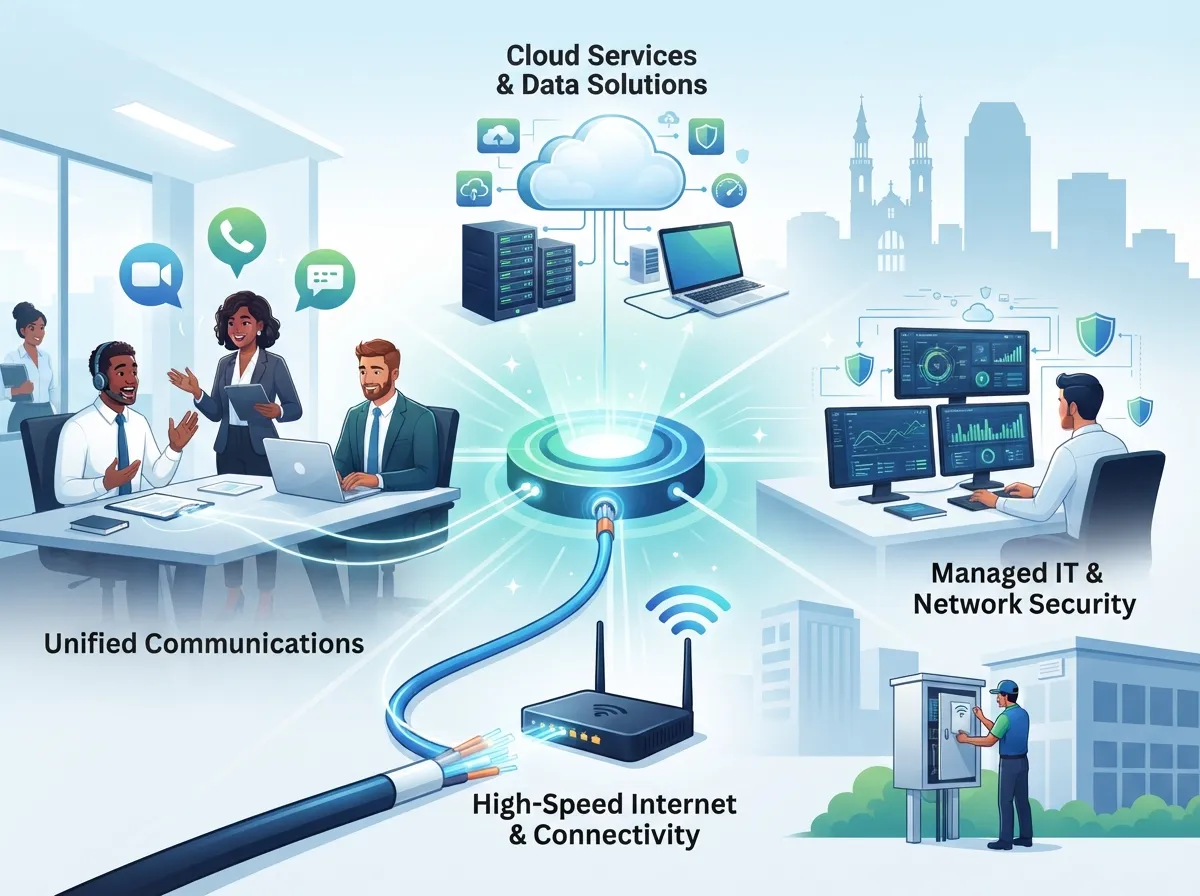
The Tampa market offers a wide menu of business communications services. Not every company sells all of them, so it helps to know what is out there.
- Business internet: Fiber and cable plans, plus dedicated internet for companies that cannot afford slowdowns.
- Voice and VoIP: Hosted PBX and cloud phone systems that replace old desk phones and landlines.
- Unified communications: Calling, messaging, and video meetings in one place.
- Structured cabling: The organized wiring behind your phones, computers, and cameras.
- Networking: Wi-Fi, switches, SD-WAN, and managed network services.
- Security systems: Cloud video cameras and access control for doors.
- Managed IT and cybersecurity: Ongoing support and protection.
In some larger projects, you may even need cellular or public-safety distributed antenna systems (DAS). That is less common, but it shows how broad the field really is.
Many owners find it easier to work with one partner for all of this. You can read more about that approach in 11 reasons to use one telecom partner in Tampa FL.
Which Tampa Business Internet Providers Are Available?
Let us talk about internet, since it is the backbone of everything else. Tampa has a healthy number of options. One third-party comparison page, dated 2026, lists 12 business internet providers in the city. Treat that number as a snapshot, since it can change.
Two names come up often: Spectrum Business and Frontier. Here is a quick look at what each advertises.
| Provider | What It Advertises in Tampa | Good to Know |
|---|---|---|
| Spectrum Business | Fiber-powered internet and business phone bundles, with features like call forwarding and voicemail | The network uses fiber, but coaxial cable may connect to your premises. “Fiber-powered” does not always mean fiber to your door. |
| Frontier | Business fiber, networking, and integrated voice and data, including a unified communications option with RingCentral | Products and speeds depend on your location and eligibility. |
You may also see promotional pricing. For example, Spectrum advertises an online-exclusive internet-only offer starting at $50 per month for one year with a 500 Mbps plan. It also lists internet-and-phone bundles starting at $70 per month for one year. These offers come with terms, taxes, fees, and availability limits, so always confirm the details with the provider.
For a closer comparison, take a look at fiber vs. cable business internet in Tampa.
Why Does Your Exact Address Matter So Much?
Here is a lesson many business owners learn the hard way. Internet availability is address-specific. A provider may advertise citywide coverage or a top speed. That still does not mean your particular office can order it.
Third-party estimates show how wide the gaps can be. One comparison page reports Spectrum Business availability of 99.1% in Tampa and Frontier Business at 32.1%. A separate Downtown Tampa comparison, citing FCC Broadband Data Collection data as of June 30, 2025, reports 8 business internet providers in that neighborhood, with Spectrum at 95.8% and Frontier at 49.5%.
These numbers are helpful for a general picture. They are not a promise for your building. Neighborhood estimates are not the same as an address check.
Before you get excited about any plan, verify these items:
- Your exact service address, including suite number.
- Whether the building allows new carriers to enter.
- Installation requirements and any construction charges.
- Realistic installation timelines.
Think of it like a restaurant menu. Just because a dish is listed does not mean the kitchen can make it tonight. A good local partner checks serviceability first, so you do not waste weeks on a plan that is not actually available.
What Is the Difference Between Advertised Availability and Confirmed Serviceability?
This is a big one, so it deserves its own moment. Advertised availability means a provider says it serves your area. Confirmed serviceability means the provider has checked your exact address and can actually deliver.
An independent advisor or integrator can often confirm serviceability across several carriers at once. That saves you from calling five companies and getting five different answers. It also helps you compare fiber, cable, and dedicated options side by side.
If you are curious about your options at the high end, read dedicated vs. shared fiber for Tampa businesses.
How Do You Compare Telecom Providers Beyond Price?
A low monthly price looks great on paper. But the cheapest plan can become the most expensive one if it fails when you need it. Smart buyers look at the whole picture.
Here is a simple checklist to use when you compare vendors:
- Service-level commitments: What uptime and repair targets are promised in writing?
- Symmetrical speeds: Are upload and download speeds the same? This matters for video calls and cloud backups.
- Static IP needs: Do you run servers, cameras, or remote access tools that need a fixed address?
- Failover options: Is there a backup connection if the main line goes down?
- Security: What protections come with the service?
- Number porting: Can you keep your existing phone numbers?
- Emergency calling: Does the phone service handle 911 properly, including location details?
- Contract and renewal terms: Watch for auto-renewals and early termination fees.
- Installation costs: Are they included or extra?
- Support hours: Is help available when your business is open?
- Responsibility with third parties: If another carrier is involved, who owns the problem?
That last point is easy to overlook. When a local company resells or coordinates another carrier’s service, you need to know who answers the phone when something breaks. A clear answer is a good sign.
If you want help sorting through offers, how to compare business internet providers in Tampa is a handy next read.
How Much Does Business Telecom Cost in Tampa?
This is the question everyone asks, and the honest answer is: it depends. Pricing changes with the provider, the speed, the contract length, and your location. Promotions come and go. Taxes and fees add up.
Frontier, for example, promotes business fiber and integrated voice and data solutions in Tampa, but it does not publish one universal price or speed for every location. That is normal. Real quotes depend on your address and needs.
Here are a few factors that move the price:
- Internet speed and whether it is shared or dedicated.
- The number of phone users and the features you need.
- Cabling work required for a new or older building.
- Contract length and any promotional discounts.
- Extras such as backup connections and managed support.
The smartest move is to ask for itemized quotes and compare them line by line. To dig into the cost side, try how much a VoIP phone system costs for a business in Tampa. And if you suspect you are paying too much already, see whether your Tampa business is overpaying for telecom services.
Should You Choose Fiber, Cable, or Dedicated Internet?
Each option fits a different kind of business. Here is a simple way to think about it.
| Option | Best For | Watch Out For |
|---|---|---|
| Cable | Small offices with everyday needs and tight budgets | Speeds are often shared, and uploads may be slower |
| Fiber | Growing teams that use cloud tools, video calls, and VoIP | Availability depends on your address |
| Dedicated internet | Companies that need guaranteed performance and strong service levels | Higher cost and longer installation |
There is no single winner. A five-person office may do great on cable. A medical practice or multi-location franchise may need fiber or dedicated service for reliability. When in doubt, ask for a side-by-side comparison from a partner who is not tied to one carrier. For more detail, check out how to choose the right fiber internet for your business.
What Phone Systems and VoIP Options Do Tampa Businesses Have?
Many Tampa businesses are moving away from old phone lines and toward cloud-based phones. Hosted PBX and VoIP let your team make and take calls using the internet. They often include voicemail, call forwarding, mobile apps, and easy add-ons for new employees.
For multi-location franchise operators, cloud phones can be a real time saver. You can manage several sites from one dashboard instead of juggling separate systems. For office managers, it often means fewer service calls and simpler changes.
One important tip: your phones are only as good as your network. Poor cabling or weak internet can cause choppy calls. That is why it pays to think about phones, internet, and cabling together. Our article on how structured cabling supports VoIP and cameras explains the connection nicely.
Curious about the cloud route? Start with what a cloud-based phone system is and whether you need one. Then, when you are ready to evaluate vendors, how to choose cloud-based phone system providers in Tampa FL will walk you through it.
Why Does Structured Cabling Deserve Your Attention?
Cabling is the unglamorous hero of business telecom. You rarely see it, but everything depends on it. Good structured cabling keeps wires organized, labeled, and ready to grow with you.
Messy, ad-hoc wiring causes dropped connections, slow speeds, and long troubleshooting sessions. A clean, standards-based setup makes upgrades faster and cheaper later. If you are building out a new office or refreshing an old one, plan your cabling early. It pairs well with our guide on professional structured cabling services for Tampa businesses.
How Do You Know a Local Telecom Company Is the Right Fit?
Trust your gut, but back it up with questions. A good partner will welcome them. Here are some things to look for:
- Clear explanations. They talk in plain language and do not hide behind jargon.
- Honest comparisons. They show you more than one option and explain the tradeoffs.
- Address-level checks. They confirm what is truly available at your location.
- Transparent pricing. You can see installation costs, fees, and renewal terms up front.
- Ongoing support. Help does not vanish after installation day.
- Verified claims. Provider descriptions on directories are often company claims, so check references and reviews yourself.
Tampa has plenty of local and regional firms that handle phone systems, hosted PBX, cabling, and support. Directory listings can be a starting point, but do your homework. Ask for references from businesses like yours. For a handy list of what to ask, see what to look for in a business telecom provider in Tampa FL.
Where Does Ideal Solutions Provider Fit In?
If you like the idea of one friendly point of contact, that is exactly what Ideal Solutions Provider offers. We are a Tampa-based telecom and IT partner with over 24 years of experience. Instead of selling one carrier’s products, we work with more than 35 vetted suppliers, so we can compare options for you.
We help with cloud phone systems, high-speed internet, structured cabling, networking, cloud video security, and cloud access control. We handle everything from the first consultation to installation and ongoing support. And while we are based in Tampa Bay, we serve businesses nationwide, which is great news for franchise operators with sites in several states.
We also offer free consultations to review your current setup and look for savings. Many businesses we audit are overpaying, underperforming, or both. Sometimes a quick look is all it takes to fix that. You can also see what we are up to on YouTube or follow along on Facebook.
Your Next Step: Make a Simple Plan
Choosing a local telecom company in Tampa does not have to be stressful. Start by deciding what you need: faster internet, a modern phone system, better cabling, or all of the above. Then confirm what is truly available at your address, compare more than price, and ask plenty of questions.
Remember the big ideas. Know whether you are talking to a carrier, an integrator, or an advisor. Check serviceability, not just advertising. Look closely at service levels, contract terms, and support. And do not be shy about asking for help.
Ready to take the stress out of your telecom decisions? Contact us for a free consultation, or call us today. We would love to help your Tampa business stay connected, protected, and running smoothly.
FAQs
Q: What local telecom companies serve businesses in Tampa, Florida?
A: Tampa businesses can choose from national carriers like Spectrum Business and Frontier, local and regional phone and cabling firms, and independent advisors like Ideal Solutions Provider that compare many carriers at once. The best fit depends on your address and needs, so always verify availability first.
Q: What is the difference between a telecom carrier and a telecom advisor?
A: A carrier owns or operates the network and sells you service directly. An advisor does not own the network. Instead, it compares offers from several carriers and helps you pick the best one, often handling installation and support too.
Q: How much does business internet and phone service cost in Tampa?
A: Prices vary by provider, speed, contract length, and location. Some carriers advertise introductory internet plans around $50 per month and bundles around $70 per month, but promotions, taxes, and fees change. Ask for an itemized quote for your exact address.
Q: Should a Tampa business choose fiber, cable, or dedicated internet?
A: Cable often suits small offices with basic needs and tight budgets. Fiber works well for growing teams using cloud tools and VoIP, while dedicated internet is best when you need guaranteed performance and strong service commitments.
Q: Can one Tampa telecom provider bundle internet, phones, and cabling?
A: Yes, many can. A single partner can coordinate internet, cloud phones, structured cabling, networking, and security systems, which means fewer vendors to manage and one number to call when you need help.