

Key Takeaways
-
Fiber offers symmetrical upload and download speeds (matching speeds), while cable broadband is asymmetrical with much slower uploads—critical for businesses using cloud apps, file transfers, and video calls.
-
Fiber delivers superior reliability with consistent performance and lower latency (under 10ms vs. 15-40ms on cable), especially during peak hours when cable speeds often degrade due to shared infrastructure.
-
Fiber infrastructure is highly scalable and can upgrade to 100+ Gbps without equipment replacement, while cable broadband has infrastructure limits that make future upgrades expensive and difficult.
-
Fiber availability in Tampa is limited (1.2-31.4% coverage depending on provider) compared to cable broadband, so check your specific address before choosing—cable may be the only current option in many locations.
-
Fiber costs more upfront but offers better long-term value at higher speeds and eliminates downtime costs; cable broadband is budget-friendly initially but may cost more in lost productivity from slowdowns and reliability issues.
-
Tampa businesses with 10+ employees, cloud-heavy operations, VoIP systems, video conferencing, or security camera streams significantly benefit from fiber’s symmetrical speeds and dedicated bandwidth options.
If you’ve ever asked yourself, “What is the difference between fiber and broadband internet for businesses in Tampa?” — you’re not alone. It’s one of the most common questions we hear from business owners, IT managers, and office admins trying to make smart decisions about their connectivity. And honestly, the confusion makes total sense. These terms get used interchangeably all the time, even by providers who should know better.
Here’s the quick answer: broadband is an umbrella term for any high-speed internet connection. Fiber is one specific type of broadband that uses light signals through fiber-optic cables. So all fiber is broadband, but not all broadband is fiber. Think of it like cars and SUVs — all SUVs are cars, but not all cars are SUVs.
In Tampa’s competitive business landscape, the type of internet you choose can affect everything from your VoIP call quality to your cloud backups and video meetings. Let’s break down the 9 key differences so you can make a confident, informed decision.

What Does Broadband Actually Mean for Tampa Businesses?
Before we dive into the differences, it helps to know what we’re comparing. According to the Internet Service Provider industry, broadband simply means high-speed internet that’s always on. It includes several technologies:
- Fiber-optic internet — uses light through glass or plastic cables
- Cable broadband — uses the same coaxial cable as TV service
- DSL (Digital Subscriber Line) — uses copper phone lines
- Fixed wireless — transmits signal over radio waves
- Satellite internet — delivers signal from orbiting satellites
When Tampa business owners say “broadband,” they often mean cable or DSL — the older, more widely available options. Fiber is a newer, premium tier within the broadband family. Now let’s look at how they stack up.
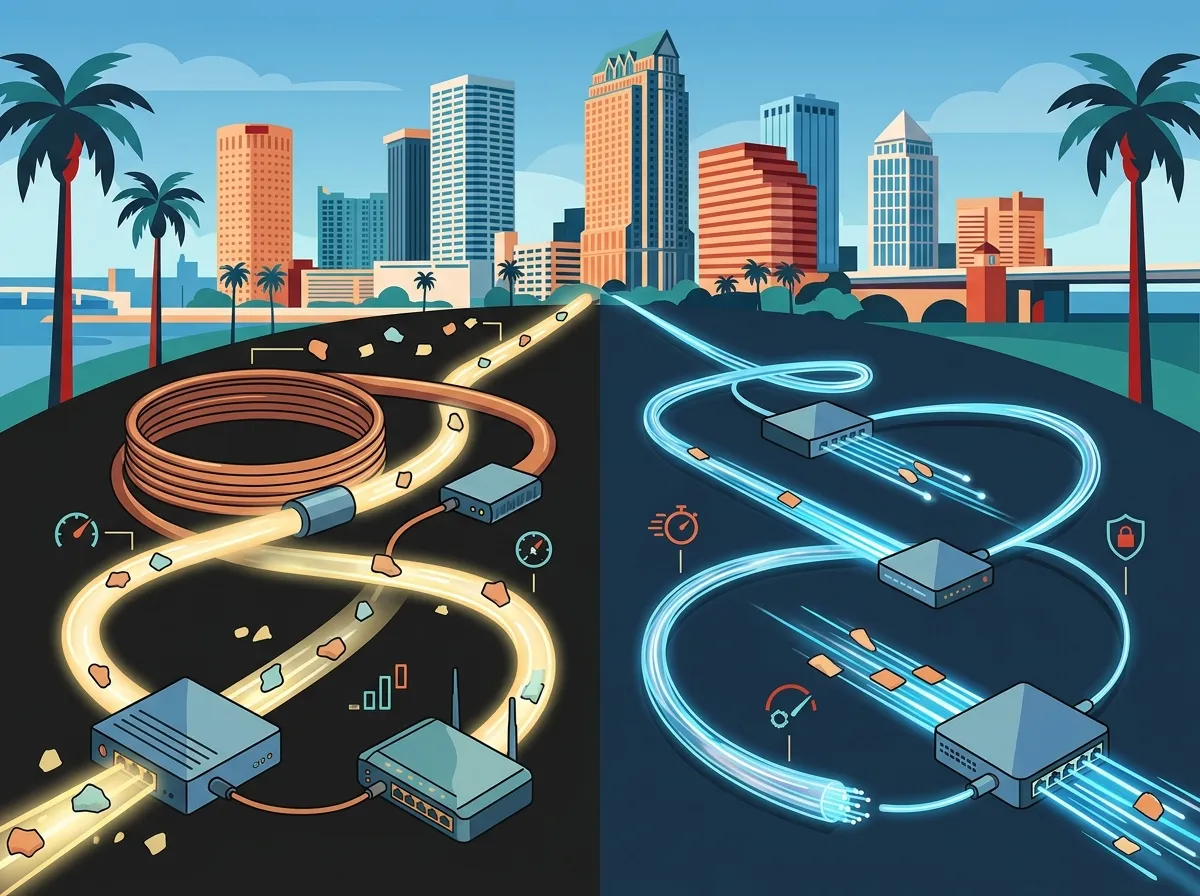
9 Key Differences Between Fiber and Broadband Internet for Tampa Businesses
1. How the Signal Travels
Fiber uses light pulses sent through thin glass or plastic cables. Traditional broadband (cable or DSL) uses electrical signals through copper wiring. Light travels faster and degrades less over distance. That’s a big deal for Tampa businesses spread across large office buildings or campuses.
2. Upload vs. Download Speeds
This is one of the biggest practical differences. Fiber plans often offer symmetrical speeds — meaning your upload speed matches your download speed. Most cable broadband plans are asymmetrical, offering fast downloads but much slower uploads.
Why does this matter? If your team uses cloud apps, sends large files, or runs video calls, you need strong upload speeds. Check out our guide on 13 High-Speed Internet for Business Tips That Save Money for more insight on how speed choices affect your bottom line.
| Connection Type | Typical Download Speed | Typical Upload Speed | Symmetrical? |
|---|---|---|---|
| Fiber (Business) | 200 Mbps – 10 Gbps+ | 200 Mbps – 10 Gbps+ | Yes |
| Cable Broadband | 100 Mbps – 1 Gbps | 10 Mbps – 50 Mbps | No |
| DSL | 1 Mbps – 100 Mbps | 1 Mbps – 20 Mbps | No |
| Fixed Wireless | 25 Mbps – 300 Mbps | 5 Mbps – 100 Mbps | Rarely |
3. Reliability and Consistency
Fiber signals don’t degrade over distance the way copper-based broadband does. Fiber also isn’t affected by electromagnetic interference or network congestion as heavily. For Tampa businesses that depend on steady connectivity, fiber usually wins in day-to-day reliability.
Cable broadband is shared infrastructure. During peak hours — think 9 AM Monday mornings — speeds can slow significantly. Fiber dedicated circuits maintain consistent performance around the clock.
4. Latency (Lag Time)
Latency is the delay between sending and receiving data. Low latency is critical for cloud-based phone systems, video conferencing, and real-time cloud applications. Fiber internet typically delivers latency under 10 milliseconds. Cable broadband can range from 15 to 40+ milliseconds. That difference is small in theory, but noticeable in a busy office environment.
5. Scalability
Growing businesses in Tampa need internet that can grow with them. Fiber infrastructure is built to scale. Providers can often upgrade your speeds without replacing physical equipment. Enterprise fiber networks can scale up to 100 Gbps in some cases.
Cable broadband has a ceiling. Once you hit the limits of the local coaxial infrastructure, upgrading becomes harder and more expensive. For franchise operators or mid-sized companies planning to expand, this matters a lot. Learn more about scalable solutions at our Business Network Solutions page.
6. Availability Across Tampa
Here’s the honest reality: fiber isn’t available everywhere in Tampa just yet. Cable broadband covers a much larger share of the market today.
| Provider | Type | Tampa Coverage | Max Speed |
|---|---|---|---|
| Frontier Business | Fiber | ~31.4% of locations | Up to 6,712 Mbps |
| Spectrum Business | Fiber/Cable | ~20.7% fiber coverage | Up to 1,000 Mbps (fiber) |
| AT&T Business Fiber | Fiber | ~1.2% of locations | Up to 5 Gbps |
| Open Infra | Fiber | ~3.7% of locations | Up to 8,000 Mbps |
Availability is highly location-dependent. Your building, neighborhood, and provider infrastructure all play a role. If fiber isn’t available at your specific address, a quality cable broadband or fixed wireless solution may be the best alternative for now. Our blog post on How to Find Affordable Business Broadband Service in Tampa FL can help you explore your options.
7. Cost Differences
Fiber business internet generally costs more than standard cable broadband. However, the gap is narrowing as fiber infrastructure expands. Entry-level business fiber plans can start around $40–$80 per month for lower-tier speeds, while enterprise fiber circuits can run several hundred dollars monthly depending on speed and contract terms.
- Cable broadband is often the more budget-friendly option upfront
- Fiber offers better value per Mbps at higher speed tiers
- Dedicated fiber (vs. shared) costs more but delivers guaranteed performance
- Long-term costs of downtime and slow speeds should factor into your decision
For a deep dive into comparing provider pricing, visit our resource on How Do You Compare Business Internet Providers in Tampa Florida?
8. Dedicated vs. Shared Access
This is closely related to the fiber vs. broadband conversation. Most cable broadband is shared — your bandwidth is split with neighboring businesses. Fiber can be either shared or dedicated.
Dedicated fiber means your business gets its own reserved bandwidth. No sharing. No slowdowns. This is ideal for healthcare practices, law firms, financial offices, and any business handling sensitive data or real-time communication. Read more on this topic in our article about Dedicated vs. Shared Fiber: Which Is Right for Tampa Businesses?
9. Impact on Business Applications
The type of internet you choose directly affects your daily business tools. Here’s how fiber and broadband compare across common Tampa business applications:
| Business Application | Fiber Performance | Cable Broadband Performance |
|---|---|---|
| VoIP Phone Calls | Excellent — low latency | Good — may degrade at peak hours |
| Video Conferencing | Excellent — symmetrical speeds | Fair — slow upload can hurt quality |
| Cloud App Access | Excellent — consistent speeds | Good — occasional slowdowns |
| Large File Transfers | Excellent — fast uploads | Poor — upload bottleneck common |
| Cloud Backups | Excellent — runs in background | Fair — may slow other activity |
| Security Camera Streams | Excellent — handles multiple feeds | Fair — bandwidth may be stretched |
If your business relies on cloud video security cameras or cloud-based access control systems, fiber internet gives you the bandwidth and consistency those systems need to run without interruptions.

How to Decide: Fiber or Broadband for Your Tampa Business?
The right choice depends on your specific needs. Here’s a simple framework to help you decide:
- Count your users: More employees mean more bandwidth demand. Fiber handles scale better.
- Audit your apps: Heavy cloud usage, VoIP, and video calls favor fiber’s symmetrical speeds.
- Check availability: Not all Tampa locations have fiber yet. Know what’s actually accessible at your address.
- Set your budget: Cable broadband may be the right short-term solution while fiber infrastructure expands nearby.
- Think about growth: If you’re planning to add staff, open new locations, or upgrade technology, fiber is the more future-proof investment.
Still not sure? Our friends at Ideal Solutions Provider’s Business High Speed Internet Services page lays out exactly what options are available for Tampa businesses of every size. With partnerships across 35+ vetted suppliers, they compare options side-by-side so you don’t have to do it alone.
For a broader overview of available options in the area, check out this helpful overview of the 7 Best Business High Speed Internet Services in Tampa FL.

Do Tampa Businesses Really Need Fiber?
Not every business needs fiber — but more and more businesses do. Here are the signs fiber is the right upgrade for your Tampa operation:
- Your team regularly experiences dropped VoIP calls or choppy video meetings
- Cloud backups are slowing down your network during business hours
- You have 10 or more employees sharing the same internet connection
- Your business handles sensitive data and needs consistent, reliable performance
- You’re running cloud security cameras or access control systems that stream continuously
- You’re planning to grow your team or add new locations soon
The good news? Tampa’s fiber infrastructure is expanding. Providers are actively building out networks across the metro area. If fiber isn’t available at your address today, it may be soon. In the meantime, exploring which business internet service providers in Tampa Florida offer the best cable or hybrid solutions is a smart move.
It also helps to understand how your internet connects to the rest of your network. Proper structured cabling services ensure that even the fastest fiber connection performs at its best inside your building. Poor internal cabling is one of the most overlooked bottlenecks in business networks — and it’s completely avoidable. You can learn more about what structured cabling involves on Wikipedia’s structured cabling overview.
A Note on Dedicated Internet Access
You may also hear the term Dedicated Internet Access (DIA) when shopping for business internet in Tampa. DIA is a type of fiber service where bandwidth is reserved exclusively for your business. It’s not shared with anyone else. This is different from a standard fiber broadband plan, which may still use shared infrastructure.
DIA is typically used by larger businesses, data-heavy operations, and companies with strict uptime requirements. Learn more in our dedicated resource: Why Do Tampa Businesses Need Dedicated Fiber Internet?
Conclusion: Making the Right Call for Your Business
Understanding what is the difference between fiber and broadband internet for businesses in Tampa comes down to one core idea: fiber is a specific, premium technology within the broader broadband category. It offers faster speeds, symmetrical uploads and downloads, lower latency, and better scalability. Traditional broadband options like cable or DSL are more widely available and budget-friendly, but they come with trade-offs in performance and consistency.
The best internet solution for your Tampa business depends on your team size, your applications, your location, and your budget. Whether you’re a small business owner upgrading from DSL, an IT manager evaluating enterprise fiber, or a franchise operator rolling out internet across multiple locations — the right answer is out there.
Not sure where to start? Follow Ideal Solutions Provider on Instagram for regular tips and updates on business telecom, or watch helpful explainer content on their YouTube channel. You can also connect with their community on Facebook for local Tampa business insights.
Ready to find the right internet solution for your business? Reach out to our team at Ideal Solutions Provider for a free consultation. With over 24 years of experience and access to 35+ vetted suppliers, we’ll help you compare your options and find the best fit — without the headache of doing it all yourself.
FAQs
Q: Is fiber internet better than cable broadband for businesses in Tampa?
A: For most businesses, yes! Fiber offers faster speeds, symmetrical uploads and downloads, and more consistent performance — especially during busy hours. That said, cable broadband can still be a solid, budget-friendly choice if fiber isn’t yet available at your location.
Q: Which Tampa business internet providers offer true fiber service?
A: Several providers offer fiber options in Tampa, including Frontier Business, Spectrum Business (enterprise fiber), AT&T Business Fiber, and Open Infra. Coverage varies quite a bit by neighborhood and building, so it’s worth checking availability at your specific address before committing.
Q: What business internet speeds do Tampa companies actually need?
A: A good rule of thumb is 25–50 Mbps per active user for typical office tasks. If your team runs video calls, large cloud backups, or VoIP phone systems simultaneously, you’ll want to lean toward 100 Mbps or more — and fiber’s symmetrical speeds make a real difference in those scenarios.
Q: Does fiber internet have better upload speeds than cable broadband?
A: Absolutely — and this is one of the biggest practical differences for businesses. Fiber plans are often symmetrical, meaning upload speeds match download speeds. Cable broadband typically has upload speeds much slower than download speeds, which can bottleneck video calls, cloud backups, and file sharing.
Q: Is dedicated internet access different from standard fiber broadband?
A: Yes, great question! Dedicated Internet Access (DIA) is a fiber-based service where bandwidth is reserved exclusively for your business — no sharing with other customers. Standard fiber broadband plans may still run on shared infrastructure. DIA costs more but delivers guaranteed, consistent performance ideal for data-heavy or high-uptime businesses.