

Key Takeaways
-
VoIP providers cost as low as $15/user/month versus $50-100+ per line for traditional systems, delivering immediate cost savings for most businesses.
-
VoIP enables true remote and hybrid work by allowing employees to make calls from any internet-connected device using their business number anywhere.
-
Modern VoIP includes bundled features like video meetings, SMS, call recording, CRM integrations, and auto-attendants that traditional systems rarely offer without expensive add-ons.
-
Internet quality is critical to VoIP success; ensure your business has reliable, business-grade connectivity before switching to avoid dropped calls and poor audio quality.
-
Avoid choosing VoIP based on price alone; evaluate features, support quality, and reliability (99.99% uptime SLAs) to avoid costly mistakes and ensure your team can effectively use the system.
-
Request a free telecom audit before switching to understand your current overspending, identify must-have features, and compare options across multiple vetted providers for the best fit.
If you’re running a business in 2026, your phone system matters more than ever. Whether you’re a small shop in Tampa or a multi-location franchise, how your team communicates can make or break your day. The big question most business owners face is simple: stick with a traditional phone provider or make the switch to a modern VoIP provider?
This isn’t just a tech debate. It’s about real money, real flexibility, and real results for your business. We’re going to break down both options clearly and honestly so you can make the best decision for your team. By the end, you’ll know exactly what each option offers, what it costs, and which one fits your business best.
Let’s dive in and make this comparison easy to follow. No confusing jargon. Just straight talk about what works.
What Is a VoIP Provider and How Does It Work?
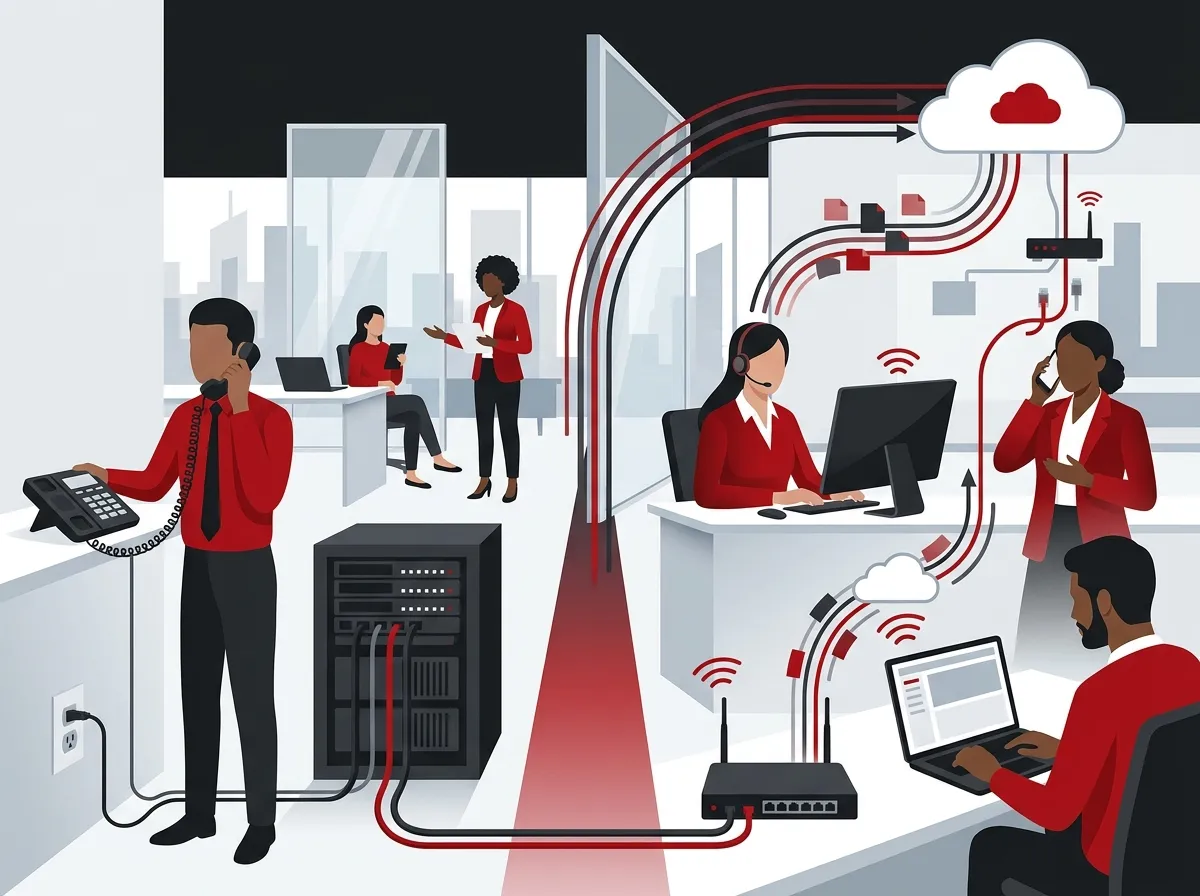
A VoIP provider delivers phone service over your internet connection instead of old copper telephone wires. VoIP stands for Voice over Internet Protocol. Think of it like sending a phone call as data, the same way you send an email.
When you call someone using VoIP, your voice gets converted into digital data packets. Those packets travel over the internet and reassemble on the other end. The result? A clear, reliable phone call without a traditional phone line. You can learn more about how this works by checking out our guide on 6 Key Differences Between VoIP and Traditional Phone Systems.
Modern VoIP services often include much more than just calling. Many providers bundle features like SMS messaging, video meetings, team chat, and CRM integrations into one platform. This is often called UCaaS, or Unified Communications as a Service.

What Is a Traditional Phone Provider?
A traditional phone provider delivers voice service through the public switched telephone network (PSTN). This uses physical copper wire infrastructure that has been in place for decades.
Traditional systems often rely on hardware called a PBX (Private Branch Exchange) installed at your office. Your business pays for a set number of phone lines, and calls travel through those dedicated connections. It’s a system that has worked reliably for many years, but it comes with notable limitations in today’s fast-moving business world.
Side-by-Side Comparison: VoIP vs. Traditional Phone
Here’s a quick look at how these two options stack up across the features that matter most to businesses today.
| Feature | VoIP Provider | Traditional Phone Provider |
|---|---|---|
| Monthly Cost | Starting as low as $15/user/month | Often $50–$100+ per line |
| Installation | Minimal hardware needed | Requires physical PBX hardware |
| Scalability | Add users instantly | Requires new lines and hardware |
| Remote Work Support | Works on any internet-connected device | Limited to desk phones in office |
| Advanced Features | Video, SMS, call routing, CRM integrations | Basic calling, voicemail |
| Reliability | Up to 99.99% uptime with good internet | Reliable but no redundancy options |
| Maintenance | Provider handles updates | You manage on-site hardware |
As you can see, VoIP pulls ahead in most categories that growing businesses care about. If you want a deeper look at the financial side, check out our resource on How Much Does a VoIP Phone System Cost for a Business in Tampa?
Key Benefits of Choosing a VoIP Provider
Switching to a VoIP provider isn’t just about saving money, though that’s certainly a big perk. Here are the top benefits businesses experience after making the switch.
- Lower monthly costs: VoIP plans start as low as $15 per user per month, a fraction of traditional line costs.
- Remote and hybrid work ready: Employees can take calls from laptops, smartphones, tablets, or desktops anywhere they have internet access.
- Scalability made easy: Adding a new team member means adding a new user account, not installing new phone lines.
- Feature-rich communication: Features like voicemail-to-email, call routing, auto-attendants, and video meetings come standard with most plans.
- Simplified management: Most VoIP platforms let IT managers or office managers handle everything from a single online dashboard.
- CRM integrations: Many VoIP providers connect directly with popular CRM and helpdesk tools, saving your team time on every call.
For Tampa businesses thinking about making the jump, our post on 7 Reasons Tampa Businesses Are Switching to VoIP in 2026 covers even more reasons this trend is accelerating.
Where Traditional Phone Still Holds Ground
To be fair, traditional phone systems aren’t without their strengths. Some businesses still prefer the old way for specific reasons.
- No internet dependency: Traditional phones work even during internet outages.
- Familiar technology: Teams accustomed to desk phones may need less training.
- Some compliance settings: Certain regulated industries have historically required landline infrastructure, though this is becoming less common.
- Existing hardware investment: If you’ve already spent heavily on PBX hardware, replacing it immediately may not make financial sense.
That said, these advantages are narrowing every year as VoIP technology improves and internet reliability increases across Tampa Bay and nationwide.
VoIP Provider Features Businesses Love Most
One of the biggest reasons businesses choose a VoIP provider is the sheer number of features included. Here’s a comparison of what you typically get versus what traditional systems offer.
| Feature | Available with VoIP | Available with Traditional |
|---|---|---|
| Auto-Attendant / IVR | ✅ Yes | ⚠️ Sometimes (add-on cost) |
| Voicemail to Email | ✅ Yes | ❌ Rarely |
| Call Recording | ✅ Yes | ⚠️ Requires extra hardware |
| Video Meetings | ✅ Yes (up to 200 participants) | ❌ No |
| SMS / Team Chat | ✅ Yes | ❌ No |
| Mobile App | ✅ Yes | ❌ No |
| CRM Integration | ✅ Yes | ❌ No |
Want to see what features your business really needs? Our guide on 9 VoIP Phone System Features Every Business Needs in 2026 is a great starting point.
How to Choose the Right VoIP Provider for Your Business
Not all VoIP providers are created equal. The right choice depends on your business size, team setup, and budget. Here’s a simple step-by-step process to guide your decision.
- Assess your current setup. Review how many phone lines, users, and locations you have. Understand what features your team actually uses daily.
- Set a clear budget. Determine how much you’re currently spending on phone service and compare it against VoIP pricing. Most businesses see immediate savings.
- List your must-have features. Do you need video meetings? CRM integration? Call recording? Knowing this helps you narrow down providers quickly.
- Check internet readiness. VoIP quality depends on your internet connection. Make sure your bandwidth and network infrastructure can support it. Our post on 13 High-Speed Internet for Business Tips That Save Money can help you evaluate this.
- Ask about support and reliability. Look for providers offering 99.99% uptime SLAs and responsive customer support. Downtime costs you money.
- Consider a local telecom partner. Working with a trusted partner like Ideal Solutions Provider gives you access to 35+ vetted VoIP suppliers side by side, without the sales pressure of going directly to a single carrier.
For a deeper dive into this process, check out How to Choose a Business VoIP Solutions Provider in Tampa.
Common Mistakes Businesses Make When Picking a VoIP Provider
We see businesses make the same avoidable mistakes every week. Here are the top ones to watch out for.
- Choosing based on price alone. The cheapest plan isn’t always the best fit. Low-cost plans may lack critical features or support quality.
- Ignoring internet infrastructure. A great VoIP provider still needs a solid internet connection to perform well. Poor connectivity leads to dropped calls and frustrated customers.
- Not testing before committing. Always ask for a trial period or demo before signing a long-term contract.
- Forgetting to port your existing numbers. You don’t have to lose your business phone number when switching. Learn how to protect it with our guide on How to Keep Your Phone Number When Switching to VoIP in Tampa.
- Skipping employee training. New features are only valuable if your team knows how to use them. Factor in onboarding time when planning your rollout.
Our detailed post on 8 VoIP Provider Mistakes Tampa Businesses Must Avoid covers even more pitfalls worth reading before you commit.
Who Benefits Most from a VoIP Provider?
VoIP is a great fit for a wide range of businesses, but some benefit more than others. Here’s a quick breakdown.
| Business Type | Why VoIP Works Well |
|---|---|
| Small Businesses | Low startup cost, no hardware to manage, easy to scale up |
| Remote / Hybrid Teams | Employees use one number across all devices, anywhere |
| Multi-Location Businesses | One unified platform connects all offices seamlessly |
| Franchise Operators | Standardized system deployed quickly across locations |
| Growing Companies | Add users instantly without new hardware or wiring |
If you’re running multiple locations, our guide on 11 Reliable Network Solutions for Multi-Location Tampa Businesses pairs perfectly with your VoIP planning.
The Role of Internet Quality in VoIP Performance
Your VoIP provider is only as good as your internet connection. This is one of the most important things to understand before switching. A slow or unstable connection can result in choppy audio, dropped calls, and frustrated team members.
Before choosing a VoIP provider, make sure your business internet can handle the load. Business-grade fiber or dedicated circuits offer the best performance. Check out Why Do Tampa Businesses Need Dedicated Fiber Internet? to understand why connection quality matters so much for VoIP.
Also, your office network infrastructure matters. Properly structured cabling ensures that your VoIP phones and connected devices all get the signal quality they need to perform reliably. For more on this connection, explore 13 Ways Structured Cabling Supports VoIP & Cameras.
Making the Switch: What to Expect
Switching from a traditional phone system to a VoIP provider is simpler than most businesses expect. Here’s a general outline of what the process looks like.
- Consultation and audit. A trusted telecom partner reviews your current setup, identifies what you’re overpaying for, and recommends the right VoIP solution.
- Provider selection. You choose a plan that fits your features, budget, and team size after seeing a clear side-by-side comparison.
- Number porting. Your existing business phone numbers are transferred to the new VoIP system without interruption.
- Installation and configuration. Phones, apps, and call routing are set up. For most businesses, this takes less than a day.
- Training and go-live. Your team learns the new system and you go live. Ongoing support keeps everything running smoothly.
For a step-by-step walkthrough, check out 5 Steps to Switch Your Business Phone to the Cloud in Tampa.
You can also follow along with tips and updates from Ideal Solutions Provider on Facebook and Instagram for real business communication advice shared regularly.
The Verdict: Which One Wins?
For the vast majority of businesses in 2026, a modern VoIP provider wins hands down. The cost savings are real. The features are powerful. The flexibility for remote and hybrid teams is unmatched. And the ability to scale without adding physical infrastructure is a game-changer for growing companies.
Traditional phone systems still work, but they’re aging infrastructure. They cost more, do less, and can’t keep up with the way businesses communicate today. For most businesses, sticking with traditional phone service means paying more for less.
The best move? Get a free telecom audit. Find out exactly what you’re paying now, what features you actually need, and which VoIP provider fits your business best. Companies like Ideal Solutions Provider compare options across 35+ vetted suppliers so you always get the best fit, not just the first option presented. You can also explore more on our YouTube channel for helpful videos on business phone systems and telecom solutions.
Ready to stop overpaying and start communicating smarter? Reach out to our team today for a free consultation and see exactly how much your business can save by switching to the right VoIP provider.
FAQs
Q: What is a VoIP provider for business?
A: A business VoIP provider delivers phone service over your internet connection instead of traditional copper phone lines. Most modern VoIP plans include calling, SMS, video meetings, and team chat all in one platform — making it a much more flexible and affordable option than legacy phone systems!
Q: How much does a business VoIP provider cost?
A: Business VoIP plans can start as low as $15 per user per month, which is significantly less than traditional phone line pricing. Your total cost will depend on the number of users, features needed, and the provider you choose — and a telecom audit can help you find the best deal fast.
Q: Is VoIP reliable enough for business phone service?
A: Absolutely! Leading VoIP providers offer uptime SLAs of up to 99.99%, which is on par with or better than traditional phone lines. The key is pairing your VoIP service with a strong, stable business internet connection for the best call quality.
Q: Can a VoIP provider support remote and hybrid teams?
A: Yes, and this is one of VoIP’s biggest advantages! Employees can make and receive calls using their business number from any internet-connected device — laptop, smartphone, tablet, or desktop — no matter where they’re working from.
Q: What is the difference between VoIP and SIP trunking?
A: VoIP is the broader technology that sends voice calls over the internet, while SIP trunking is a specific method used to connect an existing on-premises PBX system to the public phone network via the internet. Many businesses use SIP trunking as a bridge when transitioning away from legacy phone hardware.