

Key Takeaways
-
MPLS offers contracted SLAs for latency, uptime, and QoS, while SD-WAN depends on the quality of underlying links but can reroute traffic away from failing connections in real time.
-
A hybrid design, with SD-WAN managing both MPLS and broadband or cellular links, lets you keep MPLS for critical voice or database traffic while routing less sensitive traffic over cheaper paths.
-
SD-WAN is typically faster to deploy for new locations than waiting on a new MPLS circuit, which matters for businesses that open sites frequently.
-
MPLS does not encrypt data by itself, and SD-WAN encryption and security features vary by vendor, so verify firewalling, encryption, and monitoring rather than assuming they are included.
-
Compare total cost of ownership, including equipment, licensing, security, installation, and support, instead of relying only on the monthly circuit price.
-
Start a move from MPLS to SD-WAN with a pilot site, test voice, video, and key apps, and keep the MPLS circuit active until the new setup is proven.
If you run a business with more than one location, you have probably heard the two big WAN buzzwords: SD-WAN and MPLS. Maybe a vendor told you to “modernize.” Maybe your IT person told you to “keep what works.” Both can be right, and that is exactly why the choice feels confusing. The good news? You do not need an engineering degree to sort it out.
When people compare SD-WAN vs MPLS, they are really asking one question: how should my offices, cloud apps, and phone systems talk to each other? In this friendly guide, we will walk through three practical differences, plus a simple way to decide. We will keep the jargon light and the advice real.
Whether you are a small business owner in Tampa, an IT manager juggling vendors, or a franchise operator with sites across the country, you will find something useful here. Let’s dive in.
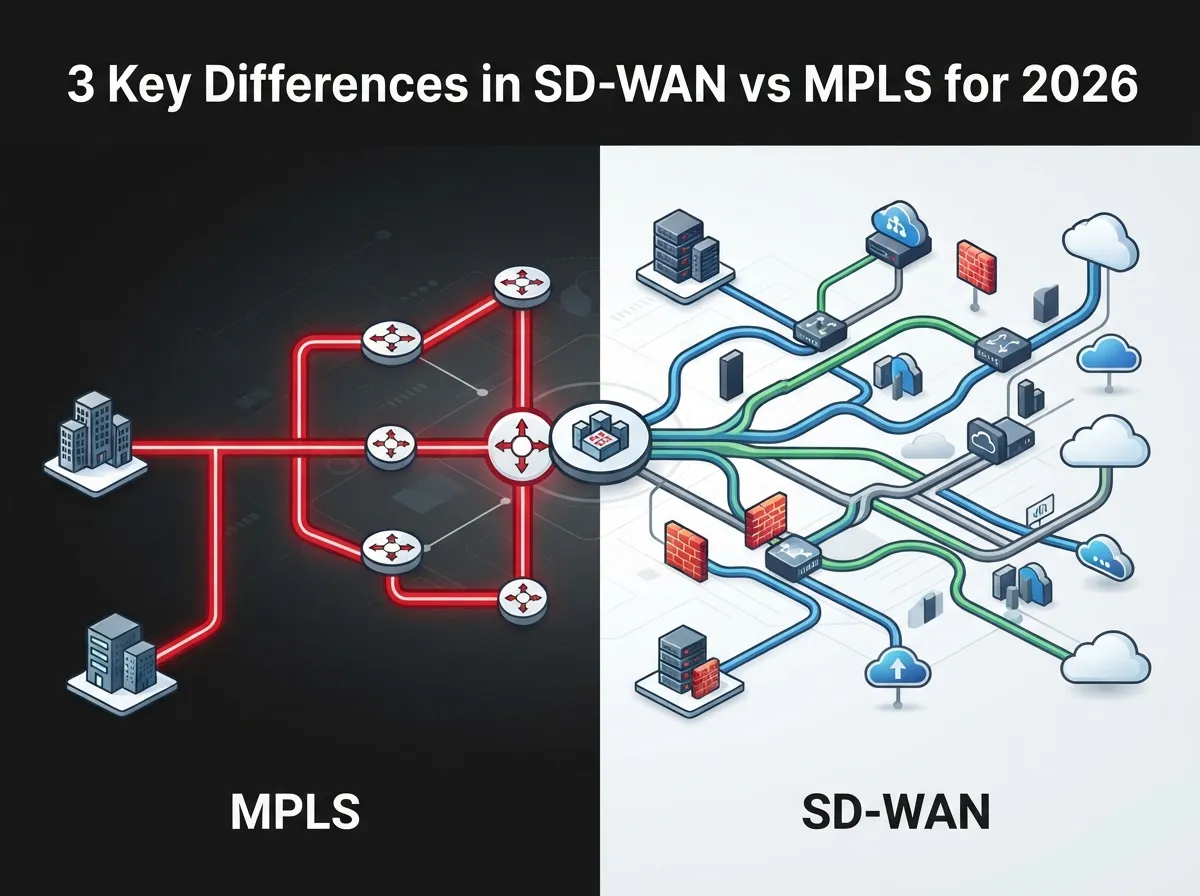
What Are MPLS and SD-WAN, in Plain English?
Before we compare, let’s get the basics straight. Think of this as the quick “who’s who” before the main event.
MPLS in a Nutshell
MPLS stands for Multiprotocol Label Switching. It is a carrier-provided network that sends your traffic along engineered, pre-set paths. Because the provider controls the route, they can offer service-level agreements (SLAs) for things like uptime, latency, and quality of service (QoS). If you want to dig deeper, we cover it in What Is MPLS and How Does It Work for Business?
SD-WAN in a Nutshell
SD-WAN is a software-defined layer that sits on top of your connections. It can manage broadband, dedicated internet, cellular, and even MPLS links at the same time. Then it picks the best path for each app based on live conditions and your business rules. For a deeper look, see What Are SD-WAN Services and Does Your Business Need Them?
Here is the simple way to remember it: MPLS is a type of road your provider builds and guarantees. SD-WAN is a smart GPS that can use many roads at once.
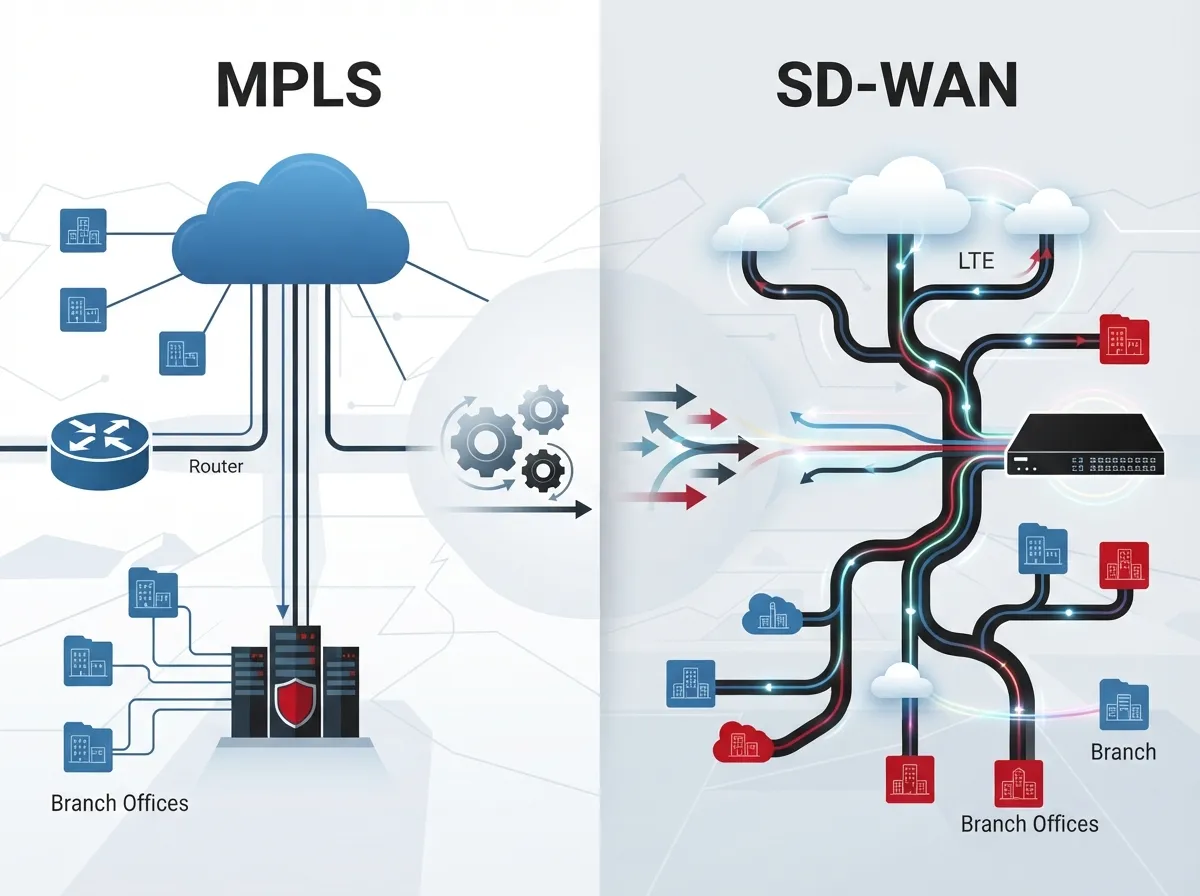
3 Key Differences in SD-WAN vs MPLS
Now for the heart of it. These three differences tend to drive most real-world decisions.
1. Performance Guarantees
This is where MPLS shines. Because a carrier manages the path, you can get contracted SLAs for bandwidth, availability, latency, and QoS. That predictability matters for latency-sensitive apps, like voice and video, or for sites with strict service needs.
SD-WAN works differently. Its performance depends on the quality and variety of the links underneath it. Regular internet paths do not come with the same end-to-end guarantee as an MPLS SLA. However, SD-WAN can watch link health in real time and steer traffic away from a struggling connection. Used well, that gives you strong resilience, just not the same contractual promise.
Quick takeaway: if you need a written guarantee, MPLS has the edge. If you want smart, flexible routing, SD-WAN has the edge.
2. Cost and Flexibility
MPLS circuits often cost more and can take longer to install. Third-party market research has estimated that international MPLS averaged around US$450 per Mbps per month in 2025, compared with about US$12 per Mbps for broadband. Please treat those numbers as a rough illustration. They are not apples-to-apples, since MPLS includes service guarantees and broadband does not, and real pricing varies by location and contract.
SD-WAN makes it easier to use lower-cost or mixed connections, like fiber, cable, or even 5G backup. Some research suggests hybrid designs could reduce WAN spending by 30 to 50 percent. That is a reported potential, not a promise, and your results depend on your network and contracts.
Flexibility is the other big win. Adding a new office to an SD-WAN can be much faster than waiting on a new MPLS circuit. If your business opens locations often, that speed is a real perk. You can see how this plays out locally in 11 Reliable Network Solutions for Multi-Location Tampa Businesses.
3. Cloud Access and Security
Traditional MPLS often sends branch traffic back to a central data center first. That made sense when most apps lived there. Today, many of your tools live in the cloud, so that extra trip can slow things down.
SD-WAN lets branches connect directly to cloud services. That can make everyday apps feel snappier for your team. It also gives you one dashboard to set policies across every site.
On security, here is a point worth knowing. MPLS traffic is usually kept separate from other customers’ traffic, but MPLS alone does not encrypt your data. Many SD-WAN products support encrypted tunnels, but features vary a lot by vendor. So do not assume firewalling, segmentation, or monitoring are included. Ask for specifics. Our guide on choosing network security services can help you build that checklist.
SD-WAN vs MPLS at a Glance
Here is a side-by-side view to make things easy to scan.
| Factor | MPLS | SD-WAN |
|---|---|---|
| Performance guarantees | Provider SLAs for latency, uptime, and QoS | Depends on underlying links; smart traffic steering |
| Typical cost | Higher circuit costs | Can use lower-cost circuits; added licensing or equipment |
| Setup speed | Often slower provisioning | Often faster to add new sites |
| Cloud access | Often routes through a central hub | Direct-to-cloud options |
| Security | Private path, but not encrypted by itself | Often encrypted tunnels; varies by vendor |
| Management | Carrier-managed paths | Centralized, policy-based control |
When MPLS Is the Better Fit
MPLS is not outdated. It is simply a specialist. Here are situations where it often makes sense:
- Strict performance needs: Sites that cannot tolerate jitter or delay, such as busy contact centers.
- Compliance-heavy environments: Teams that want a private, provider-backed path with contract terms.
- Limited local internet options: Locations where reliable broadband or fiber is hard to find.
- Simple, stable networks: Businesses that rarely add sites and prefer a hands-off approach.
If MPLS is on your shortlist, you may like 8 MPLS Network Benefits Every Tampa Business Should Know.
When SD-WAN Is the Better Fit
SD-WAN tends to shine when your business is changing and your apps live in the cloud. Consider it when:
- You rely on cloud tools: Think video meetings, CRM, and cloud phone systems.
- You add locations often: Franchise operators and growing companies love the quick rollout.
- You want diverse connections: Mixing fiber, cable, and cellular backup can boost uptime.
- You want central control: One dashboard beats logging into many boxes.
You can explore the upsides in 6 SD-WAN Benefits Every Business Owner Should Know. Adoption is growing too. One 2023 WAN Manager survey found 63 percent of respondents had installed SD-WAN on at least part of their network. That is one survey, not a universal rate, but it shows the trend.
Why Not Both? The Hybrid Approach
Here is a secret many people miss: you do not have to pick a side. SD-WAN and MPLS work well together.
In a hybrid setup, SD-WAN manages traffic across MPLS, broadband, and cellular links. You keep MPLS for your most critical workloads, like voice or a key database. Meanwhile, less sensitive traffic, such as web browsing or backups, takes lower-cost paths. This gives you a nice balance of reliability, savings, and flexibility.
Hybrid is also a gentle way to modernize. You can move one site or one app at a time instead of flipping the whole network overnight. That lowers risk and keeps your team calm.
What About Voice and Video Quality?
A very common question is whether SD-WAN can handle phone calls and video meetings well. It often can. Good SD-WAN platforms support QoS-style policies that prioritize voice and video, and they can switch paths if call quality drops.
That said, results depend on your underlying connections. If your internet links are shaky, even the smartest software cannot work miracles. That is why pairing SD-WAN with solid fiber or dedicated internet makes such a difference. If you use VoIP, check out What Internet Speed Do I Need for VoIP in Tampa? to size things up.
How to Choose: A Simple 5-Step Process
Ready to decide? Follow these steps. They keep the process friendly and practical.
- List your sites and apps. Note which locations and tools matter most to daily work.
- Rank your must-haves. Decide what needs a guarantee and what can be flexible.
- Check local circuit options. Find out what fiber, cable, and MPLS are truly available at each address.
- Compare total cost of ownership. Count circuits, equipment, licensing, managed services, security, installation, and support. Do not stop at the monthly circuit price.
- Ask about security and support. Confirm encryption, firewalling, segmentation, monitoring, and who answers the phone when something breaks.
Also think about outage tolerance and compliance. If an hour of downtime would cost you a lot, build in backup paths from day one. Not sure where to begin? Our guide on how to choose SD-WAN solutions for Tampa Bay businesses walks through it step by step.
Mistakes to Avoid When Comparing SD-WAN vs MPLS
A little caution goes a long way. Watch out for these common slip-ups:
- Choosing by label alone. The right answer depends on your needs, not the buzzword.
- Ignoring the underlay. SD-WAN is only as strong as the connections beneath it.
- Assuming security is included. Always verify encryption and firewall features.
- Forgetting the cabling. A great WAN cannot fix poor wiring inside the building. See structured cabling services if your office needs a tune-up.
- Skipping the contract details. Terms, renewals, and early-exit fees can sting later.
Mistakes like these are easy to make when you juggle many vendors at once. That is one reason a single point of contact can be so helpful.
Making the Switch Without the Stress
If you are moving from MPLS to SD-WAN, take it in stages. Start with a pilot site. Test your voice, video, and key apps. Keep your MPLS circuit alive until you are confident in the new setup. Then roll out to more locations.
This is also a great time to audit your whole telecom setup. Overlapping contracts and forgotten lines can hide real savings. Our post on 11 Telecom Audit Steps That Cut Business Costs in 2026 shows how.
Many businesses find it easier to work with one partner who knows the whole landscape. Ideal Solutions Provider is a Tampa-based telecom and IT partner with over 24 years of experience and relationships with 35+ vetted suppliers. They compare options side by side, so the recommendation fits your needs rather than a sales quota. You can learn more about our business network solutions and see how it all fits together.
The Bottom Line on SD-WAN vs MPLS
So, which one wins? Honestly, it depends, and that is a perfectly good answer. MPLS gives you provider-backed predictability. SD-WAN gives you flexibility, cloud-friendly routing, and central control. Many businesses get the best of both with a hybrid design.
Remember the three big differences: performance guarantees, cost and flexibility, and cloud access with security. Match those to your sites, your apps, and your budget, and the right path becomes much clearer.
You do not have to figure it all out alone. If you would like a friendly second opinion, contact us for a free consultation, or call us to talk it through. We will review your current setup, point out where you might be overpaying, and help you pick the network that fits. For more local insight, you can also read SD-WAN vs. MPLS: What Tampa Businesses Need to Know. And if you like following along, find us on YouTube for helpful telecom tips.
FAQs
Q: What is the difference between SD-WAN and MPLS?
A: MPLS is a carrier-managed network that sends traffic along set paths, often with contracted performance guarantees. SD-WAN is a software layer that manages many connection types, like broadband, cellular, and even MPLS, and steers traffic based on your rules and live link conditions.
Q: Does SD-WAN replace MPLS, or can a business use both?
A: You can absolutely use both! Many businesses run a hybrid setup where SD-WAN manages traffic across MPLS and internet links. MPLS stays in place for critical workloads, while lower-cost paths handle less sensitive traffic or serve as backup.
Q: Is SD-WAN cheaper than MPLS for a business?
A: It can be, since SD-WAN lets you use lower-cost circuits, but it is not guaranteed. Total cost depends on circuits, equipment, licensing, security, and support, so compare the full picture instead of just the monthly circuit price.
Q: Is MPLS more secure than SD-WAN?
A: Not automatically. MPLS traffic is usually separated from other customers, but it is not encrypted by itself. Many SD-WAN products offer encrypted tunnels, though features vary by vendor, so always verify encryption, firewalling, and monitoring.
Q: What should a business consider before migrating from MPLS to SD-WAN?
A: Start by reviewing your apps, sites, and uptime needs. Check what local internet options exist, confirm security features, and plan a pilot site before a full rollout. Keeping MPLS in place during testing is a smart safety net.





