Key Takeaways
-
Cloud access control enables instant credential updates from any device, allowing manufacturers to revoke a terminated employee's access across all plants in seconds instead of requiring on-site server access.
-
The global cloud access control market is projected to grow from $12.4 billion in 2025 to $47.8 billion by 2034, with manufacturing representing 12.4% of current spending and showing 16.1% projected growth.
-
Reliable network infrastructure including wired Ethernet with Power over Ethernet, Wi-Fi, and cellular backup is essential before deploying cloud access control, as the system only works as well as the underlying connectivity.
-
Cloud access control integrates with HR, video surveillance, visitor management, and time-and-attendance systems, automatically granting access to new hires and revoking it for departing employees on the same day.
-
Hybrid deployment models that combine local door operation with centralized cloud reporting are popular for manufacturers with legacy equipment, ensuring production continuity during internet outages while maintaining corporate visibility.
-
Network segmentation, multifactor authentication, role-based permissions, and regular patching are critical security practices for manufacturing environments where operational technology systems have strict uptime and safety requirements.
Picture this: it’s 6 a.m., and your plant manager just realized a former employee’s badge still opens the loading dock door. With an old on-site system, fixing that means driving to the plant and plugging into a clunky server. With cloud access control, it takes about ten seconds from a phone. That difference is exactly why so many manufacturers are rethinking how they protect their buildings today.
If you run a factory, warehouse, or multi-site production operation, you already know that security can’t slow down your line. You need doors that open fast for the right people and stay locked for everyone else. In this article, we’ll compare cloud access control manufacturing solutions against traditional on-site systems, so you can see which one actually fits your plant, your team, and your budget.
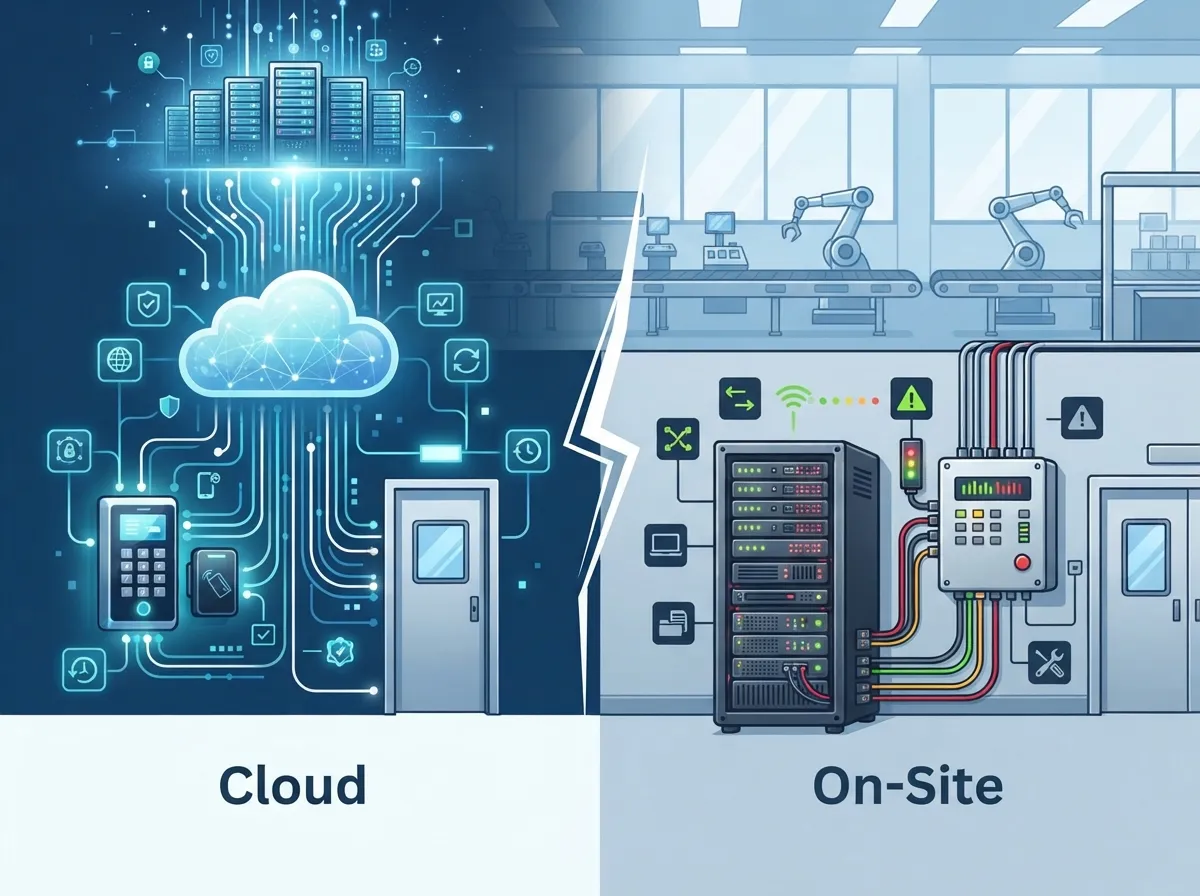
What Does “Cloud Access Control Manufacturing” Actually Mean?
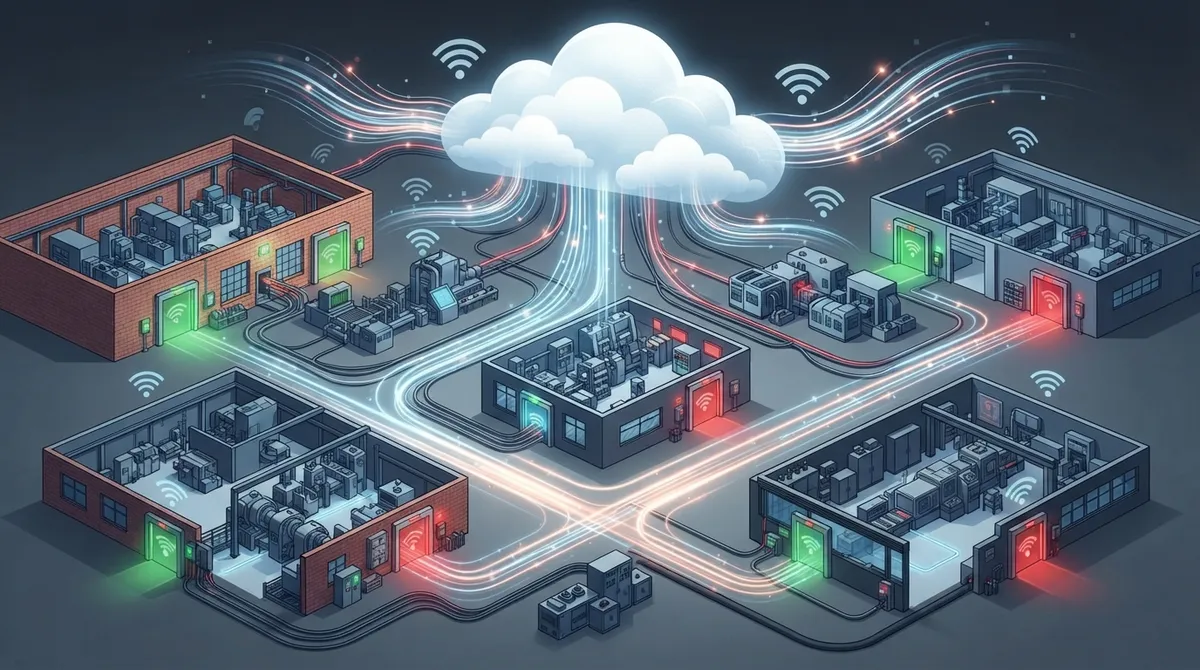
In the world of business telecom and physical security, cloud access control manufacturing doesn’t mean building access-control hardware. It means using a cloud-managed system to control doors, gates, and secure areas across factories, warehouses, and distribution centers. Think of it as a security brain that lives online instead of in a dusty server closet.
Administrators log into a web browser or mobile app to manage every door, every badge, and every schedule. There’s no need to drive between sites just to add a new hire or lock down a lab. This is a major shift for manufacturers who often run several buildings across different cities or states.
Why Manufacturers Are Paying Attention Now
Market data backs up this shift. One 2025 estimate placed the global cloud access control market at $12.4 billion, with projections reaching $47.8 billion by 2034. Another report estimated a similar $12.8 billion market in 2025, growing to $49.2 billion by 2034. These are estimates from commercial research firms, and the numbers vary by methodology, but the trend is clear: cloud-based security is growing fast.
Industrial and manufacturing organizations already make up a meaningful slice of that spending. One source pegs industrial use, including manufacturing, utilities, and oil and gas, at about 10.5% of 2025 spending. Another estimates manufacturing and industrial users at 12.4% of revenue, with 16.1% projected growth for that segment alone.
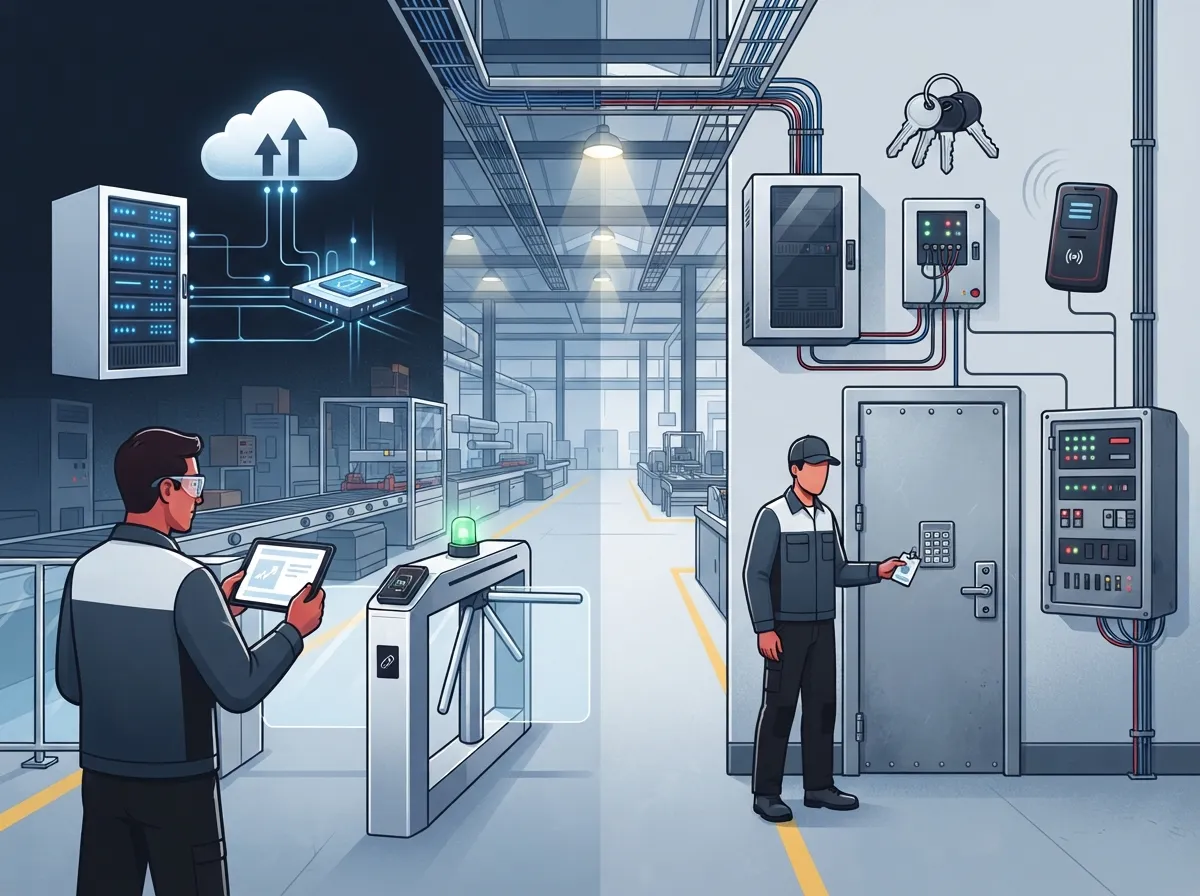
Cloud vs. On-Site Access Control: A Side-by-Side Look
Let’s break down how these two approaches stack up for a manufacturing environment. This comparison should help you see where each option shines.
| Feature | Cloud Access Control | On-Site (Legacy) System |
|---|---|---|
| Multi-site management | Centralized, one dashboard for all plants | Separate systems per location |
| Credential changes | Instant, from any device | Requires on-site server access |
| Software updates | Automatic, handled by provider | Manual, often delayed |
| Remote monitoring | Real-time alerts and logs anywhere | Limited to local network access |
| Offline operation | Doors can still function locally during outages | Fully local, no cloud dependency |
| Upfront cost | Lower hardware investment, subscription fees | Higher upfront hardware and server costs |
| Scalability | Easy to add sites or doors | Often requires new servers per site |
On-site systems still have a place, especially in plants with strict operational technology rules or older equipment that can’t easily connect to the internet. But for most growing manufacturers, cloud access control offers more flexibility without sacrificing security.
Key Benefits of Cloud Access Control for Manufacturing Plants
Manufacturers face unique challenges. You’re protecting production lines, hazardous materials, tool cribs, and loading docks, all while keeping employees, contractors, and visitors moving efficiently. Here’s how cloud access control helps.
- Centralized management across every plant, warehouse, and distribution site from one dashboard
- Instant credential updates, so a terminated employee loses access immediately, everywhere
- Mobile credentials that let staff use their phones instead of carrying separate badges
- Role-, shift-, and zone-based rules that restrict sensitive areas like labs and server rooms
- Real-time event logs and alerts for suspicious activity, sent straight to your phone
- Integration with video surveillance, visitor management, and HR systems to reduce duplicate work
This last point matters a lot. When your access system talks to your HR software, new hires get access automatically, and departing employees lose it the same day. No more forgotten badges floating around the plant.
Protecting Production Continuity
Manufacturing floors can’t afford downtime, and that includes downtime caused by a security system glitch. A good cloud access control setup is built with local fallback options, so doors keep working even if the internet drops for a moment. This blend of cloud convenience and local reliability is what makes the technology practical for factories, not just offices.
What Telecom Infrastructure Do You Actually Need?
Here’s where a lot of manufacturers get surprised. Cloud access control isn’t just a security purchase, it’s also a network project. Your readers, controllers, and cameras all need reliable connections to talk to the cloud and to each other.
Before rolling out cloud access control, most plants need to address:
- Reliable wired and wireless connectivity across the facility, including Ethernet and Power over Ethernet for door hardware
- Cellular backup or failover, so access control keeps working during an internet outage
- Secure VPNs and network segmentation, so security devices stay isolated from production equipment
- SD-WAN or similar technology, if you’re connecting multiple plants over a wide area
- Structured cabling that supports both current devices and future expansion
This is exactly where a telecom partner earns their keep. Getting the network right the first time saves you from costly rework later. If your cabling is outdated or your internet connection can’t handle the extra devices, even the best access control software will struggle. That’s why pairing a project like this with solid structured cabling services and dependable connectivity matters so much.
Wired, Wireless, and Cellular: Picking the Right Mix
Most manufacturing sites use a mix of connection types. Wired Ethernet is often best for door controllers because it’s stable and can carry both power and data through Power over Ethernet. Wi-Fi works well for mobile credential scanning and camera feeds in areas where running cable is difficult. Cellular backup acts as an insurance policy, keeping your system online if your main internet connection fails.
You can learn more about the technical side of network cabling for these kinds of projects, including how the structured cabling standard supports voice, data, and security devices on the same backbone.
Cloud, On-Premises, or Hybrid: Which Deployment Fits Your Plant?
Not every manufacturer needs a fully cloud-based system right away. There are three main deployment models worth considering.
| Model | Best For | Trade-Offs |
|---|---|---|
| Fully Cloud | Multi-site operations wanting central control | Depends on internet, needs cellular backup |
| On-Premises | Single plants with strict OT requirements | Harder to manage remotely, more hardware upkeep |
| Hybrid | Plants needing local door control plus central visibility | More complex setup, but flexible long-term |
Hybrid setups are popular in manufacturing because they let doors keep working locally even if cloud connectivity drops, while still giving corporate teams centralized reporting and control. This is especially useful for plants with legacy equipment that can’t be fully replaced overnight.
Integrating Access Control With the Rest of Your Systems
One of the biggest advantages of cloud access control is how well it plays with other business tools. Instead of managing five separate systems, you get one connected ecosystem.
- Video surveillance systems that automatically pull footage tied to door events
- Visitor management software that issues temporary credentials for contractors and guests
- HR and identity platforms that sync new hires and departures automatically
- Time-and-attendance tools that use badge swipes for accurate payroll records
- Alarm and building management systems for a fuller security picture
If you’re already using cloud security cameras in your facility, connecting them to your access control platform means you can see exactly who opened a door and when, all from one screen. It’s a simple way to close gaps that used to slip through the cracks.
Security Considerations for Manufacturing and OT Environments
Manufacturing plants often run a mix of IT (information technology) and OT (operational technology) systems. OT includes things like production line controllers and industrial equipment, and it usually has stricter uptime and safety requirements than typical office IT.
When rolling out cloud access control, keep these practices in mind:
- Use network segmentation to keep access control devices separate from production equipment
- Require multifactor authentication for administrator accounts
- Encrypt data both in transit and at rest
- Apply role-based administration, so only the right people can change permissions
- Patch and update software regularly, ideally through automated cloud updates
- Keep detailed logs for audits and compliance reviews
These steps aren’t just good practice, they’re often necessary to satisfy insurance requirements or industry regulations. A telecom and security partner who understands both IT and OT needs can help you avoid costly missteps.
How Much Does This Cost, and What Should You Budget For?
Costs vary a lot based on plant size, number of doors, and whether you’re starting fresh or upgrading. Generally, you’ll want to budget for a few categories.
- Hardware: door controllers, readers, and credentials (badges or mobile passes)
- Cabling and network upgrades, including Power over Ethernet switches
- Software subscription fees, often billed per door or per user
- Installation and configuration labor
- Ongoing support and monitoring
Because software makes up roughly 45% of the overall cloud access control market according to recent estimates, subscription costs are worth comparing carefully across providers. A good partner will walk you through a clear, itemized quote instead of a vague bundle price.
Steps to Roll Out Cloud Access Control Across Multiple Plants
If you manage more than one facility, a phased rollout usually works better than switching everything at once. Here’s a simple approach that works well for manufacturers.
- Audit your current network and access control setup at each site
- Identify high-priority doors and zones, such as server rooms and hazardous material storage
- Upgrade cabling and connectivity where needed, including cellular backup
- Choose a cloud platform that supports your integrations, like HR and video systems
- Pilot the system at one plant before expanding company-wide
- Train staff and set up role-based permissions
- Monitor performance and adjust schedules, zones, and alerts as needed
This kind of rollout takes coordination between your IT team, plant managers, and your telecom provider. That’s exactly the kind of project Ideal Solutions Provider helps manage, acting as a single point of contact instead of leaving you to juggle multiple vendors on your own.
Why a Telecom Partner Matters for Access Control Projects
Cloud access control depends on connectivity, and connectivity is exactly what a business telecom provider specializes in. A partner with 24+ years of experience and relationships with 35+ vetted suppliers can help you design the network, set up VPNs and firewalls, add cellular backup, and keep everything running smoothly across every site.
This matters even more for multi-location businesses managing several plants at once. Instead of hiring separate vendors for phones, internet, cabling, and security, you get one team handling consultation, installation, and ongoing support. You can follow their project updates and behind-the-scenes work on Facebook, Instagram, and YouTube to see real examples of these systems in action.
Common Mistakes to Avoid
Manufacturers often run into the same pitfalls when adopting cloud access control. Watch out for these issues:
- Skipping a network assessment before installing new access control hardware
- Ignoring cellular backup, leaving doors vulnerable during internet outages
- Choosing a platform that doesn’t integrate with existing HR or video systems
- Underestimating cabling needs for Power over Ethernet devices
- Failing to set clear role-based permissions for contractors and visitors
Avoiding these mistakes early saves time, money, and frustration down the road. A strong Internet Service Provider relationship combined with proper network design makes a huge difference in how well your access control system performs long term.
Making the Right Choice for Your Plant
So, cloud versus on-site: which one wins? For most manufacturers running more than one facility, juggling contractors, or wanting real-time visibility into their plants, cloud access control is the clear winner. It offers centralized control, faster credential changes, and easier integration with the tools you already use. On-site systems still make sense for isolated facilities with strict OT requirements, but even then, a hybrid approach often bridges the gap nicely.
Whatever direction you choose, remember that access control is only as strong as the network behind it. Reliable cabling, dependable internet, and smart network design are what make cloud access control actually work on the plant floor, not just on paper.
Ready to see how cloud access control could work for your manufacturing facility? Contact us for a free consultation, or call us today to talk through your plant’s specific needs.
FAQs
Q: What is cloud access control for manufacturing facilities?
A: It’s a system that manages plant doors, badges, and security cameras through an online platform instead of a local server. You can add employees, lock down zones, or check alerts right from your phone, no matter which plant you’re managing.
Q: How does cloud access control work when a factory loses its internet connection?
A: Good systems are designed to keep doors working locally even during an outage, so your plant doesn’t grind to a halt. Adding cellular backup is a smart way to keep the cloud connection alive too, so you’re covered from both angles.
Q: What telecom network is required for cloud-based access control?
A: You’ll want reliable wired connections like Ethernet with Power over Ethernet for your door controllers, plus solid Wi-Fi and cellular backup for redundancy. A properly cabled network really is the backbone that makes everything else run smoothly.
Q: Can cloud access control integrate with HR, time-and-attendance, or visitor-management systems?
A: Yes, and it’s one of the biggest perks. When your access system talks to HR software, new hires get access automatically and departing employees lose it the same day, saving your team a lot of manual work.
Q: How much does cloud access control cost for a manufacturing facility?
A: Costs depend on the number of doors, cabling needs, and software subscription fees, so there’s no one-size-fits-all number. The best approach is getting a clear, itemized quote based on your specific plant layout and goals.