Key Takeaways
-
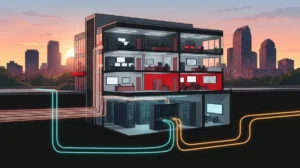
Fiber optic cabling services in Tampa now include full-service installation from design through testing and ongoing maintenance, covering network design, cable installation, termination, splicing, and certification to ensure reliable performance.
-
Fiber optic cabling supports up to 100 Gbps speeds and can transmit data miles without signal loss, compared to copper cabling limited to ~10 Gbps and ~100 meters per segment, making it essential for growing businesses.
-
Multi-mode fiber works best for in-building networks up to 550 meters, while single-mode fiber is ideal for long-distance runs between buildings on a campus, and a qualified technician should assess your specific needs.
-
Retrofitting fiber into existing commercial buildings is common and achievable through existing conduit, drop ceilings, and raised flooring, allowing businesses to upgrade gradually without major operational disruption.
-
Installation costs depend on building size, number of floors, fiber type, connection points, and infrastructure complexity, so get a custom site survey quote rather than flat-rate estimates to avoid red flags.
-
Choose fiber cabling contractors with BICSI-certified technicians, commercial building experience, testing capabilities, structured cabling integration expertise, and ongoing support to ensure your investment delivers long-term reliability.
If your Tampa commercial building is still running on old copper cabling, you might be leaving serious performance on the table. Slow networks, dropped calls, and bandwidth bottlenecks are real problems that cost businesses time and money every single day. The good news? Fiber optic cabling services for commercial buildings in Tampa have become more accessible and affordable than ever in 2026. Whether you run a busy medical office, a growing corporate campus, or a multi-location franchise, fiber infrastructure can transform the way your business communicates and operates. Let’s walk through everything you need to know — from what these services include to how to get started without the headache.
What Are Fiber Optic Cabling Services for Commercial Buildings?
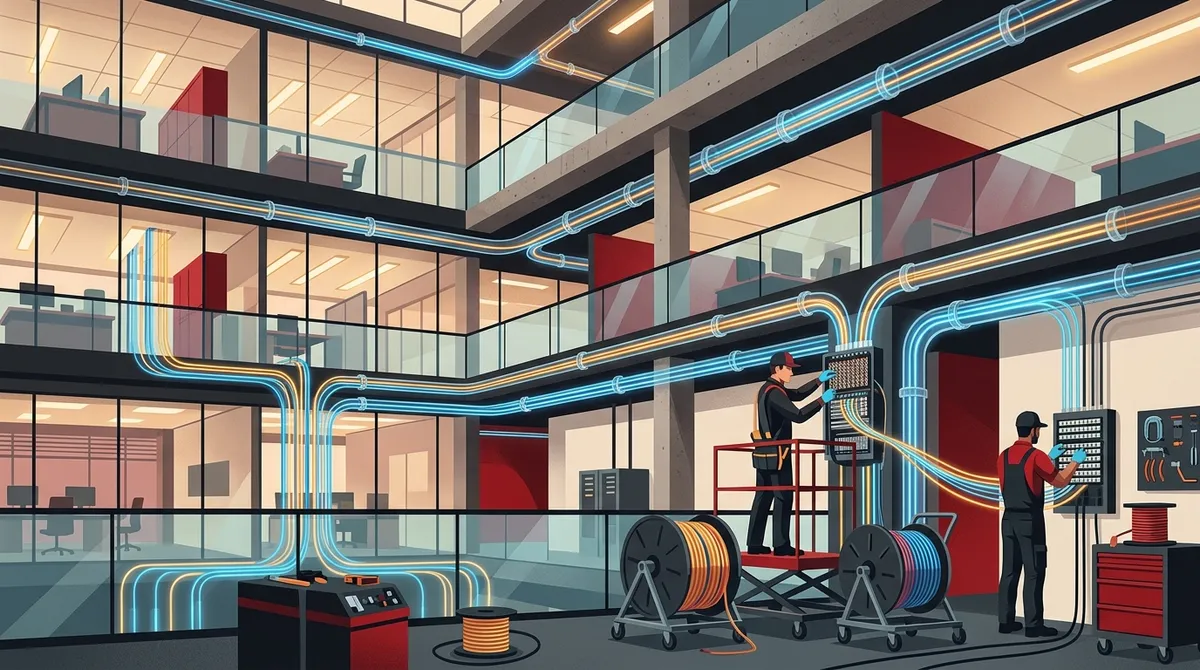
Fiber optic cabling uses thin strands of glass or plastic to transmit data as pulses of light. This is very different from traditional copper cabling, which carries electrical signals. The result? Much faster speeds, higher bandwidth, and better security for your business network. For commercial buildings in Tampa, fiber cabling services typically cover the full project lifecycle — from design and planning all the way through installation, testing, and ongoing maintenance.
These services are used to build the backbone of your business’s communications infrastructure. That includes internal networks, connections between buildings, and links to your internet service. If you want to learn more about how strong cabling ties into your overall connectivity, check out this helpful guide on why Tampa businesses need dedicated fiber internet.
What Does a Commercial Fiber Installation Actually Include?
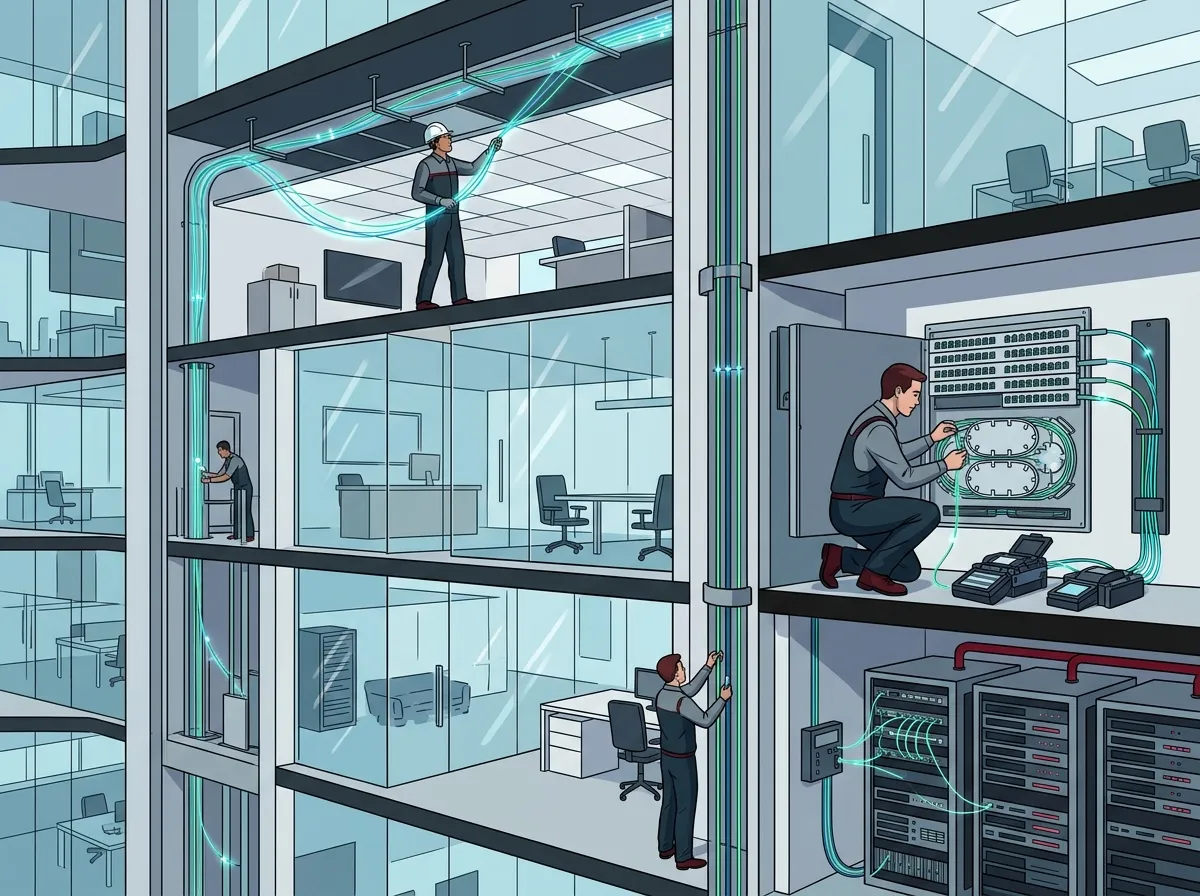
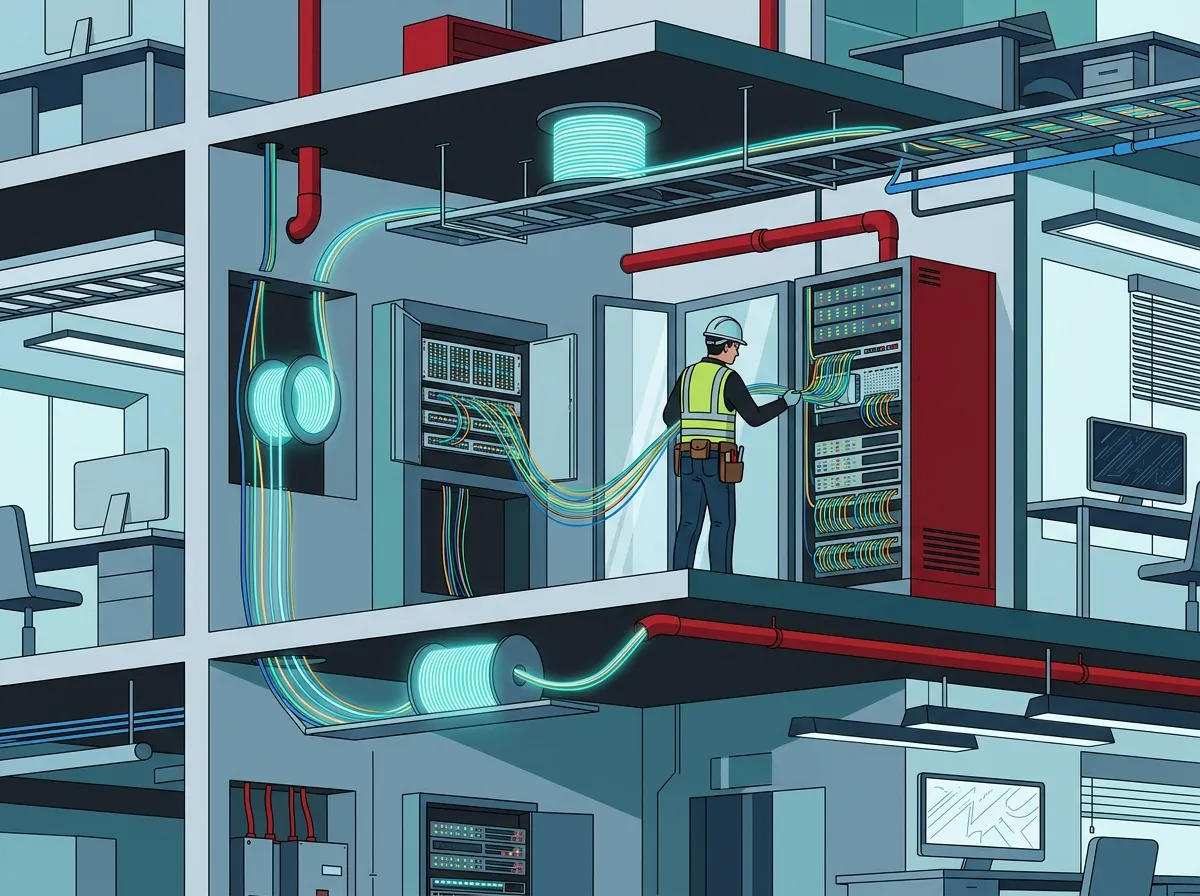
A complete fiber optic cabling service for a commercial building covers much more than just running cables through walls. Here is a breakdown of what certified technicians typically handle during a commercial project in Tampa:
- Network Design and Planning — Technicians assess your building layout and design a cabling system that meets your current and future needs.
- Cable Installation — This includes running fiber through conduit, walls, ceilings, and between floors or buildings.
- Termination and Splicing — Each fiber end is precisely terminated or spliced to ensure a clean, reliable connection.
- Testing and Certification — Every cable run is tested and certified to confirm it meets performance standards before the project is signed off.
- Labeling and Documentation — Cables are labeled clearly, and full documentation is provided so your IT team can manage the network easily going forward.
- Ongoing Maintenance and Troubleshooting — Many providers also offer emergency support and scheduled maintenance after installation.
This full-service approach is what separates a professional fiber cabling contractor from a cut-rate alternative. For a deeper look at how structured cabling ties into this process, the Wikipedia article on structured cabling is a great reference.
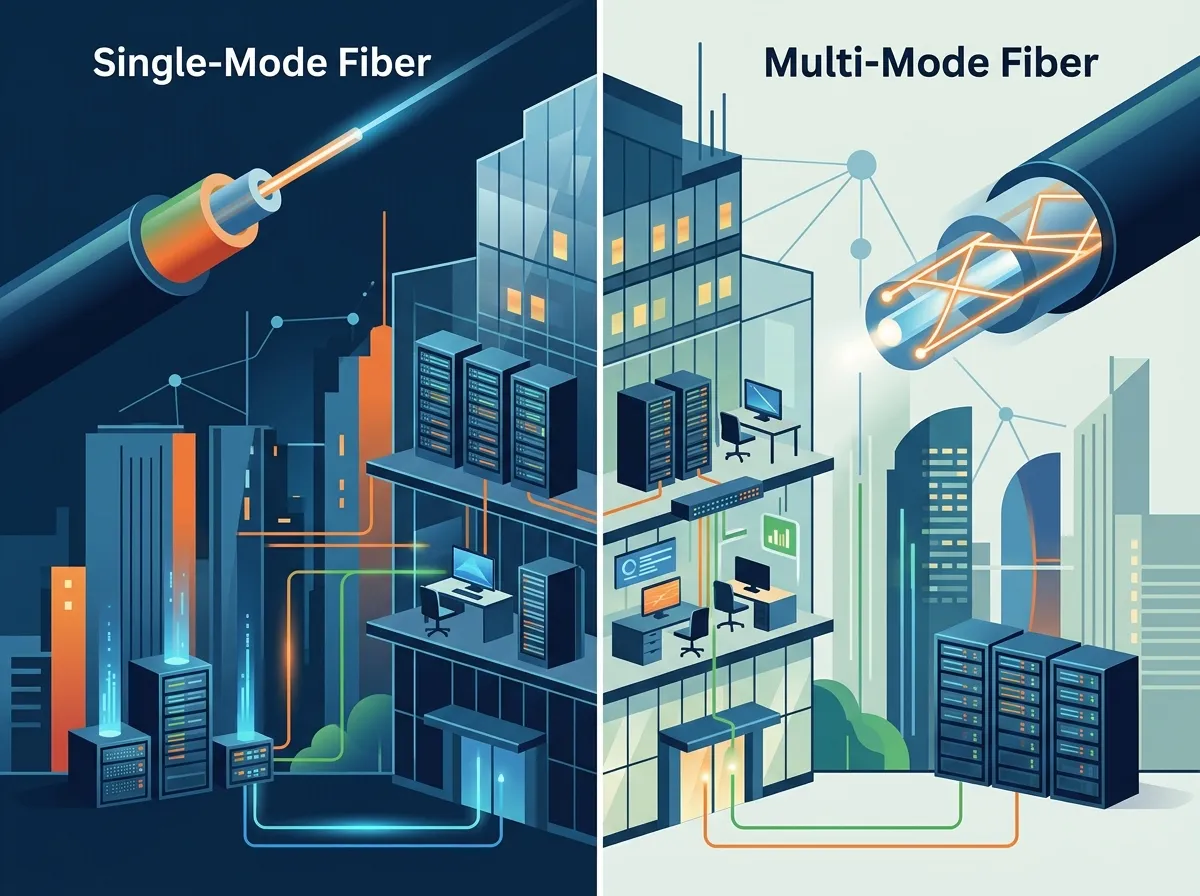
Single-Mode vs. Multi-Mode Fiber: Which Does Your Building Need?
One of the most common questions Tampa business owners ask is: what type of fiber is right for my building? The answer depends on distance and application. Here is a simple comparison to help you decide:
| Feature | Single-Mode Fiber | Multi-Mode Fiber |
|---|---|---|
| Best For | Long-distance runs between buildings | Short-distance LAN applications |
| Typical Distance | Up to several miles | Up to 550 meters (OM4) |
| Core Size | 9 microns | 50 or 62.5 microns |
| Cost | Higher upfront | Lower upfront |
| Common Uses | Campus backbones, WAN connections | Within-building networks, data centers |
For most commercial buildings in Tampa, multi-mode fiber works great for in-building networks. But if you need to connect multiple buildings across a campus or parking lot, single-mode is the way to go. A qualified technician will help you choose based on your specific setup. You can also explore structured cabling services that include both fiber types as part of a complete solution.

Which Tampa Commercial Buildings Benefit Most from Fiber?
Fiber optic cabling services for commercial buildings in Tampa are a smart investment across many industries. Here are the types of properties that see the biggest gains:
- Office Buildings — Support video conferencing, VoIP calls, and cloud applications without slowdowns.
- Medical Facilities — Handle large patient data files, real-time imaging, and HIPAA-compliant communication securely.
- Corporate Campuses — Connect multiple buildings with a high-speed backbone that keeps everything in sync.
- Retail Chains and Franchises — Maintain consistent connectivity across multiple store locations throughout Tampa Bay and beyond.
- Data Centers — Handle massive bandwidth demands with low latency and reliable uptime.
- Educational Facilities — Support online learning platforms, administrative systems, and secure student networks.
If your business falls into any of these categories, it is well worth having a professional assess your current cabling setup. Chances are, there is room to upgrade. You can also check out our article on professional structured cabling services for Tampa businesses for more insights.
Fiber Optic vs. Copper Cabling: A Quick Comparison
Still on the fence about making the switch? Here is a side-by-side look at how fiber stacks up against traditional copper cabling for commercial applications:
| Category | Fiber Optic | Copper Cabling |
|---|---|---|
| Speed | Up to 100 Gbps and beyond | Typically up to 10 Gbps (CAT6A) |
| Bandwidth | Very high | Limited by cable category |
| Distance | Miles without signal loss | Limited to ~100 meters per segment |
| Security | Harder to tap or intercept | More vulnerable to interference |
| Interference | Immune to EMI | Susceptible to electromagnetic interference |
| Long-Term Cost | Lower maintenance costs | May require more frequent upgrades |
As you can see, fiber wins in almost every category that matters for a growing business. And with installation costs continuing to drop in 2026, the return on investment is stronger than ever. Pair your fiber cabling with the right business high-speed internet service and you have a truly future-proof setup.
How the Installation Process Works
Wondering what to expect when you schedule fiber optic cabling services for your Tampa commercial building? Here is a simple step-by-step overview:
- Initial Consultation and Site Survey — A technician visits your building to evaluate the layout, measure distances, and identify any challenges.
- Design and Proposal — You receive a custom design plan and quote based on your building’s specific needs.
- Scheduling and Preparation — The installation is scheduled to minimize disruption to your business operations.
- Cable Installation — Technicians run fiber through walls, conduit, or underground pathways as needed.
- Termination, Splicing, and Testing — Each connection is carefully finished, tested, and certified for performance.
- Handover and Documentation — You receive a complete record of your cabling layout for easy future management.
Most commercial fiber installations in Tampa can be completed within a few days, depending on building size and complexity. Larger campuses or multi-building projects may take longer. Either way, a good contractor will keep you informed every step of the way.
What to Look for in a Tampa Fiber Cabling Contractor
Not all cabling contractors are created equal. When choosing a provider for fiber optic cabling services for commercial buildings in Tampa, keep an eye out for these key qualities:
- Certified Technicians — Look for contractors with BICSI-certified installers or equivalent credentials. Certification means they follow industry best practices.
- Commercial Experience — Make sure they have real experience with office buildings, multi-story facilities, and campus environments — not just residential work.
- Testing and Certification Capabilities — A quality contractor will test every fiber run and provide certified results before calling the job done.
- Structured Cabling Integration — Fiber should work seamlessly with your overall cabling infrastructure, including CAT6 runs, patch panels, and network equipment.
- Ongoing Support — Choose someone who will be available after installation for troubleshooting and maintenance.
That last point is especially important. Your fiber network is a long-term investment, and you want a partner who sticks around. Companies like Ideal Solutions Provider act as a single point of contact for all your telecom and cabling needs, making ongoing support simple and stress-free. With over 24 years of experience and partnerships with 35+ vetted suppliers, they make sure you always have the right solution for your building’s needs.
How Fiber Cabling Supports Your Broader Telecom Infrastructure
Fiber optic cabling does not exist in a vacuum. It is the foundation that supports all of your other business communications systems. Here is how it connects to the bigger telecom picture:
- VoIP Phone Systems — Crystal-clear voice calls depend on low latency and consistent bandwidth, both of which fiber delivers. See how cloud-based phone systems work hand-in-hand with fiber infrastructure.
- Business Internet — Fiber backbone cabling supports the delivery of high-speed internet throughout every corner of your building.
- Cloud Security Cameras — High-resolution video surveillance requires serious bandwidth. Fiber handles it without breaking a sweat. Learn more about cloud video security options for your building.
- Access Control Systems — Modern cloud-based access control systems rely on a stable, fast network to function properly.
- Business Networking — Fiber ties directly into your business network solutions, supporting SD-WAN, MPLS, and managed services.
In short, investing in fiber cabling is investing in the reliability of everything your business runs on. It is one of those upgrades that touches every department, every user, and every application under your roof.
Common Questions About Fiber Cabling Costs and Timelines
Cost is always a factor, and we get it — budgets are real. Here is a general overview of what impacts the cost of fiber optic cabling services for commercial buildings in Tampa:
| Cost Factor | Impact on Price |
|---|---|
| Building Size | More square footage = more cable runs = higher cost |
| Number of Floors | Multi-story buildings require vertical pathways and more labor |
| Fiber Type (Single vs. Multi-Mode) | Single-mode is typically more expensive upfront |
| Number of Connection Points | More endpoints mean more terminations and hardware |
| Existing Infrastructure | Retrofit projects may cost more than new construction |
| Underground or Aerial Runs | These specialty installations add labor and material costs |
The best way to get an accurate number for your building is to schedule a site survey and get a custom quote. There is no one-size-fits-all price for commercial fiber cabling — and any contractor who quotes you a flat rate without seeing your building first should raise a red flag. To learn how to find the best deal on connectivity services in Tampa, read our guide on 12 ways to find the best business internet deal in Tampa.
Can You Install Fiber in an Existing Commercial Building?
Absolutely — and this is great news for Tampa business owners who are not in a brand-new building. Retrofitting fiber into an existing commercial property is very common. Experienced technicians can route fiber through existing conduit, above drop ceilings, and through raised flooring. In some cases, new pathways need to be created, but skilled contractors handle this routinely without causing major disruption to your operations.
If your building already has structured cabling in place, a technician can often integrate fiber alongside existing copper runs to create a hybrid network. This approach lets you upgrade gradually without replacing everything at once. For more details on how cabling installation works in existing buildings, check out our article on structured cabling installation companies in Tampa FL.
Stay Connected Beyond the Installation
Getting your fiber cabling installed is just the beginning. To truly get the most out of your investment, you want a telecom partner who supports you long after the job is done. That means someone who monitors performance, responds quickly to issues, and helps you scale as your business grows.
Want to see real-world examples of how businesses like yours have upgraded their infrastructure? Check out the Ideal Solutions Provider video library for helpful overviews and client stories. You can also follow along on Facebook, Instagram, and YouTube for tips, updates, and behind-the-scenes looks at real commercial cabling projects in Tampa.
Ready to Upgrade Your Tampa Commercial Building with Fiber?
Fiber optic cabling services for commercial buildings in Tampa are one of the smartest investments you can make in your business infrastructure right now. Faster speeds, stronger security, higher bandwidth, and lower long-term maintenance costs all add up to a serious competitive advantage. Whether you are starting fresh in a new build or retrofitting an existing property, the right cabling partner makes all the difference.
Do not wait until slow networks start costing you clients or productivity. Reach out to our team today for a free consultation, or give us a call at 813-388-4935 to talk through your building’s specific needs. We are happy to help you design a fiber cabling solution that fits your budget, your timeline, and your long-term goals.
FAQs
Q: What do fiber optic cabling services include for commercial buildings in Tampa?
A: Great question! A full-service fiber cabling project typically includes network design, cable installation, termination and splicing, testing and certification, labeling, and ongoing maintenance support. Think of it as a complete infrastructure package — not just pulling cable through walls.
Q: How long does a commercial fiber optic installation take in Tampa?
A: Most commercial fiber installations in Tampa can be completed in a few days, depending on the size and complexity of your building. Larger properties or multi-building campuses may take longer, but a good contractor will keep you updated throughout the process so there are no surprises.
Q: Can fiber optic cabling be installed in an existing commercial building?
A: Absolutely! Retrofitting fiber into an existing building is very common and totally doable. Experienced technicians route fiber through existing conduit, drop ceilings, and raised floors. You do not need to be in a brand-new building to enjoy the benefits of fiber.
Q: What is the difference between single-mode and multi-mode fiber for businesses?
A: Single-mode fiber is designed for long-distance runs — like connecting buildings across a campus — while multi-mode fiber works best for shorter distances within a single building. Your cabling contractor will help you choose the right type based on your building layout and network needs.
Q: Do fiber optic cabling contractors in Tampa provide testing and certification?
A: Yes, and this is actually something you should specifically ask about before hiring anyone! Reputable contractors test every fiber run and provide certified results to confirm everything meets performance standards. This protects your investment and gives your IT team confidence in the network.