
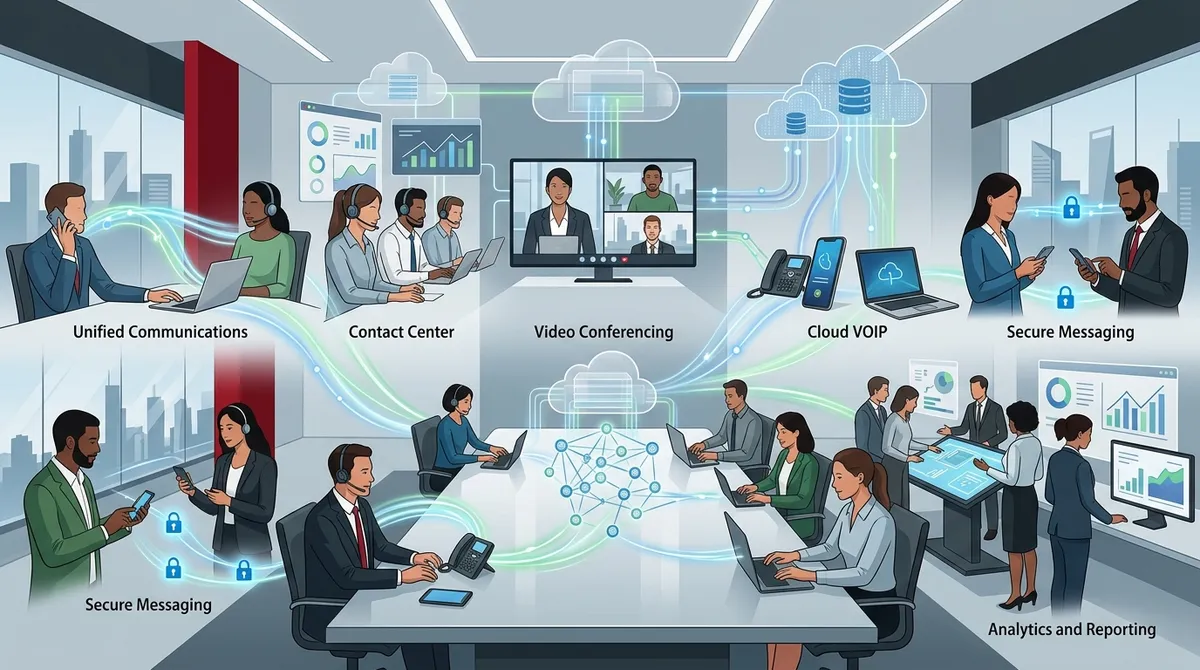
Key Takeaways
-
Cloud-based enterprise phone solutions eliminate expensive on-site hardware, reduce per-user costs, and scale seamlessly across multiple locations without disrupting operations.
-
AI-powered analytics and real-time call transcription provide actionable insights into customer satisfaction, enabling managers to coach teams more effectively and identify trends before they become problems.
-
CRM and business tool integrations automatically pull up customer history during calls, enabling agents to personalize interactions and significantly improve efficiency and customer satisfaction.
-
UCaaS platforms consolidate voice, video, messaging, and file sharing into one unified system, eliminating tool sprawl and reducing IT management overhead for large organizations.
-
Enterprise phone solutions include robust security features like end-to-end encryption, multi-factor authentication, and compliance tools for HIPAA and PCI-DSS standards.
-
Softphone apps enable employees to use smartphones, tablets, and laptops as full business phones from anywhere, keeping personal and business numbers separate while supporting remote and hybrid work.
If your business is growing fast, your phone system needs to keep up. Old, clunky systems drop calls, limit features, and cost more than they should. Enterprise phone solutions solve all of that — and then some. These are purpose-built communication platforms designed for organizations with high call volumes, multiple locations, and complex needs.
In 2026, the best enterprise phone solutions are cloud-based, AI-powered, and deeply flexible. Whether you manage a single large office or dozens of locations nationwide, the right system can save money, improve productivity, and keep your team connected from anywhere. Let’s walk through seven of the most impactful enterprise phone solutions available today — and what makes each one worth your attention.

What Makes Enterprise Phone Solutions Different?
Not all business phone systems are created equal. Small business systems are built for simplicity and low cost. Enterprise phone solutions are built for scale, customization, and deep integration. The table below breaks down the key differences clearly.
| Feature | Small Business System | Enterprise Phone Solution |
|---|---|---|
| Scalability | Limited users | Hundreds or thousands of users |
| Call Management | Basic call routing | Advanced auto-attendants and queues |
| Integrations | Few or none | CRM, email, helpdesk, and more |
| Security | Standard | Enhanced encryption and compliance tools |
| Analytics | Basic call logs | AI-powered reporting and transcription |
| Support | Self-serve | Dedicated account management |
If your organization has outgrown its current setup, it’s worth exploring what enterprise VoIP is and whether your business needs it. The jump from a basic system to a true enterprise solution is significant — and the benefits are real.

7 Enterprise Phone Solutions That Transform Business Communications
1. Cloud PBX (Hosted Phone Systems)
Cloud PBX is the backbone of modern enterprise phone solutions. Instead of relying on aging copper-wire hardware, calls are routed through the internet using VoIP technology. This means no bulky equipment rooms, no expensive maintenance contracts, and no geographic limits.
Cloud PBX systems are managed entirely by your provider. Your IT team doesn’t need to babysit servers or chase down hardware issues. You get enterprise-grade reliability without the enterprise-sized headache. To understand how this compares to older setups, check out the key differences between VoIP and traditional phone systems.
- No on-site PBX hardware required
- Easy to scale up or down as your team changes
- Managed updates and security patches from your provider
- Works across multiple office locations seamlessly
2. UCaaS (Unified Communications as a Service)
UCaaS platforms bring voice, video, messaging, and file sharing into one unified system. Think of it as your entire communications stack rolled into a single, cloud-based platform. For large organizations, this eliminates tool sprawl and keeps everyone on the same page.
In 2026, choosing the right enterprise communication solution often means choosing a UCaaS platform. Features like team chat, video conferencing, and call recording are all available under one login. That’s a huge win for productivity and IT management alike.
- Voice, video, and messaging in one platform
- Single sign-on and centralized administration
- Available on desktop, mobile, and tablet
- Supports remote and hybrid work environments
3. Advanced Auto-Attendant and IVR Systems
First impressions matter. When a customer calls your business, they should reach the right person or department quickly. Auto-attendants and IVR (Interactive Voice Response) systems make that happen automatically — no receptionist required.
Enterprise-grade IVR systems go beyond simple menus. They can recognize speech, route calls based on customer history, and even integrate with your CRM to personalize the experience. For businesses handling hundreds of calls daily, this is a game-changer. You can learn more about cloud phone system features that transform your business to see how these tools fit into the bigger picture.
4. AI-Powered Call Analytics and Transcription
Artificial intelligence is no longer a futuristic concept — it’s a standard feature in leading enterprise phone solutions in 2026. AI tools analyze your calls in real time, providing transcriptions, sentiment analysis, and actionable insights.
Imagine knowing which customer service calls led to satisfaction and which ones didn’t — and understanding exactly why. AI analytics help managers coach their teams more effectively and identify trends before they become problems. This kind of intelligence is what separates good enterprise systems from great ones.
| AI Feature | What It Does | Business Benefit |
|---|---|---|
| Real-Time Transcription | Converts calls to text instantly | Easier note-taking and compliance |
| Sentiment Analysis | Detects customer emotions | Identify at-risk customers faster |
| Intelligent Call Routing | Routes calls based on context | Faster resolution, happier customers |
| Call Summaries | Auto-generates meeting notes | Saves time on follow-ups |
5. Enterprise Mobility and Softphone Solutions
Your team doesn’t sit at a desk all day — and your phone system shouldn’t assume they do. Enterprise phone solutions support mobility by turning smartphones, tablets, and laptops into full business phones. This is done through softphone apps that connect to your cloud PBX.
Whether your sales rep is at a client meeting or your support agent is working from home, they can make and receive calls using their business number. No one needs to give out their personal cell. For more on this topic, explore how to choose business VoIP solutions that actually work for distributed teams.
- Use any device as your business phone
- Keep personal and business numbers separate
- Access voicemail, call history, and contacts from anywhere
- Works on iOS, Android, and Windows
6. CRM and Business Tool Integrations
Enterprise phone solutions don’t work in isolation — they work best when connected to the tools your team already uses. Deep integrations with CRM platforms, helpdesk software, email, and collaboration tools create a seamless workflow that saves time every day.
For example, when a customer calls, your CRM can automatically pull up their account history. Your agent greets them by name and already knows their last order or support ticket. That’s a powerful experience — and it happens automatically. Businesses that embrace these integrations report significant gains in efficiency and customer satisfaction.
If you’re evaluating options, it helps to understand which VoIP phone system features every business needs in 2026 — especially when it comes to integration capabilities.
7. Multi-Location and Scalable Phone Networks
Growing businesses need phone systems that grow with them. Enterprise phone solutions are built to scale — adding new users, locations, or features without disrupting existing operations. Whether you’re opening a new office in Tampa or expanding nationwide, your phone system should handle it effortlessly.
Cloud-based systems make multi-location management simple. You can manage all your sites from one admin dashboard, set consistent call policies, and ensure every location has the same professional experience. Scalable vs. fixed telecom systems — it’s a comparison worth making before you commit to any solution.
- Add new locations without buying new hardware
- Manage all sites from one central dashboard
- Consistent call routing rules across every office
- Supports hundreds or thousands of simultaneous users
How Enterprise Phone Solutions Are Implemented
Making the switch to an enterprise phone solution doesn’t have to be stressful. The process is structured and manageable when you work with the right partner. Here’s a typical implementation timeline:
- Discovery and Assessment: Your telecom partner reviews your current setup, call volume, user count, and existing tools. This helps identify the right solution for your needs.
- System Design and Configuration: The new system is configured to match your business rules — call routing, auto-attendants, user extensions, and integrations are all set up before go-live.
- Testing and Training: Your team gets hands-on training with the new system. Soft launches or pilot programs help catch any issues early.
- Cutover Day: The scheduled switch happens — usually with minimal or zero downtime. Your old system transitions to the new one, and your team is live.
- Ongoing Support: Your partner provides continued support, system updates, and adjustments as your business evolves.
Working with an experienced telecom partner makes all the difference here. Ideal Solutions Provider has helped businesses across Tampa and nationwide navigate this exact process — with over 24 years of experience and access to 35+ vetted suppliers, they serve as a single point of contact from consultation through ongoing support. You can learn more about how VoIP implementation works for your business to feel more prepared before your first conversation.
Cost of Enterprise Phone Solutions vs. Traditional Landlines
One of the biggest motivators for switching is cost. Enterprise VoIP systems are significantly cheaper than traditional landlines — especially for organizations with high call volumes or international communication needs. The savings can be dramatic at scale.
| Cost Factor | Traditional Landline | Enterprise VoIP / Cloud PBX |
|---|---|---|
| Monthly Line Cost | High per-line fees | Lower per-user pricing |
| Long-Distance Calls | Expensive per-minute rates | Typically included or minimal cost |
| Hardware Investment | High upfront PBX hardware cost | Low — cloud-hosted with no on-site PBX |
| Maintenance | Ongoing hardware maintenance | Managed by your provider |
| Scalability Cost | Expensive to add lines | Simple and affordable to add users |
In the last decade, millions of businesses have switched to VoIP due to lower costs and increased mobility. If you’re curious about what you might be paying now versus what you could pay, explore how much a VoIP phone system costs for a business in Tampa. You might be surprised by the savings available.
Security in Enterprise Phone Solutions
Security is a top priority for any large organization. Enterprise phone solutions include robust protections that go far beyond what traditional systems offer. Here’s what to look for:
- End-to-end encryption for all voice and data communications
- Multi-factor authentication for admin portals and user accounts
- Compliance tools for HIPAA, PCI-DSS, and other regulatory standards
- Call recording with secure storage for audit and compliance purposes
- Network monitoring to detect and respond to threats in real time
If your business handles sensitive data — in healthcare, finance, legal, or government — security features aren’t optional. They’re essential. You can explore how to choose a data security service for business telecom to make sure your communications stay protected. For a broader comparison of security approaches, cloud security vs. traditional network security is a great starting point.
Choosing the Right Enterprise Phone Solution for Your Business
There’s no one-size-fits-all answer. The right enterprise phone solution depends on your size, industry, budget, and growth plans. Here’s a quick checklist to guide your decision:
- How many users and locations do you need to support?
- What tools (CRM, helpdesk, email) do you need the system to integrate with?
- Do you have remote or hybrid workers who need mobile access?
- What compliance or security standards must your system meet?
- What is your budget for monthly per-user fees and setup costs?
- Do you need 24/7 support and dedicated account management?
Answering these questions helps narrow your options significantly. If you’re not sure where to start, working with an independent telecom partner can save you a lot of time and frustration. They can compare options across multiple providers and recommend what actually fits your needs — not just what’s easiest to sell. Follow us on Facebook and Instagram for tips and updates on business telecom solutions. You can also visit our YouTube channel for helpful video guides on choosing the right system.
For those managing multiple locations, reliable network solutions for multi-location businesses offers practical advice on building a foundation that supports your phone system and everything connected to it. And if you’re still weighing your options between hosted and traditional setups, hosted VoIP vs. traditional phone breaks it all down in simple terms.
Ready to Upgrade Your Business Communications?
Enterprise phone solutions have come a long way. From cloud PBX and UCaaS to AI-powered analytics and seamless CRM integrations, today’s systems are smarter, more affordable, and more flexible than anything traditional landlines could offer. Whether you’re a growing mid-sized company or a large enterprise managing dozens of locations, there’s a solution built for exactly your situation.
The key is finding the right partner to guide you through the process. Ideal Solutions Provider specializes in helping businesses evaluate, select, and implement the right telecom solutions — without the sales pressure. With access to 35+ vetted suppliers and over two decades of hands-on experience, they make the process straightforward and stress-free.
Don’t wait for your outdated system to cause a costly disruption. Reach out to our team today for a free consultation and find out exactly which enterprise phone solution fits your business best. Or if you prefer, give us a call at 813-388-4935 and let’s talk through your options together.
FAQs
Q: What is the difference between enterprise and small business phone solutions?
A: Enterprise phone solutions are built for scale, advanced customization, and deep integrations with business tools like CRMs and helpdesks. Small business systems prioritize simplicity and lower cost, but they can’t handle the high call volumes or complex routing needs that large organizations require. If your business is growing fast, it’s worth exploring the upgrade!
Q: How do cloud-based enterprise phone systems work?
A: Cloud-based enterprise phone systems route calls over the internet using VoIP technology instead of traditional copper-wire hardware. Everything is hosted and managed by your provider, so there’s no bulky on-site equipment to maintain. Your team can make and receive calls from any device — phone, laptop, or tablet — from anywhere with an internet connection.
Q: Can enterprise phone systems integrate with tools like CRM software?
A: Absolutely — and this is one of the biggest advantages of modern enterprise phone solutions! When a customer calls, your CRM can automatically pull up their account history, giving your team instant context before the conversation even starts. These integrations save time, reduce errors, and create a much better experience for both your staff and your customers.
Q: How much can a business save by switching to an enterprise VoIP system?
A: The savings can be significant, especially for businesses with high call volumes or international communication needs. VoIP calls are typically much cheaper than traditional landline rates, and you eliminate expensive on-site hardware and maintenance contracts. Many businesses see a noticeable reduction in monthly telecom costs within the first billing cycle after switching.
Q: How long does it take to implement an enterprise phone solution?
A: Implementation timelines vary based on your organization’s size and complexity, but most businesses can complete the transition in a few weeks with proper planning. The process includes a discovery phase, system configuration, staff training, and a scheduled cutover day — typically with little to no downtime. Working with an experienced telecom partner makes the whole process much smoother and faster!