

Key Takeaways
-
Fiber cabling contractors build the physical links inside and between buildings, separate from the internet service your provider delivers, so confirm each proposal clearly states which work is covered.
-
Insist that your contract specifies the required tests and pass criteria, such as optical loss testing or OTDR, rather than leaving verification vague.
-
Choose single-mode fiber for longer campus or carrier links and multimode for shorter in-building runs, based on your equipment optics, distance, and link budget.
-
Protect fiber installs by controlling bend radius and pulling tension, keeping connectors clean, and ensuring correct polarity, since small errors can degrade performance.
-
Request a closeout package with test results, matching labels, as-built drawings, strand and connector details, and warranty terms to simplify future upgrades and troubleshooting.
-
Compare bids using the same written scope covering fiber type, strand counts, connectors, testing, documentation, permits, and pathway work, rather than relying on generic per-foot pricing.
Picture this: your team just moved into a new office, the cloud phones are ordered, and the internet circuit is scheduled. Then someone asks, “How does the fiber actually get from the closet on the first floor to the server room on the third?” Suddenly, everyone goes quiet. That gap is exactly where a fiber optic cabling contractor steps in.
A fiber optic cabling contractor plans, installs, terminates, tests, and documents the physical fiber links inside and between your buildings. It is the behind-the-scenes work that makes fast networks, clear VoIP calls, and smooth cloud video possible. If you are a small business owner, office manager, IT manager, or franchise operator, understanding this role will save you money and headaches.
In this friendly guide, we will walk through what these pros do, how to choose one, what to ask, and what a good project looks like from start to finish. No jargon overload, we promise. Grab a coffee and let’s dig in.
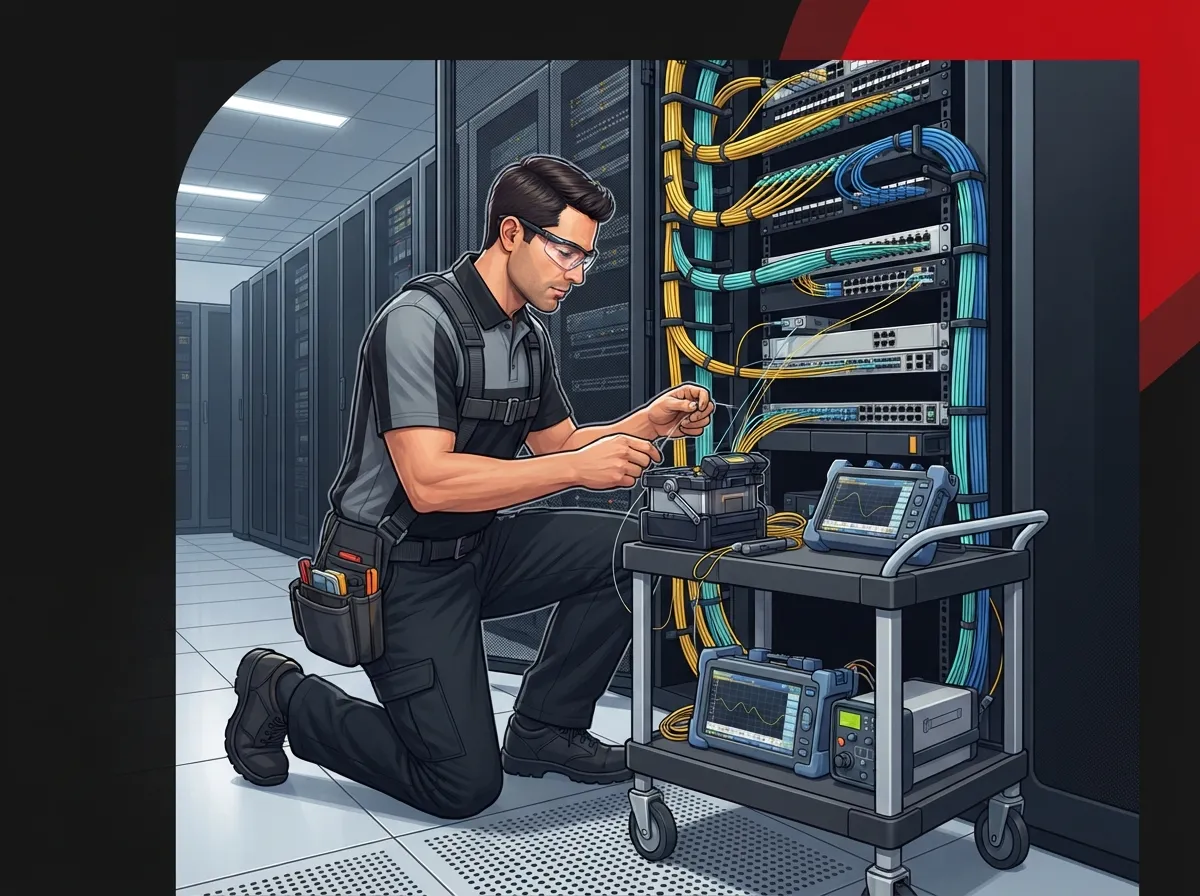
What a Fiber Optic Cabling Contractor Actually Does
Think of a fiber optic cabling contractor as the builder of your network’s highways. The internet provider brings service to your building. The contractor builds the roads inside it, connecting telecom rooms, floors, and equipment.
Typical work includes:
- Backbone cabling between floors, telecom rooms, and buildings
- Horizontal runs to specific work areas or equipment
- Data center and server room connections
- Campus links between nearby buildings
- Repairs, upgrades, and re-terminations of existing fiber
- Pathway coordination with other trades, such as electricians
The exact scope depends on your project. A small office might only need a couple of fiber links. A multi-floor building or campus may need a full backbone design. This is part of structured cabling, which is the organized, standards-based approach to building a business network.
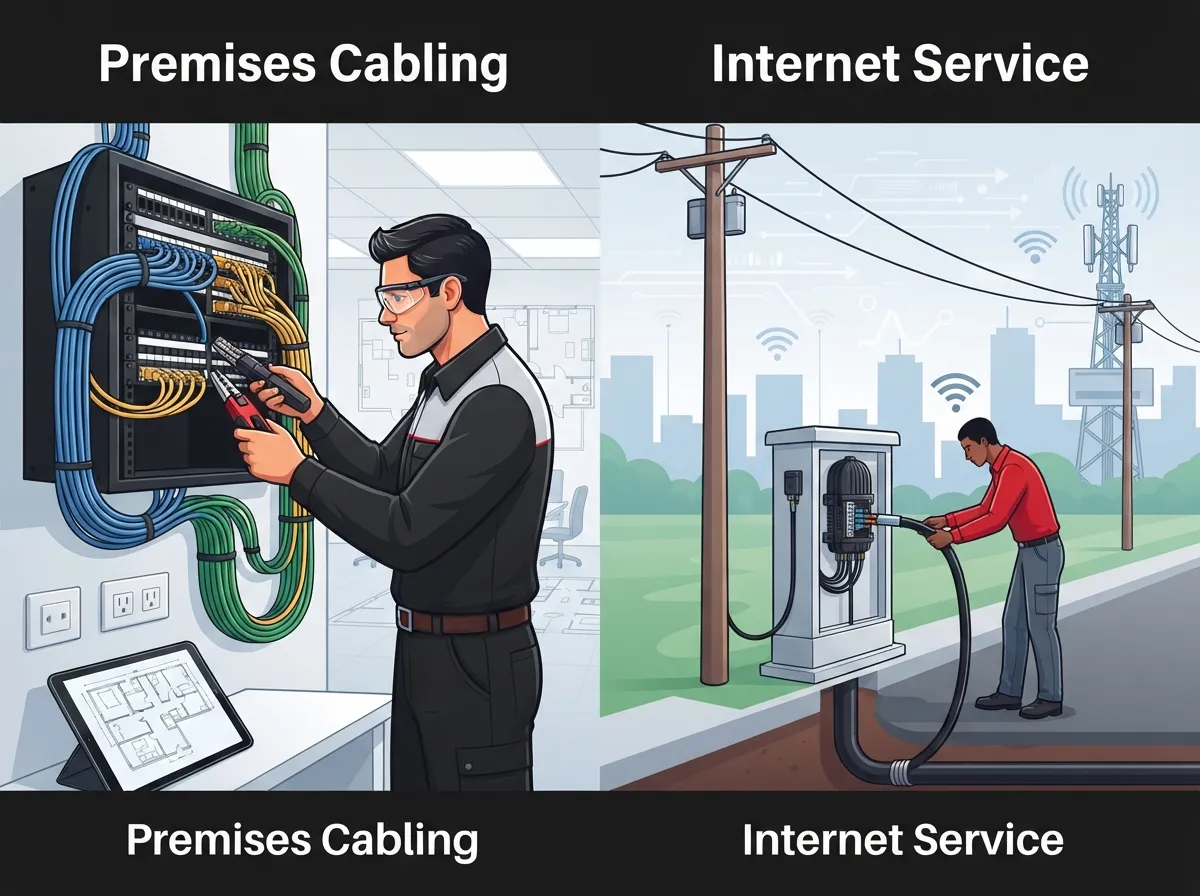
Premises Cabling vs. Internet Service: Know the Difference
Here is a mix-up we see all the time. Business owners hear “fiber” and assume it is all one thing. It is not.
A fiber optic cabling contractor builds the cabling inside your premises and between your buildings. Your Internet Service Provider delivers the actual internet service, often over fiber that comes to your building. They are related, but they are different jobs.
| Item | Cabling Contractor | Internet Provider |
|---|---|---|
| Main job | Builds and tests fiber links in and between buildings | Delivers internet or data service to your building |
| Where it happens | Inside your premises and campus | From their network to your demarcation point |
| What you own | Usually the cabling infrastructure | Typically the service, not the cabling |
| Typical deliverables | Terminations, test reports, labels, as-built drawings | Circuit, speed, uptime commitments |
Why does this matter? Because when you request quotes, you want to be sure each proposal clearly states what is covered. A good proposal separates premises cabling from carrier service, outside-plant construction, and active network equipment like switches.
If you want more help understanding this, our guide on what fiber backbone cabling is and whether your office needs it is a great next read.
Single-Mode vs. Multimode: Which Fiber Fits?
This is one of the first design choices a contractor will talk through with you. Both types carry light signals, but they suit different jobs.
- Single-mode fiber is commonly used for longer distances, campus links, and carrier connections.
- Multimode fiber is often used for shorter links inside buildings and data centers.
The right pick depends on your equipment optics, the link budget, the distance, and the application. A good contractor will not just default to one. They will ask what gear you plan to use now and what you might add later.
For a deeper look, check out how to pick the right multimode fiber cabling for your office and how to deploy single-mode fiber cabling the right way.
Why fiber at all?
Fiber offers high bandwidth and low signal loss over distance. It is also not affected by electromagnetic interference the way copper cabling can be. That makes it a strong fit for busy buildings with lots of electrical gear.
That said, fiber is not magic. It still needs compatible transceivers, correctly engineered links, physical protection, and a resilient network design. If you are weighing options, see copper vs. fiber for low voltage cabling.
How a Good Fiber Project Unfolds, Step by Step
Every project is a little different, but a well-run fiber job usually follows a clear path. Here is what you can expect.
- Needs assessment. The contractor looks at your bandwidth needs, distances, topology, growth plans, and existing pathways.
- Design and proposal. You get a written scope that spells out fiber type, strand counts, connectors, and test requirements.
- Pathway planning. The team plans routes, conduit, and cable trays, and coordinates with other trades.
- Installation. Cable is pulled with care, using proper bend radius and pulling tension limits.
- Termination. Connectors are installed or fusion splices are made, with clean, correct polarity.
- Testing. Every link is tested against the project specification.
- Labeling and documentation. You receive labels, test results, and as-built drawings.
- Closeout and warranty. The contractor walks you through the work and confirms warranty terms.
Skipping any of these steps can cause problems later. If you want a planning walkthrough, our article on how to plan fiber optic cabling Tampa businesses trust goes deeper.
Installation Quality: It’s More Than Pulling Cable
Here is something we love to tell clients: fiber is tougher than it looks in one way and more delicate in another. It carries massive speed, yet it hates sharp bends and dirt.
A skilled contractor pays attention to details that most people never see:
- Bend radius control so the glass is not stressed
- Pulling tension limits so the cable is not damaged during install
- Connector cleanliness, because even tiny dust can hurt performance
- Correct polarity so transmit and receive paths line up
- Protection from environmental hazards like moisture, heat, or physical impact
- Clear labeling so future techs can trace every link
These habits are what separate a network that hums along for years from one that gives you random trouble. Poor work can also cost you down the road, as we explain in 5 hidden costs of poor network cabling installation.
Standards and Testing: How You Know the Job Is Done Right
Good fiber work is measured, not guessed. That is where standards and testing come in.
ANSI/TIA-568.3-E, published in September 2022, specifies performance, transmission, and test-and-measurement requirements for premises optical-fiber cable, connectors, connecting hardware, and patch cords. It also covers connectivity and polarity methods. Many contractors reference it when designing and testing commercial fiber systems.
Common fiber test methods
| Test Method | What It Does | Best Used For |
|---|---|---|
| Optical loss testing (light source and power meter) | Measures total signal loss across a link | Acceptance testing for most premises links |
| OTDR (optical time-domain reflectometry) | Locates events and characterizes the link | Longer links and troubleshooting where appropriate |
The key point: your contract should state the required tests and the pass criteria. Do not leave it vague. If you want to compare testing approaches, our post on OLTS vs. OTDR breaks it down, and 4 cable testing and certification mistakes to avoid in 2026 is a handy checklist.
How to Choose a Fiber Optic Cabling Contractor
Choosing the right partner is the biggest decision you will make on this project. A little homework goes a long way. Here is what to look for.
- Relevant licensing and insurance for low-voltage work in your area
- Technician training or credentials specific to fiber
- Clear design assumptions they can explain in plain language
- Proper test equipment and a willingness to share test results
- Safety practices they can describe, since fiber work involves sharp fiber shards and laser light
- A written warranty and a defined closeout process
- Clear scope separation between premises cabling, carrier service, outside plant, and active equipment
Ask for references, and ask to see a sample closeout package. A pro will be happy to show you. If something feels vague, trust your gut. Our list of 5 mistakes to avoid when hiring cabling installers can help you spot red flags early, and how to find a reliable structured cabling contractor in Tampa offers a local angle.
What Documentation Should You Get at the End?
Nobody loves paperwork, but this is the paperwork that saves you later. When your IT manager leaves or you add a new floor, good documentation is gold.
A solid closeout package commonly includes:
- Test results for every link, tied to the pass criteria in your contract
- Cable and port labels that match the records
- As-built drawings showing actual routes and locations
- Strand counts, connector types, and fiber types used
- Warranty details and who to call for support
Think of it as the owner’s manual for your network. We cover this topic in detail in how to build structured cabling documentation that works.
What About Cost and Timeline?
Everyone wants a number, and we get it. The honest answer is that fiber cabling costs and schedules are project-specific. They depend on distance, strand count, pathways, building type, labor, materials, permitting, and testing scope.
Be careful with generic per-foot numbers you find online. For example, a 2025 Fiber Broadband Association and Cartesian report cited typical U.S. outside-plant deployment costs of about $18 per foot for underground construction and about $8 per foot for aerial construction. Those are broad outside-plant figures, not a benchmark for indoor commercial cabling, and they are not a quote.
Here is a smarter way to compare bids:
- Ask each contractor to price the same written scope.
- Confirm fiber type, strand counts, and connector types.
- Confirm the testing method and pass criteria.
- Confirm what documentation is included.
- Ask about pathway work, permits, and any after-hours labor.
A clearly scoped, apples-to-apples proposal beats a cheap number with fuzzy details every time. For budgeting help, see 10 factors that shape network cabling installation cost.
A Quick Reality Check on Fiber Availability
You may have seen big numbers about fiber growth. The Fiber Broadband Association reported 11.8 million additional U.S. FTTH passings in 2025 and about 98.3 million total passings, with fiber passing more than 60% of U.S. households.
Those are residential fiber-to-the-home figures. They do not tell you how many businesses have fiber service or in-building fiber cabling. So even if fiber is available on your street, you still need a plan for the cabling inside your walls. That is the contractor’s world.
Who Benefits Most From Professional Fiber Cabling?
Fiber is not just for giant corporations. Here is how it helps different kinds of teams:
- Small business owners get a reliable backbone that grows with them, without redoing the work in two years.
- Mid-sized companies can connect floors, server rooms, and cloud systems with room to spare.
- IT managers get clean documentation and tested links that make troubleshooting faster.
- Office managers enjoy fewer outages and fewer frantic calls when the phones go quiet.
- Franchise operators can standardize cabling designs across multiple locations.
Fiber also supports the tools you already rely on, like cloud phones and cameras. If you are curious about that link, read why cloud-based security systems fail without fast internet.
How Ideal Solutions Provider Can Help
At Ideal Solutions Provider, we have spent over 24 years helping businesses sort out telecom and cabling decisions. As a Tampa-based partner serving businesses nationwide, we act as a single point of contact. We look at your current setup, compare options across our network of 35+ vetted suppliers, and help you land on a design that fits your needs and budget.
That means no juggling a dozen vendors. You get one friendly team to handle consultation, installation coordination, and ongoing support. If you are curious about our approach to cabling, take a peek at our structured cabling services.
Final Thoughts: Build Smart Once
A fiber optic cabling contractor is more than someone who pulls cable. They are the planner, builder, tester, and record keeper for the physical backbone of your business network. Choose well, insist on clear scope and standards-based testing, and ask for complete documentation.
Do that, and you will have a network that supports your phones, internet, cameras, and access control for years to come. Ready to talk through your project? Contact us for a free consultation, or call us and let’s map out the right fiber plan for your business.
FAQs
Q: What does a fiber optic cabling contractor do for a business?
A: They plan, install, terminate, test, and document the fiber links inside and between your buildings. That includes backbone runs, data center connections, campus links, and repairs, all so your network stays fast and dependable.
Q: How is fiber optic cabling tested and certified?
A: Contractors commonly use optical loss testing with a light source and power meter, and sometimes OTDR testing for longer links or troubleshooting. Your contract should spell out the required tests and pass criteria, and you should receive the results at closeout.
Q: What is the difference between single-mode and multimode fiber?
A: Single-mode is commonly used for longer distances and campus or carrier links, while multimode is often used for shorter runs inside buildings and data centers. The best choice depends on your equipment, distance, and link budget.
Q: What documentation should I get after a fiber installation?
A: You should receive test results, cable and port labels, and as-built drawings, plus warranty details. Having these on hand makes future upgrades and troubleshooting so much easier.
Q: How much does commercial fiber cabling cost?
A: Costs vary a lot by distance, strand count, pathways, labor, materials, and permitting, so generic per-foot numbers can mislead. The best approach is to compare clearly scoped written proposals from a few qualified contractors.





