
Key Takeaways
-
Insertion-loss testing with a light source and power meter (OLTS) is the primary acceptance test, measuring the actual light your equipment will receive, while OTDR serves as a diagnostic and baseline tool.
-
Test every individual fiber, not just a sample, and record route, fiber ID, wavelength, equipment, operator, and date for each result.
-
Inspect and clean every connector end face before testing, since dirty connectors are a top cause of excess loss and misleading failures.
-
There is no universal pass number: calculate a link-loss budget from fiber attenuation, connector and splice counts, and your transceivers' optical power limits.
-
OTDR results infer loss from backscatter and can differ from end-to-end insertion loss, so don't treat an OTDR pass as a substitute for OLTS acceptance results.
-
Require a complete handover package with per-fiber results, original OTDR trace files for spliced or outside-plant links, and the standards used, so future repairs go faster.
Picture this: your new office fiber run is in the walls, the ceiling tiles are back up, and everyone is ready to celebrate. Then someone asks, “How do we know it actually works?” That is where fiber optic cable testing comes in, and it is one of the most important steps in any business network project.
Here is the tricky part. Two tools get talked about all the time: the OLTS (optical loss test set) and the OTDR (optical time-domain reflectometer). Both are useful. Both are often misunderstood. And they do very different jobs.
In this friendly guide, we will compare the two head to head. You will learn what each one measures, when to use it, and what a good test package looks like at handover. Whether you run a small shop, manage IT for a growing company, or oversee several franchise locations, you will walk away knowing what to ask for. Think of it as a simple checklist you can hand to any contractor, so you never have to take “it works, trust me” as an answer.
Why Fiber Optic Cable Testing Matters for Business Networks
Fiber carries your phones, internet, cloud apps, and security cameras. When it is installed well, you forget it exists. When it is not, you get dropped calls, slow uploads, and finger-pointing between vendors.
Testing does three jobs for your business:
- It proves the link meets its loss budget. Every fiber link has a limit on how much light it can lose and still work with your equipment.
- It creates a baseline. If something breaks two years from now, you can compare new results to the day-one results.
- It protects you contractually. Documented results show the work met the project specification.
The right test depends on your fiber type, connectors, wavelengths, and the standards named in your contract. There is no one-size-fits-all pass number, which we will cover below.
The Two Main Contenders at a Glance
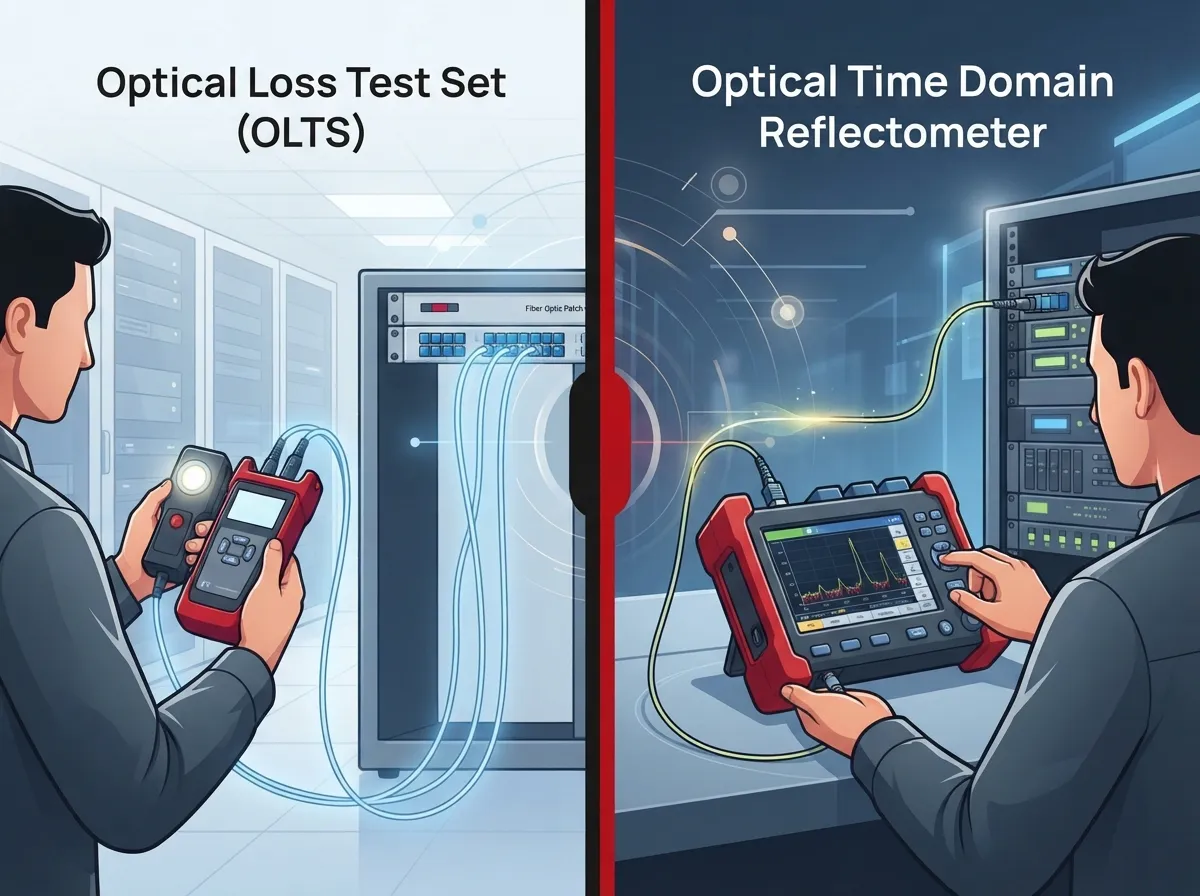
Before we go deep, here is a quick side-by-side look at the two most common methods.
| Feature | OLTS (Light Source and Power Meter) | OTDR |
|---|---|---|
| What it measures | True end-to-end insertion loss | Backscatter trace showing events along the fiber |
| Best for | Acceptance testing of installed links | Locating faults, checking splices, outside-plant routes |
| Shows where a problem is? | No | Yes |
| Needs launch and receive cables? | Uses reference test cords | Yes |
| Skill level | Moderate | Higher, trace interpretation matters |
| Typical role | Primary pass/fail measurement | Complement, diagnostic, and baseline |
Notice that we did not declare a single winner. In real projects, the answer is often “it depends on the link,” and many jobs use both.
What an OLTS Does (and Why It Is the Acceptance Workhorse)
An OLTS pairs a calibrated light source with a power meter. One end sends a known amount of light. The other end measures what arrives. The difference is your insertion loss.
Why do so many specs lean on this method? Because it directly measures what your network equipment will experience. According to the Fiber Optic Association’s 2025 installation standard, insertion-loss testing with a source and power meter is the installed-cable-plant test, while the OTDR is described as an optional verification and troubleshooting method.
How the OLTS Test Works
- Inspect and clean the connectors. Dirt on an end face is a top cause of bad readings.
- Set the reference. The technician zeroes the meter using reference test cords so the cords themselves are not counted as loss.
- Connect to the installed link. The light source goes on one end, the power meter on the other.
- Test at the required wavelengths. Multimode and single-mode links use different wavelengths, so follow the spec.
- Record the result for every fiber. Each fiber gets its own entry, not just a sample.
The result is compared with your calculated link-loss budget. FOA guidance points to IEC 61280-4-1 / TIA-526-14 for multimode installed fiber and IEC 61280-4-2 / TIA-526-7 for single-mode. Always confirm the current edition and what your contract requires.
OLTS Strengths and Limits
- Strength: It measures real transmitted light, which is the number your optics care about.
- Strength: Results are simple and easy to explain to non-technical stakeholders.
- Limit: It tells you the link is bad, but not where the problem sits.
What an OTDR Does (and Why It Is a Great Detective)
An OTDR works differently. It sends short light pulses into the fiber and watches the tiny reflections that bounce back. The result is a trace, a picture of the link from end to end. On that picture, a trained technician can spot connectors, splices, bends, and breaks, and see roughly how far away each one is.
That makes the OTDR a superstar for diagnosis. If your OLTS test fails, the OTDR helps answer “where is the problem?”
Why Launch and Receive Cables Matter
An OTDR has a blind spot right at the start of the fiber, so it cannot properly judge the first and last connectors on its own. Launch and receive cables solve this. They give the OTDR some “runway” before the link begins and after it ends, so the near-end and far-end connectors can be characterized.
Why Skill Matters with OTDR Testing
An OTDR is only as good as the person using it. A skilled technician picks the right range, pulse width, averaging, and wavelengths, then reads the trace instead of leaning on automatic pass/fail alone. A rushed setup can hide real problems or invent fake ones.
An Important Caution
Because an OTDR infers loss from backscatter rather than measuring transmitted power end to end, it should not automatically be treated as a replacement for OLTS acceptance results. FOA guidance notes that the two methods can give different numbers, and OTDR results may not reliably represent end-to-end insertion loss, particularly on some multimode links. That is not a flaw. It is just two tools answering two different questions.
Head-to-Head: Which One Wins for Your Situation?
Let’s put the two to work in real business scenarios.
| Scenario | Best Fit | Why |
|---|---|---|
| Short backbone run inside one office | OLTS | Simple, direct loss measurement is usually the main requirement |
| Campus or outside-plant route with splices | OLTS plus OTDR | Loss for acceptance, trace for splice quality and damage checks |
| Link failed its loss test | OTDR | Locates the bad connector, bend, or break |
| Building a restoration baseline for a long route | OTDR | Saved traces speed up future repairs |
| Multi-location franchise rollout | OLTS for each site, OTDR where routes are long or spliced | Consistent documentation across sites |
The takeaway: for most acceptance work, the OLTS is the main event. The OTDR is the trusted sidekick that shines on longer, spliced, or troubled links. If your project spec calls for one or both, follow it.
The Step Nobody Brags About: Clean Connectors
If there is a hero of fiber testing, it is the humble cleaning kit. Dirty or damaged connectors cause excess loss and unreliable readings, and they can make a perfectly good link look bad.
A sound workflow includes:
- Inspecting every connector end face with a scope before mating
- Cleaning when needed, then re-inspecting
- Confirming fiber identification, polarity, and continuity
- Testing at the wavelengths the application requires
It sounds basic, but skipping it is one of the most common reasons for “mystery” failures. Clean first, test second.
How to Build a Link-Loss Budget (and Why There Is No Universal Pass Number)
You may wish someone would just hand you a single number that means “pass.” Unfortunately, a universal threshold does not exist. The allowable loss depends on the link design, the components, the length, and the equipment you plan to run.
A link-loss budget adds up the expected losses:
- Fiber attenuation: loss per unit of length, multiplied by the link length
- Connector loss: the number of mated pairs times the expected loss per pair
- Splice loss: the number of splices times the expected loss per splice
- Equipment limits: the optical power budget of the transceivers you will use
Your measured result must come in at or below that calculated budget. This is why testing should be specified for the actual fiber type, connectors, wavelengths, and design, not copied from a generic template.
What Good Documentation Looks Like at Handover
Testing is only half the job. The other half is keeping the results. When your installer finishes, you should receive a complete package, not just a verbal “all good.”
Ask for these items:
- Test results for every fiber, not a sample
- Route, fiber ID, wavelength, equipment used, operator name, and date for each record
- OTDR trace files saved in their original format for outside-plant and spliced links
- Notes on any retests or corrective work
- The loss budget and standards the results were measured against
This package becomes your baseline. When a backhoe or a water leak causes trouble down the road, those saved traces and results can shave hours off the repair.
Common Fiber Testing Mistakes to Avoid
After years of watching projects succeed and stumble, a few patterns stand out. Watch for these:
- Trusting auto pass/fail blindly. Review the actual numbers and traces.
- Using OTDR as the only acceptance test when the spec calls for insertion loss.
- Skipping end-face inspection. Cleaning is cheap. Retesting is not.
- Testing at the wrong wavelengths for the application.
- Losing the data. Results that cannot be found later are not much of a baseline.
If you want a deeper look at the cabling side of a project, our guide on how to choose fiber cabling for your business network is a helpful companion read. And if you are still weighing connection types, see fiber optic cabling services for commercial buildings in Tampa.
Planning Fiber Testing Into Your Project From Day One
The best time to talk about testing is before anyone pulls a single strand. Put your test requirements in the scope of work, name the standards, and agree on the documentation you expect. This is true whether you are wiring a single suite or planning a full network cabling installation in Tampa Bay.
It also helps to understand how fiber fits into the bigger picture of structured cabling, where copper and fiber work together to support phones, cameras, and data. For many businesses, the smartest move is to have one partner handle design, installation, testing, and documentation, so nothing falls into the gaps between vendors. Our structured cabling services are built around exactly that idea.
If your fiber is feeding an internet circuit, it is also worth reading about why Tampa businesses need dedicated fiber internet. Your Internet Service Provider handles the outside connection, but your inside fiber still needs to be tested and documented properly.
So, Which Test Wins?
Here is the honest, friendly answer. Neither wins alone. The OLTS is your acceptance champion because it measures what your equipment actually receives. The OTDR is your detective because it finds and documents what is happening along the route. Together, they give you a complete picture.
Use this simple rule of thumb:
- Start with the project specification and the applicable standard.
- Run insertion-loss testing on every fiber as the acceptance measurement.
- Add OTDR testing for outside-plant, long, or spliced links, and for troubleshooting.
- Inspect and clean every connector first.
- Save all results and traces as your handover baseline.
Ready to make sure your fiber is tested right the first time? Ideal Solutions Provider has more than 24 years of experience helping businesses with cabling, networking, and telecom, with one point of contact from consultation to ongoing support. Contact us for a free consultation, or call us to talk through your next project. We would love to help you get it right.
FAQs
Q: What tests are required to certify a business fiber optic cable installation?
A: Most acceptance packages center on end-to-end insertion-loss testing with a light source and power meter (OLTS), compared against a calculated link-loss budget. OTDR testing is often added for outside-plant or spliced links. Always follow your project specification and the applicable standard, and keep results for every fiber.
Q: Can an OTDR replace a light source and power meter for fiber acceptance testing?
A: Usually not on its own. An OTDR infers loss from backscatter, while an OLTS measures actual transmitted light end to end, so the numbers can differ. Treat the OTDR as a great partner for locating events and building a baseline, and check your spec to see which results are required for acceptance.
Q: Why are launch and receive cables needed for OTDR testing?
A: An OTDR has a blind spot right at the start of the fiber. Launch and receive cables give it extra length before and after the link, so the near-end and far-end connectors can be measured and judged properly.
Q: How do you calculate a fiber optic link-loss budget?
A: Add up the expected fiber attenuation over the link length, the loss from each mated connector pair, the loss from each splice, and then compare that total with your equipment’s optical limits. Your measured loss should land at or below that calculated budget. There is no single universal number, because every link design is a little different.
Q: What documentation should a telecom contractor provide at handover?
A: Ask for test results on every fiber, labeled with route, fiber ID, wavelength, equipment, operator, and date. For spliced or outside-plant links, also request the original OTDR trace files. These records become your baseline for future troubleshooting.





