Key Takeaways
-
Cat6 typically costs $125-$350 per drop and Cat6A runs $200-$400 per drop; fiber is priced by run at $300-$1,500+ depending on distance, strand count, and building routes.
-
Labor comprises 60-70% of cabling bills; site access is critical—open ceilings are affordable while retrofits in finished walls, occupied buildings, or spaces needing lifts significantly increase costs.
-
Always request itemized quotes defining what counts as one 'drop' and confirm exclusions like pathways, firestopping, permits, racks, and after-hours labor to avoid hidden charges.
-
Insist on standards-based certification testing for copper links, optical testing for fiber, clear labeling, test reports, and as-built documentation to prevent future troubleshooting delays.
-
Installing cabling during new construction is typically cheaper than retrofits; bundling projects (cameras, Wi-Fi, access control) and planning early can significantly reduce repeat labor costs.
-
Cat6A supports future 10-gigabit speeds and is better for Wi-Fi access points, while Cat6 suits standard office needs; choose carefully now rather than replacing cable later at much higher cost.
If you have ever asked for a cabling quote and gotten three wildly different numbers, you are not alone. Cabling installation pricing can feel like a puzzle, and the pieces rarely match from one proposal to the next. One contractor quotes by the drop. Another quotes by the project. A third leaves out half the work.
The good news? Once you know what drives the price, quotes start to make sense. In this friendly guide, we will walk through typical 2026 price ranges for Cat6, Cat6A, and fiber. We will also cover what is usually included, what is often left out, and how to compare bids fairly.
Whether you run a small office in Tampa, manage IT for a growing company, or open new franchise locations, this guide will help you budget with confidence. Think of it as a chat with a friend who has seen a lot of cabling projects, and who wants you to avoid surprise charges.
What Does Cabling Installation Pricing Actually Cover?
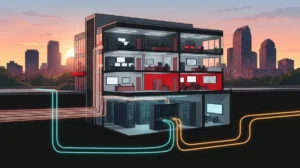
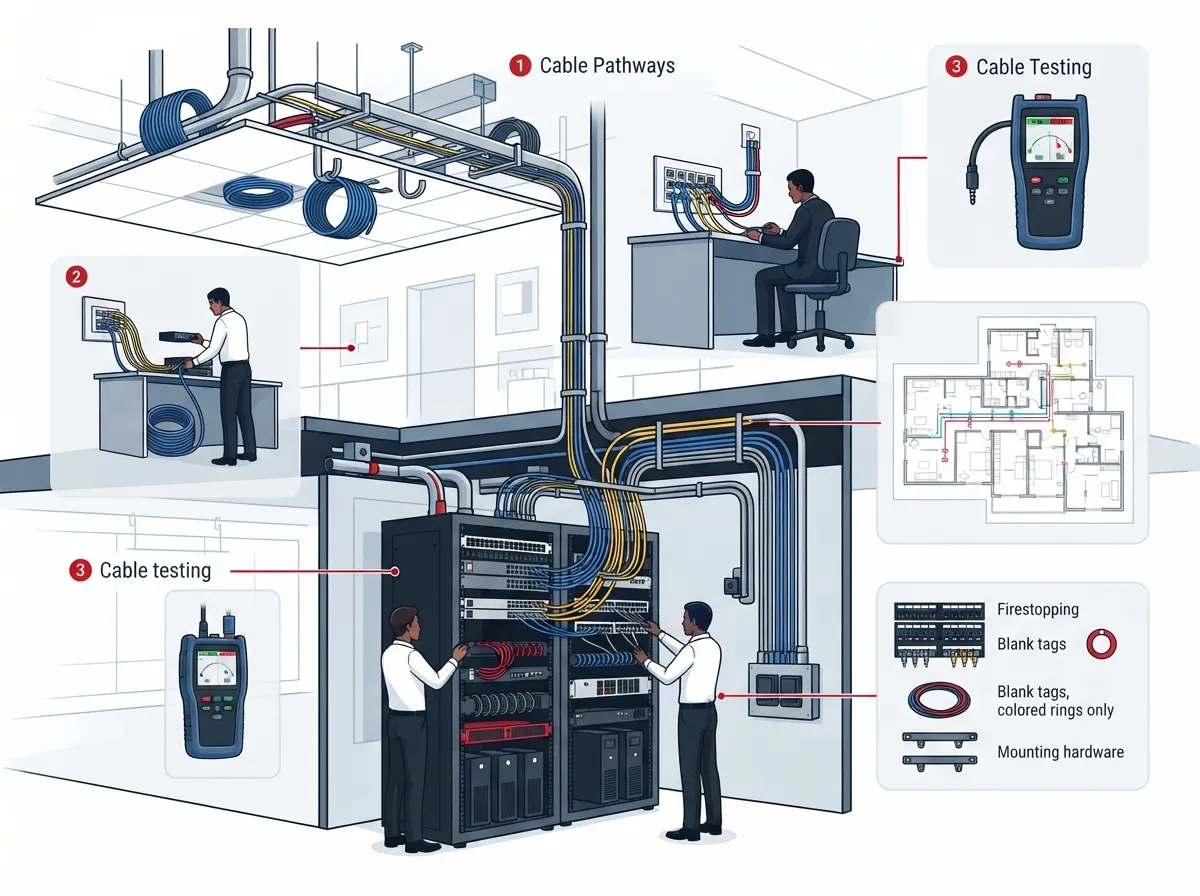
In business telecom, cabling installation pricing usually means structured cabling for voice, data, Wi-Fi access points, cameras, and other network devices. It is the hidden backbone of your office. Phones, computers, and security cameras all depend on it.
Most quotes are built around a “drop.” A drop is one cable run from your telecom room to a wall jack or device, terminated at both ends. Sounds simple, right? Here is the catch: contractors do not always define a drop the same way. Some count outlets. Others count cables or ports.
Before you compare any numbers, ask each contractor how they define a drop. That one question can save you from comparing apples to oranges.
2026 Price Ranges: Cat6, Cat6A, and Fiber
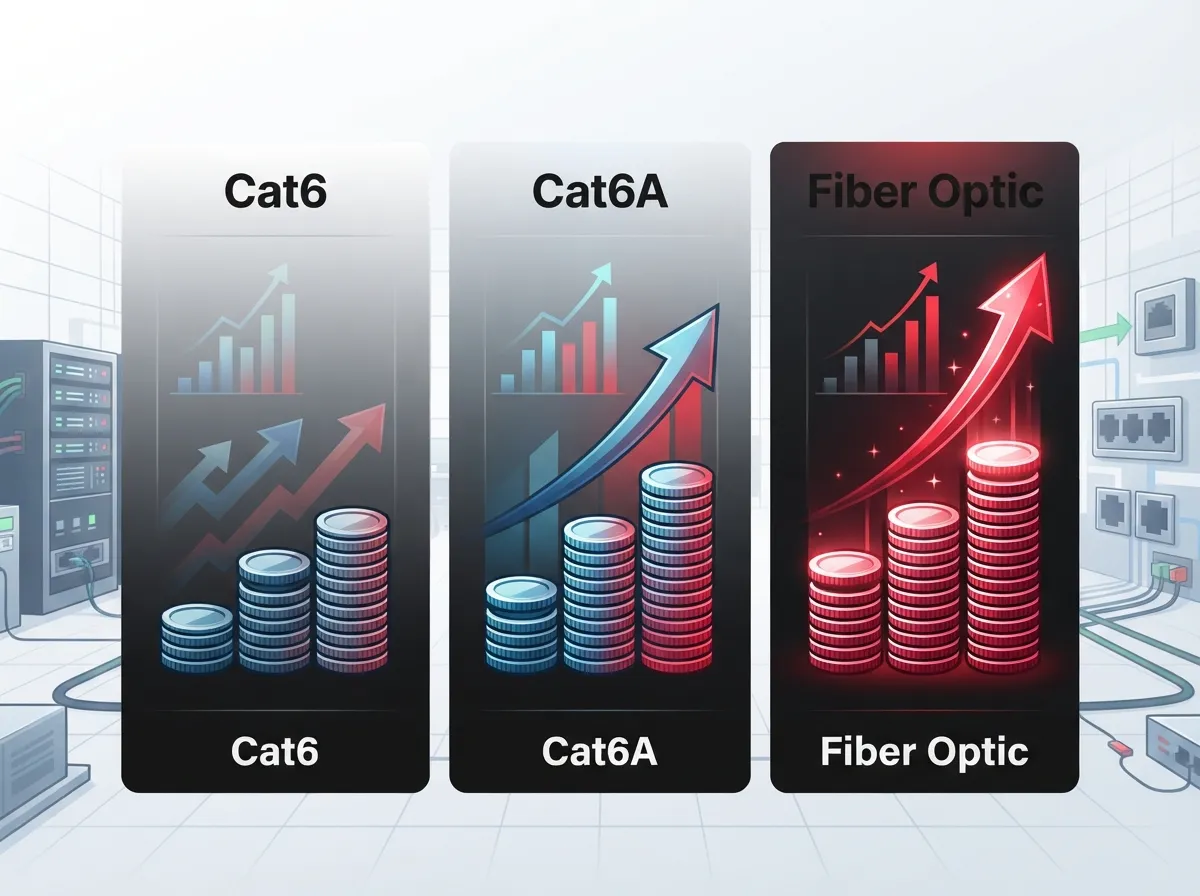
Let us look at the numbers. Keep in mind these are budgeting ranges from recent U.S. pricing guides. They are not fixed rates or guaranteed quotes. Your real price depends on your building and your project.
| Cabling Type | Typical Price Range | Best For |
|---|---|---|
| Cat6 (per drop) | $125–$350 (many straightforward jobs land near $150–$300) | Standard office desks, VoIP phones, most workstations |
| Cat6A (per drop) | $200–$400 | 10-gigabit needs, Wi-Fi access points, future growth |
| Fiber (per run) | Roughly $300–$800 for a simple interior run; $500–$1,500+ in other guides | Backbone links, long distances, high-bandwidth needs |
Why is fiber so hard to pin down? Fiber is priced by run or project scope, not by a simple drop. Distance, strand count, splicing, and building routes all change the bill. That is why published fiber ranges vary so much. They are also not directly comparable to copper drop pricing.
What Drives Cabling Installation Pricing Up or Down?
Two offices can order the same number of drops and pay very different totals. Here is why.
Labor and Site Conditions
Labor is a big slice of the invoice. One commercial pricing guide estimates labor at roughly 60% to 70% of the total cabling bill. Treat that as a helpful estimate, not a universal rule.
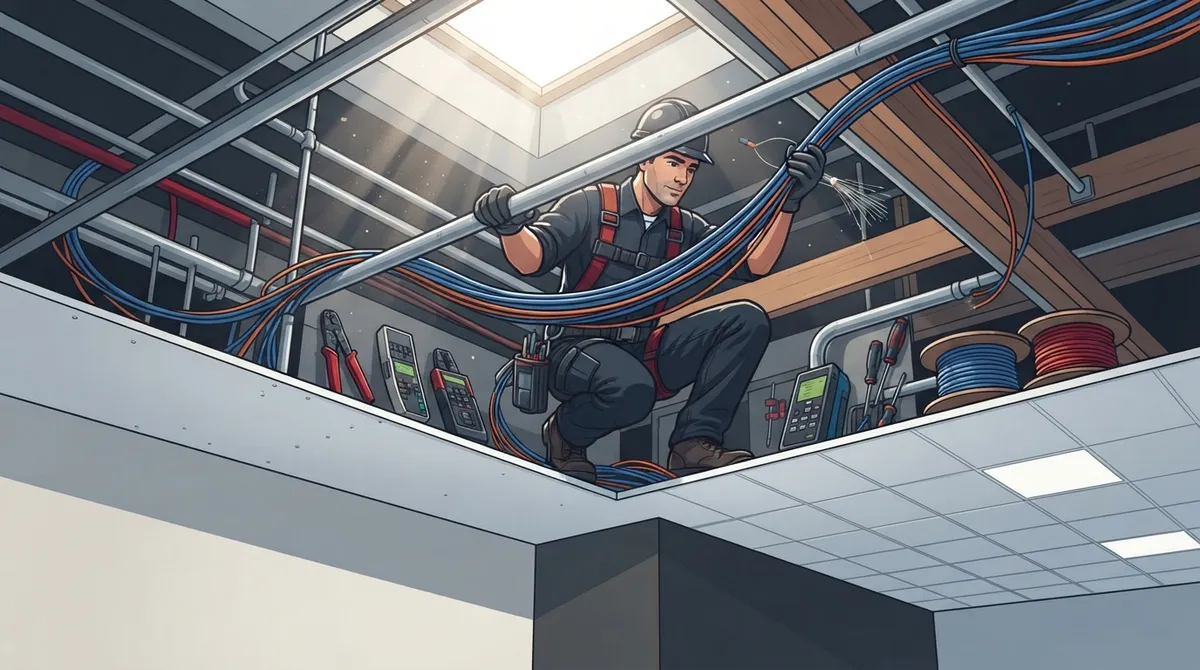
Access matters most. An open ceiling with clear pathways is easy and affordable. A finished wall retrofit is harder and costs more. Other cost boosters include:
- Hard ceilings or masonry walls
- High-bay spaces that need lifts
- Occupied buildings where crews work around your team
- Conduit or new pathway construction
- After-hours access or building-engineer coordination
Cable Category Choice
Cat6 is common for everyday office endpoints. Cat6A costs more, and the cable is larger, which can mean bigger pathways and more careful installation. In return, Cat6A can support 10GBASE-T over the full 100-meter channel when properly designed and installed. If you want a deeper comparison, see our guide on how to choose between Cat6 and Cat6A for your office.
Distance and Layout
Copper horizontal cabling is generally designed within a 100-meter channel limit. Longer runs may need a different design, such as an extra telecom closet or fiber. Learn more in our post on how far network cable can run.
New Construction vs. Existing Office
Is it cheaper to cable during new construction? Often, yes. Walls and ceilings are open, so crews move faster. Retrofits take more time and care. If you are planning a buildout, our article on structured cabling for a new office buildout can help you plan ahead.
What Is Included in a Cabling Quote?
This is where many surprises happen. A complete quote may include cable, jacks, patch-panel termination, labeling, testing, and documentation. A thin quote may leave out important items.
Common items that may be excluded:
- Pathway construction such as conduit or cable tray
- Firestopping where cables pass through fire-rated walls
- Patch cords
- Racks, cabinets, and patch panels
- Permits
- Mobilization fees
- After-hours labor
None of these are bad on their own. They just need to be spelled out. A low price with a long list of exclusions can end up costing more than a higher, fully itemized bid.
How to Compare Cabling Quotes Side by Side
Comparing bids does not have to be stressful. Follow these steps and you will be in great shape.
- Define the drop. Ask each contractor what counts as one drop: an outlet, a cable, or a port.
- Match the cable category. Make sure every quote uses the same type, such as Cat6 or Cat6A.
- Request an itemized breakdown. Look for separate lines for cable, labor, testing, and documentation.
- Check the exclusions. Ask about pathways, firestopping, permits, racks, and after-hours work.
- Confirm testing and deliverables. Ask what reports, labels, and drawings you will receive.
- Verify standards and codes. Confirm the work follows applicable codes and current project specifications.
If you want a handy checklist for choosing a partner, our article on how to find a reliable structured cabling contractor is a great next read.
Testing, Labeling, and Documentation: Do Not Skip These
Here is a tip that pays off for years. Ask whether copper links receive standards-based certification and whether fiber links receive appropriate optical testing. Testing proves the cable works the way it should before your team starts relying on it.
You should also request test reports, clear labeling, and as-built documentation. Good labels help your IT manager or office manager trace a problem in minutes instead of hours. ANSI/TIA-568 and BICSI installation guidance are widely used references. Since standards get updated, confirm which edition and which local code requirements apply to your project.
Poor documentation is a common source of future headaches. Our post on how to build structured cabling documentation that works explains why it matters.
Cabling Pricing for Different Business Types
Every business has its own cabling story. Here is how pricing questions often play out.
Small Business Owners
You want solid performance without overspending. Start by counting the drops you truly need: desks, phones, printers, Wi-Fi access points, and cameras. Then add a few spare drops. Adding extras during installation is usually far cheaper than coming back later.
IT Managers and Mid-Sized Companies
You likely need documentation, certification reports, and a plan for growth. Consider Cat6A for access points and future 10-gigabit needs. Use fiber for backbone links between floors or buildings. For a bigger picture, see our guide on how to plan network cabling installation in Tampa Bay.
Office Managers
You care about minimal disruption. Ask about after-hours work and how crews will protect your workspace. These details may add cost, but they keep your team productive.
Franchise Operators
Repeatable pricing is your friend. A standard cabling design across locations helps you forecast budgets and keep every site consistent. Ask for a template quote you can reuse.
Smart Ways to Keep Cabling Costs in Check
You do not have to cut corners to save money. Try these friendly tips:
- Plan early. Cabling during a buildout is usually cheaper than a retrofit.
- Bundle your projects. Cameras, access control, Wi-Fi, and phones often share pathways. Doing them together can reduce repeat labor.
- Choose the right category. Do not overbuy, but do not underbuy either. Replacing cable later costs far more than choosing well now.
- Avoid DIY surprises. Poor terminations can cause slow speeds and dropped calls. Our article on DIY vs. professional cabling shows why pros often win.
- Ask for options. A good contractor will offer a good, better, and best path so you can match your budget.
Also watch out for common errors that raise costs later. Our list of 12 structured cabling mistakes that hurt your business is worth a quick read before you sign anything.
How Cabling Supports Phones, Cameras, and Wi-Fi
Cabling is not just a cost. It is the foundation for everything else you run. A cloud phone system, security cameras, and access control all depend on stable wiring. Weak cabling can make even the best equipment feel slow.
If you plan to add VoIP or cameras, check out our post on how structured cabling supports VoIP and cameras. You will see why a solid cable plant makes everything else easier and more reliable.
Ready to Get a Clear Cabling Quote?
Cabling installation pricing does not have to be a mystery. Remember the big ideas: Cat6 often runs around $125 to $350 per drop, Cat6A around $200 to $400, and fiber is priced by run based on scope. Site conditions, pathways, testing, and documentation shape your final number.
Most important, compare itemized, like-for-like proposals. Ask about exclusions. Confirm testing and documentation. That is how you protect your budget and your network.
Ideal Solutions Provider has more than 24 years of experience helping businesses with structured cabling, VoIP, internet, networking, cameras, and access control. As a single point of contact, we handle everything from consultation to installation and ongoing support. Want a clear, itemized estimate for your space? Contact us or call us today. We would love to help you plan your project, and you can learn more about our structured cabling services anytime. You can also follow our tips on YouTube.
FAQs
Q: How much does commercial network cabling cost per drop?
A: Recent U.S. pricing guides place Cat6 at about $125 to $350 per drop, and Cat6A at about $200 to $400. These are budgeting ranges, so your real quote will depend on your building, access, and scope.
Q: What is included in a business cabling installation quote?
A: A complete quote often covers cable, jacks, patch-panel termination, labeling, testing, and documentation. Some quotes leave out pathways, firestopping, patch cords, racks, permits, and after-hours labor, so always ask for an itemized list.
Q: How much more does Cat6A cost than Cat6?
A: Cat6A is often quoted around $200 to $400 per drop, compared with roughly $125 to $350 for Cat6. The gap comes from higher material costs and larger cable that can need more pathway space and careful installation.
Q: Is it cheaper to cable a new construction project than an existing office?
A: In most cases, yes. Open walls and ceilings let crews work faster, while finished-wall retrofits, hard ceilings, and occupied spaces add time and cost. Planning your cabling early in a buildout is a smart way to save.
Q: What testing and documentation should a cabling contractor provide?
A: Ask for standards-based certification of copper links, optical testing for fiber, and clear labeling. You should also get test reports and as-built documentation, and confirm the work follows applicable codes such as ANSI/TIA-568 guidance.