
Key Takeaways
-
Structured cabling represents nearly 80% of a network’s efficiency; proper installation prevents dropped calls, outages, and expensive emergency fixes that poor wiring creates.
-
Always hire certified professionals for installation and ensure every cable run is tested and certified to qualify for manufacturer warranties up to 25 years.
-
Choose appropriate cable categories for your needs—Cat6 or Cat6A for modern offices with VoIP and security cameras, not outdated Cat5e that limits bandwidth.
-
Design your cabling infrastructure to support future growth for 5-10 years ahead; scaling an undersized system requires expensive rework and wall removal.
-
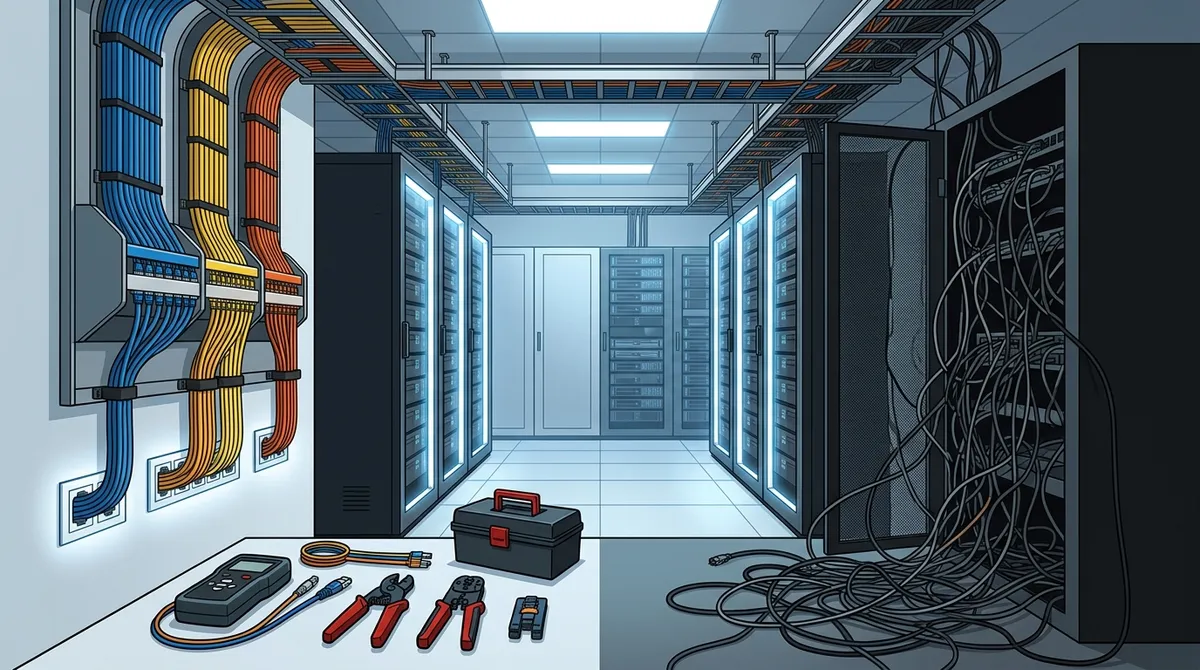
Implement proper cable management with clear labeling and organized pathways in all spaces including data centers; this reduces troubleshooting time and prevents accidental disconnections.
-
Use a single qualified partner for cabling, VoIP, internet, and security systems to avoid miscommunication gaps and ensure integrated infrastructure across all business systems.
Your network is only as good as the cables behind it. That might sound simple, but it’s a truth that catches many business owners off guard. Poor structured cabling doesn’t just slow things down — it causes dropped calls, network outages, and expensive fixes that could have been avoided from the start. If you’ve ever dealt with mysterious internet drops or tangled wiring that nobody can make sense of, you already know the pain firsthand.
The good news? Most cabling problems are completely preventable. In this article, we’re walking through 12 common structured cabling mistakes that hurt businesses — and what you should do instead. Whether you’re a small business owner, IT manager, franchise operator, or office manager, these insights will help you build a network that’s reliable, scalable, and easy to manage for years to come. Let’s dig in!
What Is Structured Cabling and Why Does It Matter?
Structured cabling is an organized, standards-based wiring system that supports your voice, data, video, security cameras, and wireless systems all in one unified infrastructure. Think of it as the nervous system of your office — everything runs through it. Without a proper cabling system in place, your business is essentially running on improvised wiring that creates chaos over time.
According to industry research, a structured cabling system can represent nearly 80% of a network’s efficiency. That’s a staggering number. For businesses considering a network upgrade, it’s worth reading about professional structured cabling services for Tampa businesses to understand what a proper installation looks like from the ground up.
The 12 Structured Cabling Mistakes to Avoid
1. Using Point-to-Point Wiring Instead of a Structured System
Point-to-point wiring is the quick-fix approach — running cables directly from one device to another without any central plan. It feels faster at first, but it creates a tangled mess that’s nearly impossible to manage or troubleshoot later. Structured cabling uses a standardized, organized approach that makes your entire network easier to understand and maintain. You can learn more about why this matters by reading structured cabling vs. ad-hoc wiring for Tampa businesses.
2. Choosing the Wrong Cable Category
Not all cables are created equal. Installing outdated Cat5e cabling when your business needs Cat6 or Cat6A is a costly mistake that limits your bandwidth before you even get started. Newer cable categories support faster speeds and higher-bandwidth applications like VoIP, 4K security cameras, and wireless access points. Check out this helpful breakdown of key differences between Cat5e and Cat6 cabling for Tampa businesses to see which option fits your needs.
3. Skipping Professional Installation
DIY cabling might seem like a money-saver, but improper installation can void warranties, fail inspections, and cause persistent network problems. Certified professionals follow industry standards, test every run, and document the entire cable plant so troubleshooting is quick and easy. Wondering if it’s worth hiring a pro? Read this comparison of DIY vs. professional cabling for Tampa offices.
4. Failing to Plan for Future Growth
One of the biggest cabling mistakes is designing for today’s needs without thinking about tomorrow. If you add employees, devices, or new services in two years, will your cabling infrastructure support it? A well-designed structured cabling system allows you to scale without ripping out walls and starting over. Businesses planning a new office should explore whether they need structured cabling for a new office buildout in Tampa.
5. Ignoring Cable Testing and Certification
Installing cables without proper testing is like buying a car without a test drive. Every cable run should be tested and certified to meet performance standards. Some vendors offer warranties of up to 25 years — but only when the installation is certified. Skipping this step leaves you with no proof that your system works correctly and no warranty protection if it doesn’t.
6. Poor Cable Management and Labeling
Messy, unlabeled cables are a nightmare for anyone who needs to troubleshoot or expand the network later. Good cable management means using proper pathways, cable trays, and clear labeling for every run. This simple step can save hours of confusion and reduce the risk of accidentally pulling the wrong cable during maintenance.
7. Not Supporting All Your Business Systems
Many businesses make the mistake of cabling only for computers and forgetting about everything else. Modern structured cabling should support VoIP phones, wireless access points, security cameras, access control systems, and IoT devices all from the same infrastructure. For example, structured cabling supports both VoIP phones and security cameras in ways that point-to-point wiring simply can’t match.
8. Ignoring Fiber Optic Options
Copper cabling is a great choice for most office environments, but fiber optic cabling is often the right answer for backbone connections, long runs, or high-bandwidth applications. Ignoring fiber as an option can limit your network performance significantly. A trusted partner can help you decide between options — check out this guide on how to choose fiber cabling for your business network for more direction.
9. Waiting Too Long to Upgrade Old Cabling
Industry experts recommend that most businesses evaluate their cabling infrastructure every 10 to 15 years, especially when upgrading bandwidth or expanding operations. Old cabling can become a bottleneck that limits your internet speed, VoIP quality, and overall network performance. If you’re seeing signs of sluggish performance, it may be time to act — read about the 9 signs your Tampa business needs structured cabling now.
10. Hiring an Unqualified Cabling Contractor
Not every cabling contractor is equal. Hiring someone without proper certifications and experience can result in a substandard installation that causes ongoing problems. Look for contractors with verifiable certifications, references, and a track record of commercial projects. This article on signs you found the best structured cabling contractor in Tampa outlines exactly what to look for.
11. Overlooking Data Center and Server Room Cabling
Many businesses focus on workstations and forget that server rooms and data closets need clean, organized cabling too. Poor organization in these spaces makes it harder to manage servers, switches, and patch panels — and increases the risk of accidental disconnections. Proper structured cabling in data center environments supports high-bandwidth applications and makes management dramatically easier.
12. Not Using a Single Point of Contact for Cabling and Telecom
Managing cabling contractors, internet providers, phone system vendors, and security installers separately is a recipe for miscommunication and gaps in your infrastructure. Working with a single trusted partner who handles everything — from cabling to VoIP to networking — simplifies the entire process. Ideal Solutions Provider is a Tampa-based telecom and IT partner that does exactly this, serving as a single point of contact for cabling, phone systems, internet, security cameras, and more.
How Structured Cabling Compares to Point-to-Point Wiring
Understanding the difference between structured and unstructured wiring helps clarify why proper installation matters so much. Here’s a quick comparison to put things in perspective:
| Feature | Structured Cabling | Point-to-Point Wiring |
|---|---|---|
| Organization | Centralized, labeled, documented | Ad hoc, often unlabeled |
| Scalability | Easy to expand without rewiring | Difficult, often requires full rework |
| Troubleshooting | Fast and straightforward | Time-consuming and confusing |
| Supports Multiple Systems | Yes — VoIP, cameras, Wi-Fi, IoT | Often limited to original devices |
| Lifespan | 10–25 years with certification | Varies, often replaced sooner |
| Cost Over Time | Lower — fewer repairs and rewires | Higher — ongoing fixes and rework |
What Systems Does Structured Cabling Support?
A properly designed structured cabling system can serve as the backbone for virtually every technology in your office. Here’s a quick look at what it supports:
- VoIP phone systems — Clean cabling reduces call quality issues and jitter
- High-speed internet — Supports fiber and broadband connections at full performance
- Wireless access points — Reliable backhaul cables ensure strong Wi-Fi coverage
- Cloud security cameras — Supports PoE camera installations and cloud connectivity
- Access control systems — Powers door readers, intercoms, and credential panels
- IoT devices — Connects smart building technologies to your network
- DAS (Distributed Antenna Systems) — Supports in-building cellular signal infrastructure
If your business relies on affordable VoIP phone services or cloud security cameras for commercial buildings, your cabling infrastructure directly impacts how well those systems perform. It all starts at the physical layer.
Cable Category Comparison for Business Use
Choosing the right cable type is one of the most important decisions in any cabling project. Here’s a breakdown of the most common options for business environments:
| Cable Type | Max Speed | Max Distance | Best Use Case |
|---|---|---|---|
| Cat5e | 1 Gbps | 100 meters | Basic office use, legacy systems |
| Cat6 | 10 Gbps (short runs) | 55–100 meters | Modern offices, VoIP, Wi-Fi APs |
| Cat6A | 10 Gbps | 100 meters | Data centers, high-density offices |
| Fiber Optic | 100 Gbps+ | Kilometers | Backbone runs, long distances, high bandwidth |
Warning Signs Your Business Has a Cabling Problem
Not sure if your current infrastructure is causing problems? Here are some red flags that point directly to cabling issues:
- Frequent network drops or unstable internet connections
- Poor VoIP call quality, including choppy audio or dropped calls
- Slow data transfer speeds despite paying for fast internet
- Security cameras going offline randomly
- Tangled, unlabeled cables that nobody can trace
- IT staff spending excessive time troubleshooting connectivity issues
If any of these sound familiar, it’s time to have your cabling infrastructure evaluated. You can also check out tips on why your business internet is slow in Tampa and how to fix it to rule out other causes.
Key Steps in a Professional Structured Cabling Installation
Here’s what a proper structured cabling installation looks like from start to finish:
- Site Assessment — A professional surveys your space, identifies cable pathways, and documents existing infrastructure
- System Design — A cabling plan is created that accounts for current needs, future growth, and all supported systems
- Cable Installation — Certified technicians run cables through walls, ceilings, and conduits following industry standards
- Termination and Patching — Cables are terminated at patch panels and wall outlets with proper connectors and labels
- Testing and Certification — Every cable run is tested with specialized equipment to verify performance standards are met
- Documentation — A complete record of every cable run, label, and location is provided for future reference
A reliable partner like a trusted structured cabling installation company in Tampa FL will follow every one of these steps to deliver a system you can count on. Want to understand the full timeline? Read more about how long structured cabling installation takes for a commercial building in Tampa.
Benefits of Getting Structured Cabling Right
When your cabling is done correctly, the benefits show up immediately and stick around for years. Here’s what you gain:
- Improved reliability — Fewer outages and connection drops
- Faster troubleshooting — Organized, labeled cables make problems easy to find
- Better scalability — Adding users or devices doesn’t require major rework
- Lower long-term costs — Fewer emergency fixes and rewiring projects
- Warranty protection — Certified installs qualify for up to 25-year manufacturer warranties
Businesses with strong cabling infrastructure also get more out of their other technology investments. For example, fast and reliable cabling makes a huge difference for businesses using dedicated fiber internet in Tampa or deploying a cloud-based phone system for Tampa businesses.
Multi-Site and Large-Scale Cabling Projects
Structured cabling doesn’t only apply to single-office businesses. Multi-location companies and franchise operators need consistent, standardized cabling across all their sites. Real-world deployments include large-scale projects like 20,000+ Cat6A outlets in a single office fitout and more than 3,000 Wi-Fi access points cabled across hundreds of schools — showing just how scalable this approach can be.
For franchise operators and enterprise businesses managing multiple locations, it’s important to partner with a provider that handles reliable network solutions for multi-location Tampa businesses. Consistency across sites reduces headaches and makes management far simpler. You can also follow along with industry updates and project spotlights by connecting with Ideal Solutions Provider on Facebook and Instagram.
How to Plan Your Structured Cabling Project
- Audit your current cabling — Understand what you have, what’s working, and what’s not
- Define your systems — List every technology your cabling needs to support (phones, cameras, Wi-Fi, etc.)
- Plan for future growth — Think about where your business will be in 5 to 10 years
- Choose the right cable type — Cat6, Cat6A, or fiber depending on your environment and bandwidth needs
- Select a certified installer — Work with a professional who tests, certifies, and documents every run
For more help planning your project, check out this practical guide on how to plan network cabling installation in Tampa Bay. And if you want to explore your cabling options side by side, this resource on the best cabling options for business networks in Tampa FL is a great place to start.
Structured Cabling Cost Factors to Know
| Cost Factor | Details |
|---|---|
| Number of cable runs | More drops mean higher material and labor costs |
| Cable category | Cat6A and fiber cost more than Cat5e or Cat6 |
| Building size and layout | Longer runs and complex routing increase installation time |
| Conduit and pathways | Running cables through conduit adds cost but improves protection |
| Testing and certification | Required for warranties; adds value even though it adds cost |
| Documentation | Detailed labeling and cable maps save money long-term |
Want more details on cabling and telecom costs? Check out tips on 15 ways to reduce business telecom costs in Tampa to see where savings are possible across your entire infrastructure. You can also browse helpful video content from Ideal Solutions Provider on YouTube for real-world guidance on telecom and cabling topics.
Conclusion: Build Your Network on a Solid Foundation
Structured cabling is the backbone of your entire business communications infrastructure. Getting it right means fewer outages, happier employees, better call quality, and a network that grows with you instead of holding you back. Avoiding the 12 mistakes we’ve covered here is the best thing you can do to protect your technology investment and keep your business running smoothly for years to come.
Whether you’re setting up a new office, upgrading an old network, or managing multiple locations, the right cabling partner makes all the difference. Finding a reliable structured cabling contractor in Tampa is easier when you know what to look for — and Ideal Solutions Provider is here to help every step of the way.
Ready to build a network your business can rely on? Reach out to our team today for a free consultation and let’s talk about the right cabling solution for your business. You can also give us a call at 813-388-4935 — we’d love to hear from you!
FAQs
Q: What is structured cabling in a business environment?
A: Structured cabling is an organized, standards-based wiring system that supports all your business communications — including internet, VoIP phones, security cameras, and wireless access points — from one unified infrastructure. Think of it as the backbone of your entire office network! Instead of running random cables everywhere, everything is planned, labeled, and documented for easy management.
Q: How long does structured cabling last in a commercial building?
A: A well-installed structured cabling system can last anywhere from 10 to 25 years, depending on the cable category and installation quality. Certified installations from qualified professionals often come with manufacturer warranties of up to 25 years, giving you excellent long-term value and peace of mind.
Q: What is the difference between structured cabling and point-to-point wiring?
A: Structured cabling uses a centralized, organized approach where all cables follow a planned design with proper labeling and documentation. Point-to-point wiring runs cables directly between individual devices without a central plan, which creates messy, hard-to-manage networks over time. Structured cabling wins every time when it comes to reliability, scalability, and troubleshooting ease!
Q: What types of business systems can structured cabling support?
A: A properly designed structured cabling system can support VoIP phone systems, high-speed internet connections, wireless access points, cloud security cameras, access control systems, IoT devices, and even distributed antenna systems (DAS). Basically, if it connects to your network, your cabling infrastructure plays a role in how well it works.
Q: When should a business upgrade its cabling infrastructure?
A: Most experts recommend evaluating your cabling every 10 to 15 years, especially when you’re upgrading internet bandwidth, adding new technology, or expanding your office. If you’re experiencing frequent network drops, slow speeds, or poor VoIP quality, those are signs your cabling may already need attention — don’t wait until a full outage forces your hand!