
Key Takeaways
-
Poor or mismatched cabling is often the hidden cause of VoIP drops, frozen video calls, and slow connections, so cabling quality directly affects daily productivity.
-
Insist on test results for every cable run, clear labeling, and as-built drawings before accepting any cabling project, since documentation makes future moves and troubleshooting far easier.
-
Choose Cat 6A when you need 10 Gb/s across the full 100-meter channel, and use fiber for backbones and inter-building links that need more distance or bandwidth than copper.
-
A standards-based copper channel reaches up to 100 meters (about 328 feet), including patch cords; for longer distances, fiber is the usual solution.
-
PoE lets one cable deliver data and power to IP phones, Wi-Fi access points, and cameras, reducing outlets and simplifying installs when planned with device power needs and heat in mind.
-
Follow TIA-568, TIA-569, TIA-606, and TIA-607 along with local codes, and get a site walk-through for an accurate quote, since costs depend on drop count, cable type, and building conditions.
Picture this: your team is on a video call, the VoIP phones are ringing, and suddenly everything freezes. Nobody did anything wrong. The culprit is often hiding in the walls, a tangled mix of old, mismatched, or poorly installed cables. That is why data cabling services matter so much more than most people realize.
Data cabling is the hidden backbone of your business. It carries the data, voice, and video that keep your computers, phones, Wi-Fi, and cameras talking to each other. When it is done well, nobody notices it. When it is done poorly, everybody notices.
In this friendly guide, we will walk through what data cabling services actually cover, how to choose between cable types, what a good project looks like from start to finish, and what to expect for deliverables. Whether you run a small shop, manage an office, or oversee a multi-location franchise, you will leave with clear, practical answers.
What Are Data Cabling Services in Business Telecom?
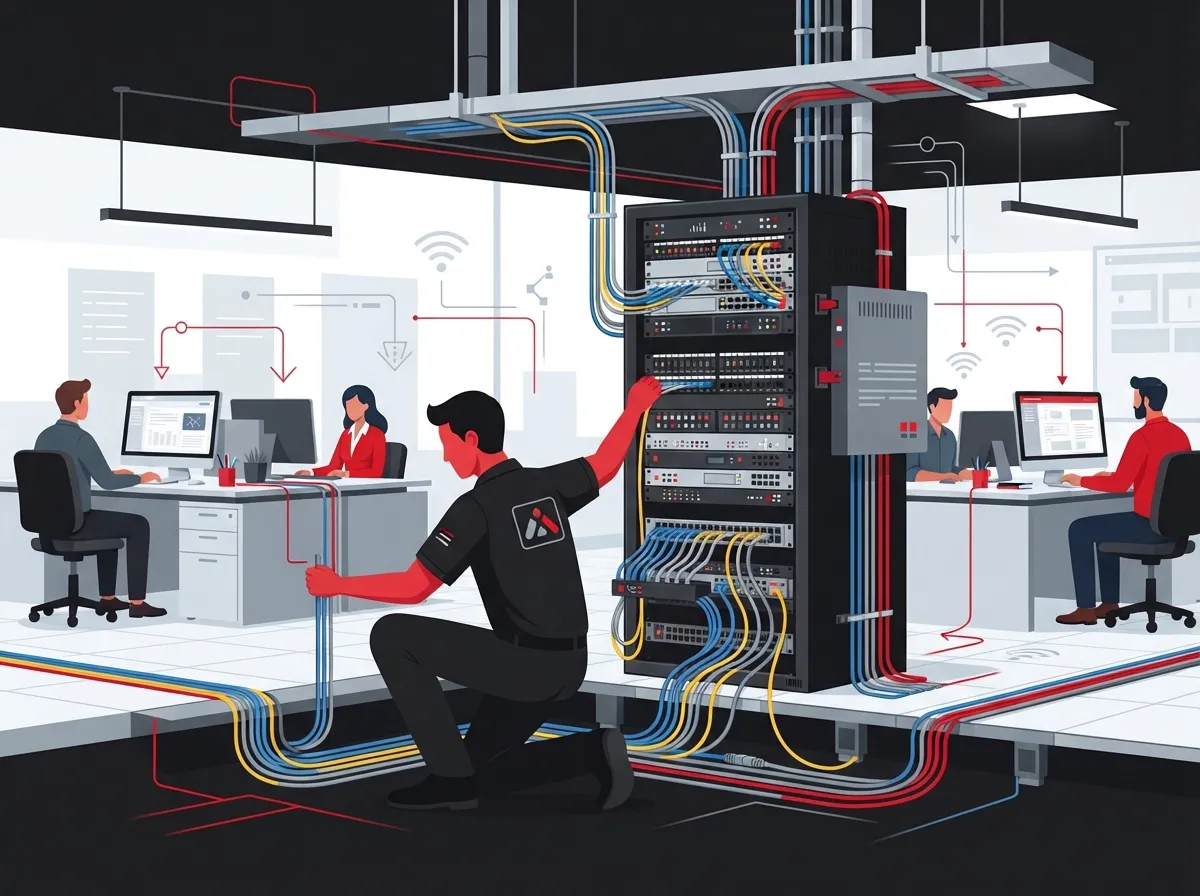
In business telecom, data cabling services cover the planning, installation, termination, testing, labeling, and documentation of the physical cabling that supports your network. Think of it as the roads and bridges your digital traffic travels on.
A well-built system supports many devices at once:
- Desktop computers and laptops using docking stations
- VoIP desk phones and conference room equipment
- Wi-Fi access points
- Security cameras and cloud video systems
- Access control readers and door controllers
- Printers, point-of-sale systems, and other connected devices
You may also hear the term structured cabling. This is the organized way of building a cabling system so it is standards-based, easy to manage, and ready to grow. If you want a deeper look at this approach, our guide on what structured cabling is for your business network breaks it down in plain English.
What Does a Typical Data Cabling Project Include?
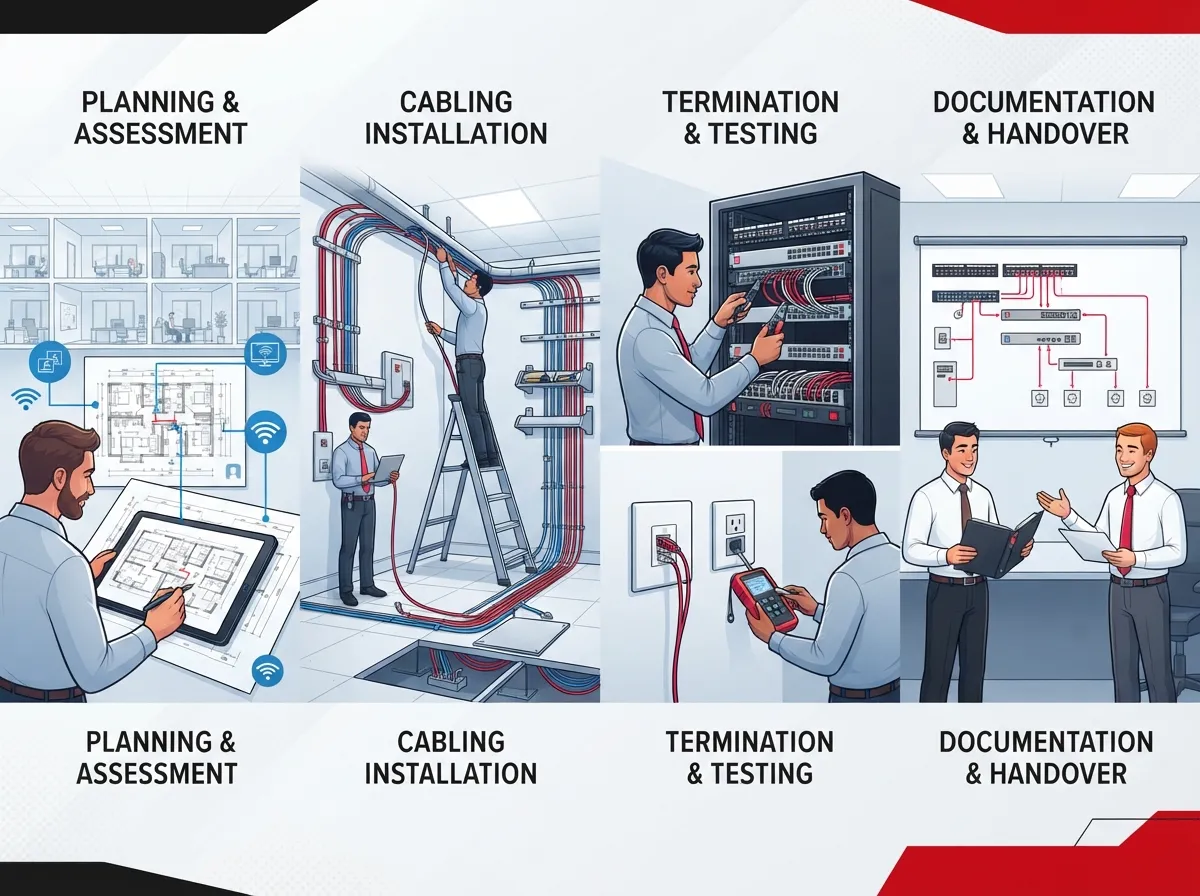
A professional project is more than running wire from point A to point B. Here is what a thorough scope often looks like:
- Site survey and consultation: A walk-through to learn how your space is used, where devices will live, and what pathways are available.
- Design and planning: Choosing cable types, outlet locations, telecom room layout, and pathways that fit your needs and local codes.
- Installation: Pulling cable through ceilings, walls, and conduits, plus mounting racks, patch panels, and outlets.
- Termination: Connecting each cable end to jacks and patch panels the right way so signal quality stays strong.
- Testing and certification: Verifying that every run performs to the target standard.
- Labeling and documentation: Marking every cable and providing test results and as-built drawings.
Many providers also handle additions, relocations, and cleanup of messy telecom closets. If your current setup feels like a bowl of spaghetti, remediation can bring order and reliability back. Our article on how to plan network cabling installation in Tampa Bay offers a helpful planning checklist.
How Do Structured Cabling Standards Fit In?
Standards are the rulebook that keeps your cabling consistent and dependable. The ANSI/TIA-568 family addresses cabling performance and components. Related standards cover other important pieces:
- TIA-569: Pathways and spaces, such as conduits and telecom rooms
- TIA-606: Administration and labeling
- TIA-607: Bonding and grounding
Standards are updated over time, so it is smart to confirm which editions apply to your project. Local building and fire codes matter too. Cable jacket ratings, firestopping, and permits all need to follow the rules where your building is located. A good contractor handles this for you, so you do not have to become a code expert.
If you are weighing a quick do-it-yourself job against a standards-based install, take a look at structured cabling vs. ad-hoc wiring before you decide.
Which Cable Types Do Data Cabling Services Use?
Most business projects mix copper and fiber. Each has a job, and picking the right one saves money and headaches.
Copper Twisted-Pair Cabling
Copper is the workhorse for connections between your telecom room and the devices on your desks and ceilings. Cat 6 and Cat 6A are the most common choices today. Cat 6A is typically selected when you need 10 Gb/s Ethernet across the full 100-meter channel. Cat 6 can support 10 Gb/s over shorter distances, depending on installation conditions and the applicable standard.
Fiber-Optic Cabling
Fiber shines when you need more distance or bandwidth than copper can offer. It is commonly used for building backbones and links between buildings. Fiber services may include termination or fusion splicing, plus optical loss testing. For certain links, OTDR testing may also be appropriate. To dig deeper, read how to choose fiber cabling for your business network.
| Feature | Cat 6 | Cat 6A | Fiber Optic |
|---|---|---|---|
| Best use | General office connections | Higher-speed desktop and device links | Backbones, long runs, inter-building links |
| 10 Gb/s support | Shorter distances, depending on conditions | Full 100-meter channel | Yes, based on optics and distance |
| Typical distance | Up to 100 m channel | Up to 100 m channel | Much longer, based on fiber type |
| Cost and effort | Lower | Moderate | Higher, with specialized termination |
Still deciding between the two copper options? Our post on how to choose between Cat6 and Cat6A for your office can help.
How Long Can a Cable Run Be?
This is one of the most common questions we hear, and the answer is helpful to know before you map out your office. A standards-based copper channel can typically reach up to 100 meters (328 feet). That channel usually includes a permanent link of up to 90 meters (295 feet) plus patch cords at each end.
If you need to go farther, such as across a campus or between floors in a large building, fiber is the usual answer. The right choice depends on distance, bandwidth needs, your equipment, and whether multimode or single-mode optics make sense. As always, verify the applicable standard and channel configuration for your specific project.
Can Data Cabling Support VoIP Phones, Wi-Fi, and Cameras?
Absolutely, and this is where good cabling really pays off. One well-designed system can carry traffic for many devices, which means fewer vendors and fewer surprises. We cover this in detail in 13 ways structured cabling supports VoIP and cameras.
Power over Ethernet, often called PoE, is a big part of the story. It lets a single cable deliver both data and power to devices like IP phones, wireless access points, and security cameras. That means fewer outlets and cleaner installs. IEEE 802.3bt Type 4 PoE can provide up to 90 W from the power-sourcing equipment per port, though the power available at the device is lower due to transmission losses.
When planning for PoE, a good designer considers:
- How much power each device needs
- Cable and connector performance
- Heat that can build up in large cable bundles
- The applicable Ethernet and cabling standards
Planning for VoIP? Pairing solid cabling with the right phone platform makes a big difference. You can explore options in our guide to choosing business VoIP solutions that actually work.
What Testing and Documentation Should You Expect?
Here is a friendly tip: never accept a cabling project without paperwork. Testing and documentation prove the work was done right and make future changes so much easier.
A professional closeout package typically includes:
- Test results for each cable run, appropriate to the medium and performance category
- Clear labels on cables, outlets, and patch panels
- As-built drawings showing where everything actually ended up
- Fiber loss test results, and OTDR results where appropriate
Think of it like a home inspection report for your network. If you ever add a new office, move a desk, or troubleshoot a slow connection, this documentation saves hours of guesswork. Our post on how to build structured cabling documentation that works explains what good records look like.
How Much Do Data Cabling Services Cost?
Honestly, there is no single price tag, and anyone who quotes one without seeing your space is guessing. Costs depend on several factors:
- Number of cable drops and total cable length
- Cable type, such as Cat 6, Cat 6A, or fiber
- Building construction and pathway difficulty
- Ceiling type, wall type, and access to existing conduits
- Telecom room needs, including racks and patch panels
- Testing, labeling, and documentation requirements
- Permits, firestopping, and code requirements
The best way to get an accurate number is a site walk-through. For help thinking through budget items, see 10 factors that shape network cabling installation cost.
How Do You Choose the Right Cabling Partner?
Great cabling is invisible, so you want a partner you can trust to do the unseen work properly. Here are a few things to look for:
- Standards knowledge: They should talk comfortably about TIA standards, local codes, and your building’s needs.
- Clear scope: Your quote should spell out what is included, from testing to labeling.
- Documentation promise: Ask for test results and as-built drawings up front.
- Coordination skills: Cabling often involves network and electrical contractors, so smooth teamwork matters.
- Ongoing support: Look for someone who will be there for moves, adds, and changes later.
If you are still comparing options, how to find a reliable structured cabling contractor offers more tips, and 13 signs you found the right cabling contractor gives you a handy checklist.
Why Work With a Single Point of Contact?
Cabling does not live in a vacuum. It connects to your internet service, phone system, networking gear, security cameras, and access control. When different vendors handle each piece, finger-pointing can happen when something breaks.
That is where a one-stop partner helps. Ideal Solutions Provider is a Tampa-based telecom and IT partner with over 24 years of experience. We work with 35+ vetted suppliers and handle everything from consultation and installation to ongoing support, so you have one friendly team to call. You can learn more about our structured cabling services or see how cabling fits into our wider business network solutions.
Franchise operators and growing companies especially love this approach. Consistent cabling across multiple sites makes rollouts faster and support simpler. For a broader view, our article on 11 reasons to use one telecom partner shares why so many businesses choose this path.
How Often Should You Inspect or Upgrade Cabling?
Good cabling can serve a business for many years, but it is not a set-it-and-forget-it item. A periodic check helps you catch problems before they cause downtime.
Consider an inspection or audit when:
- You are moving, expanding, or remodeling
- Your network feels slow even after upgrading internet service
- You are adding PoE devices, cameras, or more Wi-Fi access points
- Your telecom closet is messy, unlabeled, or poorly documented
- You plan to move to higher-speed equipment
Not sure whether it is time? Check out 9 signs your business needs structured cabling now for a quick self-check.
The Market Is Growing for a Reason
One third-party market research estimate valued the global structured cabling market at US$16.93 billion for 2025 and projected growth to US$31.12 billion by 2035, a 6.28% compound annual growth rate. Keep in mind this is a forecast, not a verified census. Still, it reflects what we see every day: as businesses add more connected devices, the demand for reliable physical infrastructure keeps climbing.
Ready to Build a Network That Just Works?
Strong data cabling services give you a foundation that supports your phones, internet, Wi-Fi, cameras, and everything you add next. The key points to remember are simple: follow standards, choose the right cable for each job, insist on testing and documentation, and plan for growth.
You do not have to figure it all out alone. We would love to help you review your current setup or plan something brand new. Contact us for a friendly, no-pressure conversation, or call us to talk with our team today. Let’s build something reliable together.
FAQs
Q: What do business data cabling services include?
A: They typically include site surveys, design, installation, termination, testing, labeling, and documentation of the cabling that supports your network, phones, Wi-Fi, and cameras. Many providers also handle additions, relocations, and cleanup of older cabling. It is the full package from planning to paperwork!
Q: Should my business choose Cat 6 or Cat 6A cabling?
A: Cat 6A is commonly chosen when you need 10 Gb/s Ethernet across the full 100-meter channel, and it is a smart pick if you want to plan ahead. Cat 6 works well for many offices and can support 10 Gb/s over shorter distances, depending on installation conditions. A quick site review helps you pick the best fit for your budget and goals.
Q: When should a business use fiber-optic cabling instead of copper?
A: Fiber is the go-to choice for building backbones, links between buildings, and any connection that needs more distance or bandwidth than copper can offer. The right type, multimode or single-mode, depends on your distance and equipment. Many businesses use copper to the desk and fiber between telecom rooms.
Q: How long can an Ethernet cable run be?
A: A standards-based copper channel can typically be up to 100 meters (328 feet), which includes a permanent link of up to 90 meters (295 feet) plus patch cords. If you need to go farther, fiber is the usual solution. Always confirm the applicable standard for your project.
Q: What testing and documentation should a cabling contractor provide?
A: You should receive test results for each cable run, clear labels throughout, and as-built drawings that show where everything is installed. Fiber links should come with optical loss test results, and OTDR results where appropriate. These records make future troubleshooting and expansions so much easier.





