
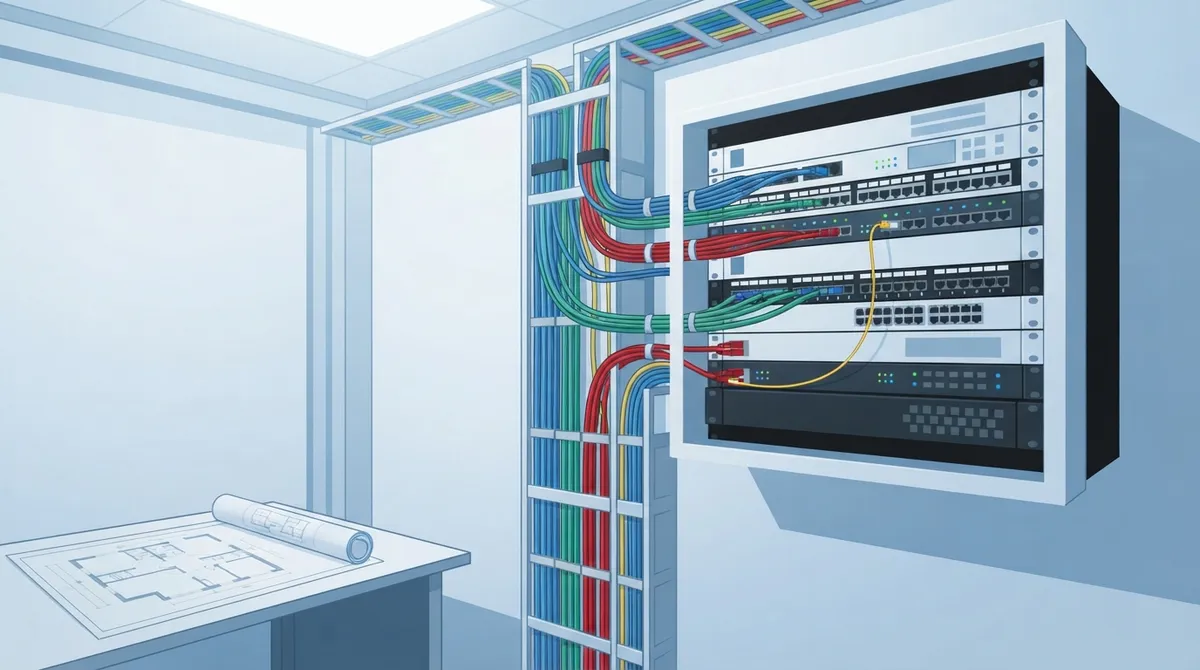
Key Takeaways
-
Choose a provider with proven commercial cabling experience in your building type, and verify licensing and insurance for your jurisdiction before requesting quotes.
-
Insist on per-run test results, a clear labeling scheme, as-built drawings, and warranty paperwork at closeout; these records make troubleshooting and future upgrades far faster.
-
Structured cabling with labeled, documented runs beats ad-hoc wiring, which becomes a guessing game to troubleshoot as a business grows.
-
Ask which cable category, standards, and revisions (ANSI/TIA-568, TIA-569, TIA-606) will be used instead of accepting a vague 'we're compliant' promise.
-
Standard twisted-pair Ethernet channels are limited to 100 meters including patch cords, so plan routes and telecom room locations carefully and use fiber for longer distances.
-
Get a written site walk and itemized quote from at least two providers, since cabling costs vary by run count, cable type, access, pathways, testing, and after-hours work.
If you’ve typed “network cabling company near me” into a search bar, chances are something in your office just isn’t working the way it should. Maybe the Wi-Fi drops every afternoon. Maybe you’re moving into a new suite and the walls are bare. Or maybe a closet full of tangled, unlabeled cables has finally become too much to handle. Good news: you’re in the right place.
A network cabling company designs, installs, tests, and documents the physical wiring that connects your computers, phones, Wi-Fi access points, and cameras. Think of it as the roads your business data travels on. When the roads are smooth, everything moves fast. When they’re cracked and cluttered, everyone feels it.
In this friendly guide, we’ll walk through what these companies actually do, what questions to ask, what paperwork you should expect, and how to compare local providers with confidence. Whether you run a small shop, manage an office, or oversee several franchise locations, you’ll leave with a clear plan.

What Does a Network Cabling Company Actually Do?
In business telecom, a network cabling company is a local low-voltage contractor. That’s a fancy way of saying they handle the physical cabling behind your network, not your home internet bill. They are different from an Internet Service Provider, which delivers the internet connection into your building. The cabling company builds the pathways that carry that connection to every desk, phone, and device.
A typical commercial project can include:
- Site assessment: Walking your space to plan routes, outlet locations, and telecom room placement.
- Design and pathways: Planning conduit, cable trays, and routes through ceilings and walls.
- Cable installation: Running Cat5e, Cat6, Cat6A copper, or fiber optic cable.
- Terminations: Connecting cables to wall jacks and patch panels.
- Rack and telecom room work: Mounting racks, organizing patch panels, and managing cable.
- Labeling and testing: Tagging every run and verifying that it performs.
- Documentation: Delivering test results and as-built drawings.
Some providers also coordinate network equipment, Wi-Fi, VoIP phones, and security systems. That’s a big plus if you’d rather not juggle several vendors.
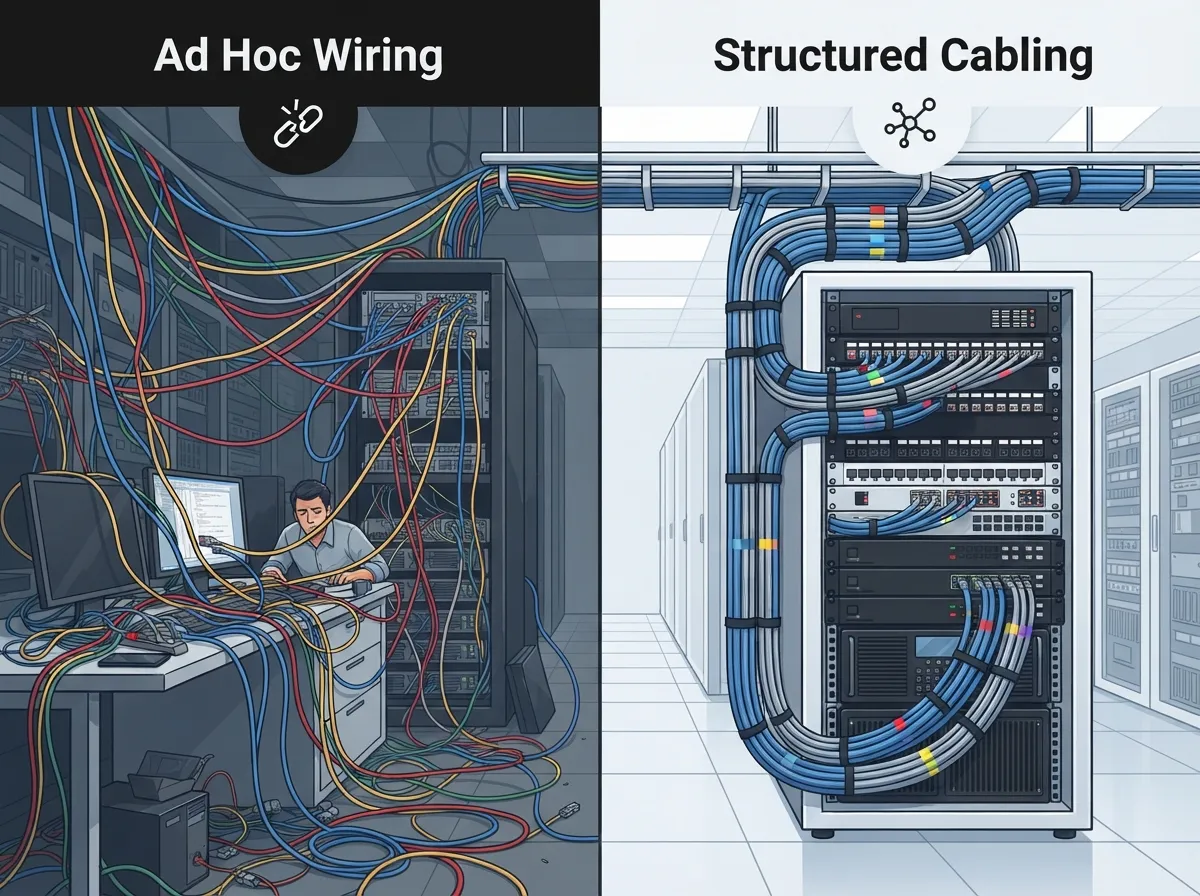
Why Structured Cabling Beats Ad Hoc Wiring
Here’s a story we hear often. A business grows a little at a time. Someone adds a cable here, a switch there, and a few extra jacks wherever they fit. Years later, nobody knows which cable goes where. Troubleshooting turns into a guessing game.
Structured cabling solves this. It organizes copper and fiber runs through outlets, patch panels, racks, and telecom rooms using a standardized layout. Because everything is labeled and documented, a standards-based system is generally easier to troubleshoot, expand, and maintain than point-to-point wiring.
If you want a deeper comparison, our guide on structured cabling vs. ad-hoc wiring breaks down the tradeoffs in plain language. And if you’re new to the topic, What Is Structured Cabling for Your Business Network? is a great starting point.
Copper vs. Fiber: Which Does Your Business Need?
Most offices use both. Copper handles the “last stretch” to desks and devices, while fiber often carries heavy traffic between floors, closets, or buildings.
| Cable Type | Common Use | Good to Know |
|---|---|---|
| Cat5e | Basic workstations, older networks | Often considered a baseline; may limit future upgrades |
| Cat6 | Workstations, phones, cameras | Popular for general office use |
| Cat6A | High-demand desks, Wi-Fi access points | Supports 10 Gbps up to 100 meters when properly installed |
| Fiber optic | Building backbones, links between floors or buildings | Better for long distances and high capacity |
Not sure which way to lean? Check out Cat5e vs. Cat6: Which Office Cabling Wins in 2026? and How to Choose Between Cat6 and Cat6A for Your Office. For longer runs and building links, Copper vs. Fiber for Low Voltage Cabling can help you decide.
One tip: always confirm the exact cable, channel, and installation requirements against your project specification. Performance claims depend on the full installed channel, not just the cable on the spool.
Standards That Matter (and What to Ask About Them)
You’ll hear a lot of letters and numbers when you talk to cabling companies. Here’s the short version:
- ANSI/TIA-568: A key standards family for commercial cabling design and performance.
- TIA-569: Covers pathways and spaces, such as cable routes and telecom rooms.
- TIA-606: Covers labeling and administration, so your records stay clear.
Here’s the part that trips people up. Don’t settle for a vague promise like “we’re TIA compliant.” Instead, ask which standards and revisions the project will follow, and what closeout documents you’ll receive. A good contractor will answer without hesitation.
Another handy rule: the standard twisted-pair Ethernet channel limit is 100 meters, including patch cords. A skilled installer plans cable routes and telecom room locations so every run stays within limits. If your building is large, that planning step matters a lot. Our article on cabling distance limits explains this in more detail.
How to Choose a Network Cabling Company Near Me
Searching for a network cabling company near me is the easy part. Picking the right one takes a little homework. Here’s a simple, step-by-step way to compare providers.
- Check commercial experience. Ask for examples of projects similar to yours in size and building type. Office, medical, retail, and warehouse spaces all have different needs.
- Verify licensing and insurance. Requirements vary by jurisdiction, so confirm what’s needed where you operate and ask for proof of coverage.
- Review the specification. Ask which cable category, brand, and standards will be used, and which revisions apply.
- Request sample test reports. You want per-run results, not a single “everything passed” note.
- Ask about labeling and drawings. Clear labels and as-built records save hours of frustration later.
- Understand the warranty. Find out what’s covered, for how long, and who handles service calls.
- Plan for disruption. Ask how they’ll schedule work around business hours, including after-hours options.
- Look at long-term support. Offices change. You’ll want someone who can handle future moves, adds, and changes.
Want help finding a pro you can trust? Read How to Find a Reliable Structured Cabling Contractor in Tampa or 5 Mistakes to Avoid When Hiring Cabling Installers before you start requesting quotes.
What Paperwork Should You Receive at Project Closeout?
A cabling job isn’t truly finished when the last cable is pulled. It’s finished when you have the records to support the network for years to come. Here’s what a solid closeout package typically includes:
- Per-run test results showing each cable passed
- A labeling scheme that matches your jacks, panels, and drawings
- As-built floor plans showing where every outlet and cable lives
- Rack elevations or panel layouts for the telecom room
- Warranty documentation
This paperwork may feel like a small detail, but it’s a lifesaver when something breaks at 4:45 on a Friday. For ideas on keeping everything tidy, see How to Build Structured Cabling Documentation That Works and 10 Network Cable Labeling Tips That Save Time in 2026.
What Affects Commercial Network Cabling Cost?
Everyone wants a number, so let’s be upfront: there’s no reliable, one-size-fits-all average price for commercial cabling. Costs vary a lot from project to project. Here are the main factors that move the price up or down:
- Number of cable runs and how long each one is
- Cable type, such as Cat6, Cat6A, or fiber
- Building access, ceiling type, and wall construction
- Existing pathways versus new conduit or trays
- Telecom room, rack, and patch panel needs
- Testing and documentation requirements
- After-hours or phased work
The best way to get a fair price is to request a written site walk and itemized quote. Our breakdown of factors that shape network cabling installation cost and cabling installation pricing in 2026 can help you read quotes like a pro.
Cabling for VoIP, Wi-Fi, and Security Cameras
Modern offices rely on more than computers. Cloud phones, wireless access points, and IP cameras all depend on solid cabling. Many of these devices are powered over the same Ethernet cable, which makes a clean, well-tested install even more important.
Planning cabling alongside your other systems saves time and money. Pulling extra runs while ceilings are open is far cheaper than doing it later. If you’re also upgrading phones or security, these guides pair nicely with this one:
- 13 Ways Structured Cabling Supports VoIP & Cameras
- Security Camera Cabling for Business: A 2026 Guide
- Why Do Cloud-Based Security Systems Fail Without Fast Internet?
Planning Tips for Different Types of Businesses
Your cabling needs depend on how your business operates. A few quick pointers:
- Small offices: Start with a clean Cat6 layout and a few spare jacks per room. Growth is easier when the extras are already there.
- Mid-sized companies: Think about telecom rooms, fiber backbones, and Cat6A for high-demand areas. Our multi-floor planning guide is worth a read.
- IT managers: Insist on standards-based documentation and per-run testing so troubleshooting stays fast.
- Office managers: Ask about scheduling, noise, and after-hours work to keep the team productive.
- Franchise operators: Standardize specs across locations so every site is built the same way. See 7 Multi-Location Telecom Solutions Florida Firms Need.
Red Flags to Watch For
Most cabling pros are hardworking and honest. Still, a few warning signs are worth knowing:
- No written scope, specification, or itemized quote
- Refusal to provide test results or drawings
- Vague answers about standards or warranty
- Pressure to skip testing or labeling to save money
- No proof of licensing or insurance where required
If you spot any of these, it’s okay to keep shopping. For more on what goes wrong, our post on 12 structured cabling mistakes that hurt your business is a helpful reality check.
Why a Single Telecom Partner Can Make Life Easier
Here’s a thought. Cabling rarely lives alone. It connects to your internet, your phones, your cameras, and your door access. When one vendor handles the cabling and another handles the rest, finger-pointing can follow when something breaks.
That’s where a single-partner approach shines. Ideal Solutions Provider is a Tampa-based telecom and IT partner with over 24 years of experience and relationships with 35+ vetted suppliers. They handle structured cabling alongside VoIP, internet, networking, cloud security cameras, and access control, so you get one point of contact from consultation through installation and ongoing support. You can learn more about their structured cabling services or explore the broader value of one telecom partner for Tampa Bay businesses.
Your Quick Checklist Before You Hire
Before you sign anything, run through this short list:
- Define how many users, devices, and rooms you need to support today and in three to five years.
- Decide on cable categories for desks, Wi-Fi, cameras, and backbone links.
- Request a site walk and a written, itemized quote from at least two providers.
- Confirm standards, revisions, licensing, insurance, and warranty terms.
- Ask for sample test reports, labeling schemes, and as-built drawings.
- Plan your schedule to limit disruption to your team.
Ticking these boxes puts you well ahead of most buyers. For a bigger-picture view of the process, see How to Plan Network Cabling Installation in Tampa Bay.
Ready to Get Your Network Cabling Right?
Finding the right network cabling company near me doesn’t have to feel overwhelming. Focus on commercial experience, clear standards, per-run testing, solid labeling, and honest warranty terms, and you’ll end up with a network that’s easy to support and ready to grow. A little planning now saves a lot of headaches later.
If you’d like a friendly, experienced team to walk your space and map out a plan, we’d love to help. Contact us to schedule a free consultation, or call us to talk through your project. You can also see us in action on YouTube.
FAQs
Q: What does a business network cabling company install?
A: A commercial network cabling company installs the copper and fiber cabling that connects computers, phones, Wi-Fi access points, and cameras. They also handle terminations, patch panels, rack work, labeling, testing, and documentation so your network is easy to support.
Q: How long can an Ethernet cable run be in a commercial building?
A: The standard twisted-pair Ethernet channel limit is 100 meters, including patch cords. A good contractor plans routes and telecom room locations so every run stays within that limit, and uses fiber for longer distances.
Q: What documentation should a cabling contractor provide?
A: You should receive per-run test results, a clear labeling scheme, as-built drawings, rack or panel layouts, and warranty paperwork. These records make future troubleshooting, moves, and upgrades much faster and cheaper.
Q: Can a network cabling company install wiring for VoIP phones, Wi-Fi, and security cameras?
A: Yes, many providers run the cabling for all three, and some also coordinate the equipment itself. Planning them together while ceilings and walls are open usually saves time and money.
Q: How much does commercial network cabling installation cost?
A: There’s no single average price because costs depend on run count and length, cable type, building access, pathways, testing, and after-hours work. The best approach is to request a site walk and an itemized written quote from a couple of providers.





